Short answer
No code forces you to replace a skylight when you replace the roof, and a young unit in good condition can stay. But the flashing around it has to be new either way, and once a crew is opening that area the added cost of a new skylight is small compared to doing it as a separate job later. If the unit is older than the roof coming off, replacing it with the roof is usually the cheaper decision over the life of the new roof.
On this page
- Why the flashing gets replaced no matter what you decide
- The flashing kit is model-specific, and that decides a lot
- When the skylight can stay
- Signs your skylight is finished
- Curb-mounted and deck-mounted units are not interchangeable
- What doing it later actually costs
- Get it settled in the written estimate
- What to do next
No, nothing requires you to replace a skylight when you replace the roof. A unit that is younger than the shingles coming off, with a sound frame and clear glass, can be reflashed and left in place. The honest qualifier is that most skylights on New Jersey roofs are the same age as the roof being torn off, and reusing one of those is how a brand-new roof ends up with a stain on the ceiling in its second winter.
Here is the decision, laid out the way it gets made in a driveway.
Why the flashing gets replaced no matter what you decide
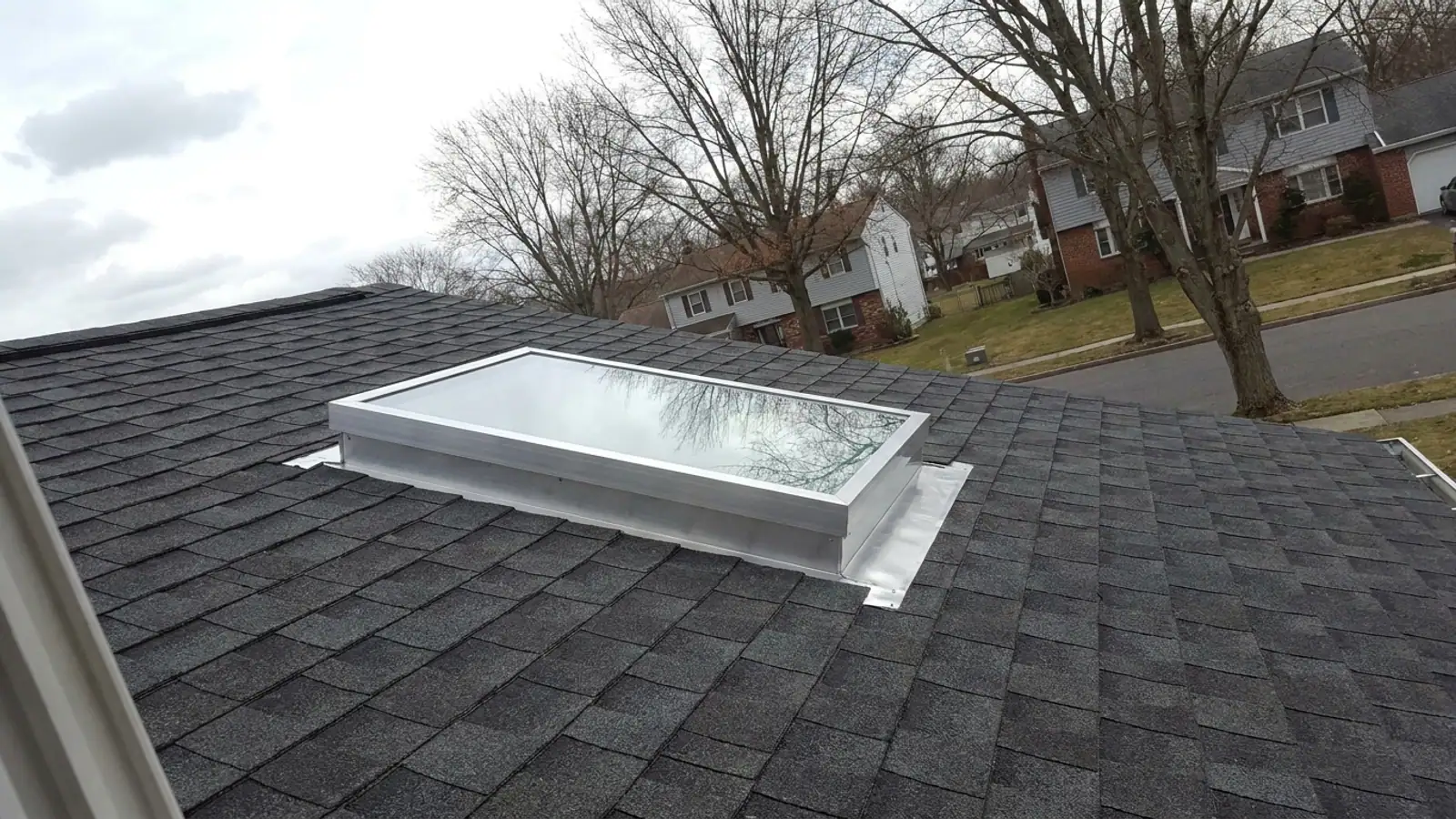
A skylight does not keep water out with caulk. It keeps water out with a layered flashing system that weaves into the shingle courses: a sill piece at the bottom, step pieces up both sides that interleave with each shingle course, and a head piece at the top that ties into the underlayment above the unit. All of that is bonded to the old roof. When the shingles come off, the flashing comes off with them.
So every skylight on a roof being replaced gets new flashing. That is not optional and it is not an upgrade. Any quote that leaves the old metal in place is cutting a corner that will show up as a leak, and reused step flashing is one of the most common reasons a low bid is low. The roof flashing guide on this site covers how a skylight is detailed into a shingle roof and what a correct installation looks like from the attic side.
That is the real fork in the road. Since the flashing is coming off either way, the extra work to swap the whole unit is smaller than homeowners expect: pull the old skylight out of the opening, set the new one, and install the new flashing kit that came with it.
The flashing kit is model-specific, and that decides a lot
Manufacturers make flashing kits sized to their own units and to the roof covering. A kit is built for a particular frame profile and a particular deck-mount or curb-mount configuration. If your skylight is an obsolete model, or an unbranded site-built box some previous owner framed out of two-by lumber and a piece of glass, there is no kit to buy. The roofer is then hand-forming metal and relying on sealant to cover the gaps.
That situation shows up constantly on older housing stock. Plenty of New Jersey towns have a median home built in the 1950s and 1960s, and the skylights in those houses are often retrofits added decades after the house was built, with no documentation and no parts available. When there is no kit, replacing the unit with a current model that has a factory flashing kit is the cleaner answer, not an upsell.
When the skylight can stay
A unit is worth keeping when all of these are true:
- The glass is clear, with no haze or moisture trapped between the panes
- The frame is straight, with no rot at the corners and no cracked or chalky cladding
- The unit is a current or recent model, so a flashing kit is available
- It is meaningfully younger than the roof being removed
- There is no water staining on the drywall or the shaft walls below it
Miss any one of those and you are gambling the price of interior repairs to save the price of a skylight.
Signs your skylight is finished
| What you see | What it means | The call |
|---|---|---|
| What you seeHaze or moisture between the panes | What it meansThe insulated glass seal has failed | The callReplace with the roof |
| What you seeWater staining on the shaft drywall | What it meansWater has been getting past the flashing | The callReplace, and check the decking around the opening |
| What you seeCracked, brittle or chalky frame cladding | What it meansUltraviolet damage over many years | The callReplace with the roof |
| What you seeBeads of water on the interior glass in winter | What it meansUsually indoor humidity condensing, not a leak | The callCheck attic ventilation first |
| What you seeA manual crank unit that no longer closes tight | What it meansWorn hardware and a compressed gasket | The callReplace with the roof |
| What you seeClear glass, tight frame, unit five years old | What it meansSound unit on a tired roof | The callReflash and keep |
On the condensation line, do not spend money on a skylight until the ventilation question is answered. A poorly vented attic puts warm moist air against the coldest surface in the assembly, and a skylight is exactly that surface. The attic ventilation guide explains how intake and exhaust are supposed to balance, and fixing that is usually cheaper than replacing glass that was never the problem.
Curb-mounted and deck-mounted units are not interchangeable
Two mounting types cover most residential skylights, and knowing which one you have makes the estimate conversation faster.
| Curb-mounted | Deck-mounted | |
|---|---|---|
| How it sits | Curb-mountedOn a wood curb framed above the deck | Deck-mountedDirectly on the roof deck |
| Profile from the ground | Curb-mountedRaised, more visible | Deck-mountedLow, closer to the roof plane |
| Flashing | Curb-mountedWraps the curb | Deck-mountedIntegrates with the frame flange |
| Swapping the unit | Curb-mountedStraightforward if the curb is sound | Deck-mountedRequires the same size and mount type |
If the curb is rotted, the curb gets rebuilt. That is carpentry, not roofing trim, and it needs to be in the estimate before anyone climbs a ladder rather than discovered at eight in the morning on tear-off day.
What doing it later actually costs
The skylight itself is one line. The rest of a standalone skylight replacement is work you already paid for during the reroof: setup, ladders, staging, tear-back of shingles around the opening, new underlayment at the head, and blending the replacement shingles into a roof that is now weathered. Shingles that have been on a roof for two years never match a fresh bundle exactly, so a later swap leaves a visible patch around the opening.
None of that appears when the work happens with the roof. The crew is already on the roof, the shingles are already off, and the shingles going back on are from the same production run as the rest of the roof.
Get it settled in the written estimate
- Point out every skylight during the free inspection, including any in a finished attic or a bathroom that is easy to forget.
- Ask which units are being reflashed and which are being replaced, and have that written per unit, not as one lump line.
- Ask for the manufacturer and model of any replacement unit, and whether it is curb-mounted or deck-mounted.
- Ask what happens if the curb or the decking around the opening is rotted. At Lightning Construction that condition is found at the inspection and priced into the quote, so it never becomes a change order.
- Ask who registers the manufacturer warranty on a new unit and what the workmanship coverage on the flashing is. The roof warranty guide explains the difference between the two.
The estimate you sign is the price you pay, and nothing is due until the work is finished and you have inspected it. Lightning pulls the permit from your municipality's construction office and attends the inspection, under the New Jersey Uniform Construction Code. Most asphalt roof replacements, skylights included, are torn off and finished in a single day.
What to do next
If you are already planning a roof, decide the skylight question before the contract is signed, not after the shingles are in a dumpster. Have the units looked at from the roof and from the attic, get the reflash-or-replace call in writing for each one, and compare quotes on whether the flashing is new.
Lightning Construction offers free inspections and written estimates with no obligation across all 21 New Jersey counties. A salesperson comes to the house; there is no cost and no pressure to book. Start with a free estimate, or read more about asphalt roof replacement and what the work includes.