Short answer
A stain on a finished porch ceiling nearly always means water is entering above it, most often at the flashing where the porch roof meets the house wall or at the eave where the gutter overflows. The finished ceiling is why you did not catch it early, because it holds water against the framing instead of dripping onto the floor. Crews usually find rotted rafter tails, a soaked outer header or reused wall flashing once a panel comes down.
On this page
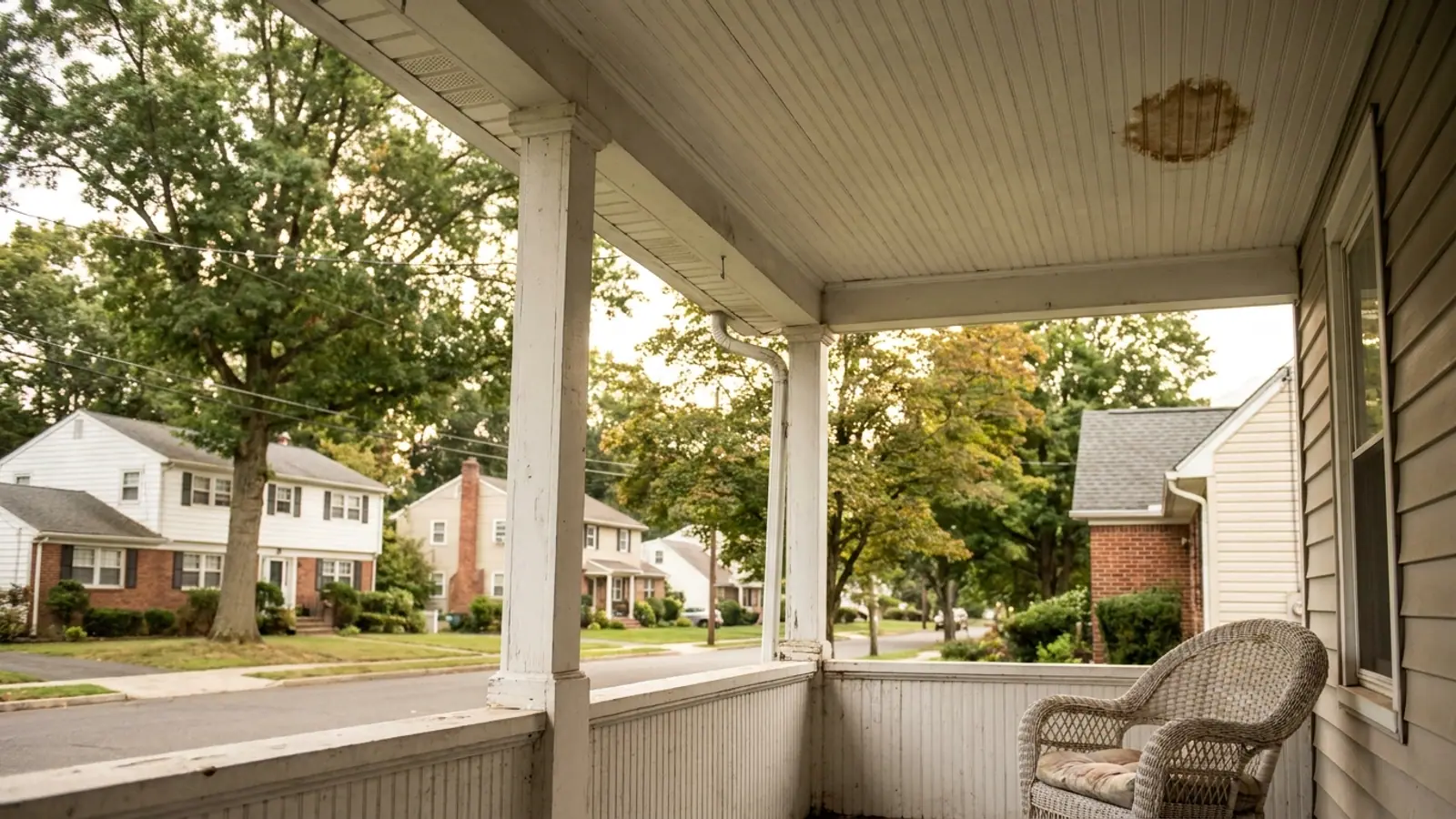
A brown stain on a finished porch ceiling means water is getting in above it. The ceiling is not the problem. It is the reason you did not catch the problem two years ago, because a beadboard or vinyl panel ceiling catches water, spreads it across the framing and holds it there instead of dripping onto the porch floor where you would have seen it the first night.
By the time the stain reaches the finish, the water has usually been in the cavity for a season or more. Here is what is actually going on up there, how to read the stain before anyone opens anything, and what to settle in writing before a crew starts.
Why a finished porch ceiling hides damage for years
An open porch with exposed rafters tells on itself. You see the drip, you see the wet rafter, you call someone.
A finished ceiling does the opposite. The cavity between the ceiling boards and the roof deck is dark, unvented in most cases, and closed on all four sides. Water that enters at the wall or the eave runs along the top of the ceiling boards, soaks into the rafter tails and the outer header, and evaporates slowly or not at all. Wood that stays above roughly 20 percent moisture content long enough starts to decay, and the decay is already advanced before anything shows on the painted side.
That is also why the stain is rarely directly under the leak. Water travels along framing, hits a blocking piece or a nail, and drops. A stain six feet from the house wall can easily be fed by a flashing failure at the wall.
What crews find when the porch ceiling comes down
Rotted rafter tails and a soaked outer header
This is the most common find. The rafter tails sit directly behind the fascia and gutter, which is the wettest part of any roof. When the tails are soft, new fascia and new gutters screwed into them will not hold, and the roof edge keeps sagging. Sound framing is what a drip edge, fascia board and gutter hanger all depend on.
Reused or missing wall flashing
A porch roof dies into the house wall. That junction is sealed by step flashing under the siding, not by shingles or caulk. On older New Jersey porches the flashing is often a single bent strip of aluminum tucked behind the siding and tarred at the top, or it is nothing at all. Water runs down the wall, behind the flashing line and straight into the ceiling cavity. If the porch roof ends at a wall with a gutter, a kickout at the bottom of that run is what keeps water out of the wall itself, and it is missing on a large share of older porches.
Shingles on a slope that is too shallow
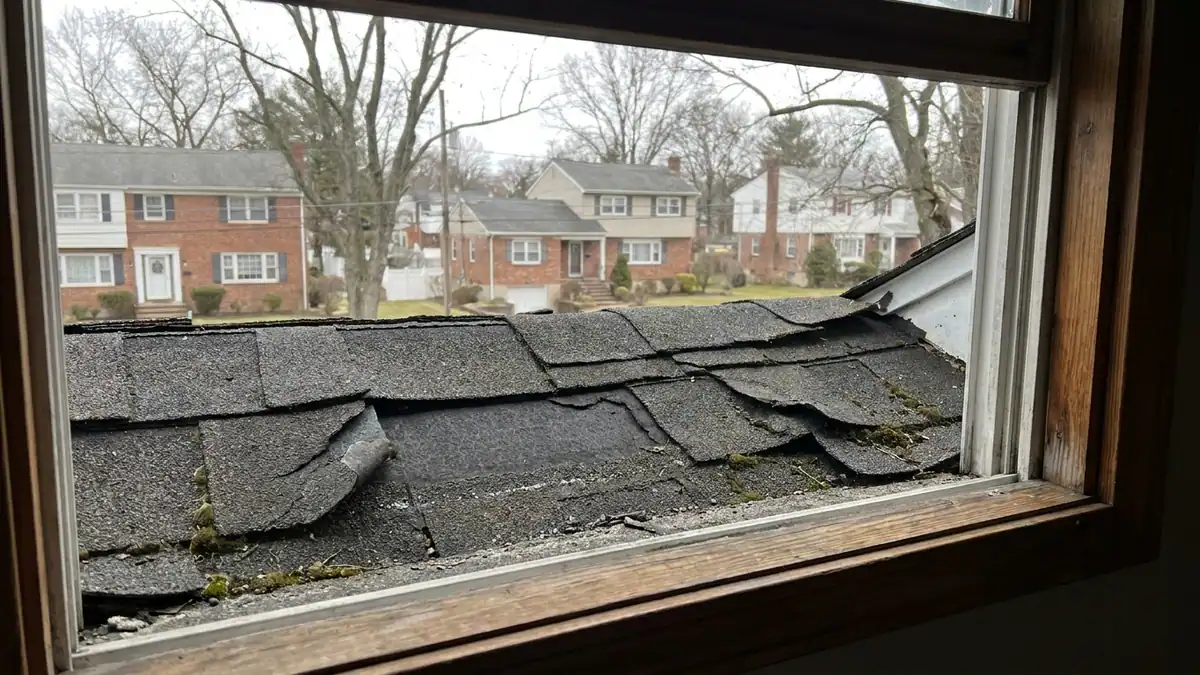
Porch roofs are frequently framed flatter than the main roof so the porch ceiling clears the first-floor windows. Asphalt shingles are designed to shed water down a slope, not to hold it. On a shallow porch roof the water moves slowly, backs up under the courses in heavy rain and finds every nail hole. If your porch roof looks nearly flat from the street and it has shingles on it, that is a likely cause on its own. A low-slope membrane is the correct covering for those roofs, and the flat and low-slope roofing guide explains how TPO, EPDM and modified bitumen differ.
Gutter water, not roof water
A clogged or back-pitched gutter on a porch overflows at the back edge, behind the fascia, and runs into the ceiling cavity. Nothing is wrong with the roof covering at all. The tell is that it only happens in sustained rain and stops within an hour of the rain ending. Seasonal cleaning and correct pitch handle most of it, and the gutter maintenance guide covers what to check and when.
Occasionally, nothing structural
Sometimes the stain is old, the leak was already fixed by a prior owner, and the framing is dry and sound. That happens. A moisture meter on the framing settles it in a minute, and the honest answer in that case is paint, not a roof.
Reading the stain before anyone opens the ceiling
| Where the stain sits | Most likely source |
|---|---|
| Where the stain sitsTight against the house wall | Most likely sourceStep flashing or a missing kickout at the wall junction |
| Where the stain sitsAlong the outer edge near the gutter | Most likely sourceGutter overflow, back pitch, or no drip edge at the eave |
| Where the stain sitsMiddle of the ceiling, broad and diffuse | Most likely sourceShingles on a slope too shallow for them, or old nail penetrations |
| Where the stain sitsAt a column top or outside corner | Most likely sourceOpen fascia miter or failed corner flashing |
| Where the stain sitsWorsens after a cold snap, not during rain | Most likely sourceIce at the eave backing water under the courses |
This narrows the search. It does not replace getting up there. Two of these conditions commonly exist on the same porch.
Does the ceiling actually have to come down
Not necessarily, and a contractor who insists on it before looking from above is guessing. The sequence that works:
- Inspect from the roof. Check the wall flashing, the shingle slope, the gutter pitch and the condition of the fascia.
- Check the gutter and downspout under running water if the stain pattern suggests overflow.
- Press and probe the fascia and the ceiling edge. Soft fascia means the rafter tails behind it are suspect.
- Pull one or two ceiling boards at the worst area if steps 1 through 3 do not explain the stain, or if the framing feels soft.
- Only then price the repair, with the framing condition known rather than assumed.
Beadboard runs tongue and groove, so one board rarely comes out alone. Vinyl or aluminum porch ceiling panels come down and go back up more easily. Know which you have before anyone quotes a price for closing it back up.
What it does to the estimate
The fix is usually some combination of new flashing at the wall, new drip edge or gutter apron at the eave, framing repair at the rafter tails and header, and the correct roof covering for the slope. Most New Jersey asphalt roof replacements run $9,000 to $22,000 in standard-value towns and $14,000 to $35,000 in higher-value towns, with the band set by the municipality's median home value from ACS 2024 five-year estimates. A porch repair alone is a different and much smaller scope, and nobody can price it honestly without seeing the framing.
This is exactly the kind of job where a change order normally shows up. The ceiling comes down, the header is rotted, and the price moves. Lightning Construction does not write change orders. Conditions like rotted decking, bad flashing and extra shingle layers are found at the free inspection and priced into the written estimate, which is the final price, and there is no deposit, so nothing is due until the work is done and you have inspected it. Lightning pulls the permit and attends the municipal inspection under the New Jersey Uniform Construction Code.
Get these four things in writing
- Exactly which ceiling boards or panels come down, and who puts them back.
- New step flashing and a kickout at the wall, stated as new material, not reused.
- Drip edge or gutter apron at the eave, and whether the gutter is being re-pitched or replaced.
- The roof covering specified for the porch slope, with the slope measured and written down.
What to do next
If the stain is spreading, the fascia feels soft, or the porch roof is visibly flatter than the main roof, have it looked at before winter sits on it. The inspection and the written estimate are free and there is no obligation, and a salesperson does come to the house. See what is included in a roof replacement, or book the free inspection and have someone read the flashing, the slope and the gutter line in one visit.