Short answer
Most asphalt shingle roofs in New Jersey give 20 to 25 years of real service, and an architectural shingle on a well ventilated attic can reach the upper end of that. Roofs that fail early almost always fail for one of three reasons: a hot, poorly vented attic, a bad installation, or storm damage that never got repaired. The number printed on the warranty is a product rating, not a promise about your house.
On this page
Most asphalt shingle roofs in New Jersey last 20 to 25 years. Architectural shingles on a house with a working attic ventilation system land at the top of that range and sometimes past it. Thin 3-tab shingles on a hot attic, a low slope or a sun-blasted south face can be finished in 15.
That spread is the whole story. Two identical houses built the same year on the same street can be eight years apart on when they need a roof, and almost none of that difference comes from the brand of shingle.
Why the number on the wrapper is not the service life
A shingle sold with a long warranty term is being rated as a product, under the manufacturer's conditions, with prorated coverage that shrinks every year after an initial period. It is not a statement that your roof will still be shedding water in year 40.
What the manufacturer covers is a manufacturing defect in the shingle. Manufacturing defects are rare. What actually ends a roof is weathering: the asphalt loses its volatile oils, the mat gets brittle, the granules that shield the asphalt from ultraviolet light wash into the gutter, and the shingle starts to curl at the corners and crack across the mat. That is a service-life question, not a warranty question. The difference between the two, and which one is worth anything when there is a problem, is covered in the roof warranty guide.
What actually shortens an asphalt roof in New Jersey
Attic ventilation
This is the big one and it is invisible from the street. Shingles are cooled from below as much as from above. An attic with blocked soffit vents, no intake, insulation stuffed into the eaves or a bathroom fan dumping moist air into the rafter bays runs hot in July and damp in January. Hot shingles age faster. Damp sheathing swells, pops nails and rots.
A roof with proper balanced intake and exhaust routinely outlasts the same shingle on an unvented attic by years. If you are getting estimates and ventilation is not a line item on any of them, read the attic ventilation guide before you sign anything.
Sun and slope direction
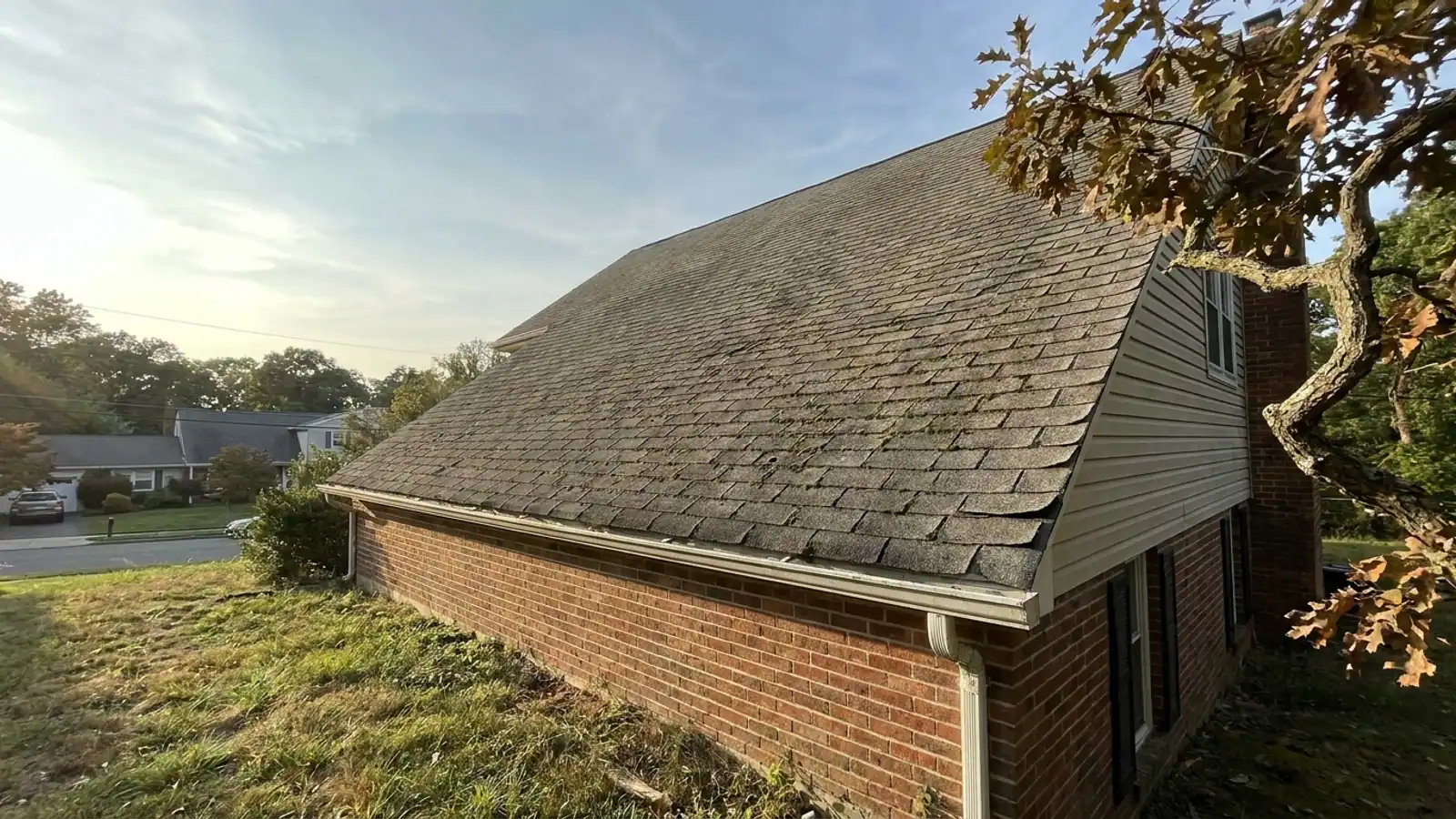
Walk around your house and compare the south or west face to the north face. On a twenty-year-old roof the difference is usually obvious: the sunny side has lost granules unevenly, shows lighter patches, and has started to lift at the butt edges, while the shaded side still looks reasonable except for moss or dark streaking. Sun ages asphalt. Shade grows biology. Both count as wear.
The installation
Nails driven high above the nail line, nails overdriven through the mat, no starter strip at the eaves and rakes, reused step flashing, missing ice and water shield at the eaves, and valleys cut sloppy all shorten a roof. None of them show up in year one. They show up in year 12 as a line of lifted tabs after a windstorm, or a stain on a bedroom ceiling.
Storm hits that never got fixed
A nor'easter pulls a few tabs. Nobody goes up. Water gets under the course above, the deck stays wet, the nails rust, and the failure spreads out from that spot. One ignored repair can take years off an otherwise healthy roof.
What the roof looks like at each stage
| Age | What you typically see | What to do |
|---|---|---|
| Age0 to 10 years | What you typically seeUniform color, flat tabs, minimal granule loss | What to doClean gutters, check after major storms |
| Age10 to 15 years | What you typically seeSome color fade, light granule accumulation in gutters, maybe dark streaking | What to doGet an inspection after any serious wind or hail event |
| Age15 to 20 years | What you typically seeGranule loss visible as darker patches, corners starting to lift on the sunny slope | What to doStart budgeting, have it inspected and documented |
| Age20 to 25 years | What you typically seeCurling, cracked mat, bare asphalt showing, flashing rusted, repairs not holding | What to doPlan the replacement rather than repairing again |
| Age25+ years | What you typically seeSoft spots underfoot, sagging between rafters, repeat leaks | What to doReplace, and expect some decking to need swapping |
How to find out how old your roof actually is
You need the real number before any of the above means anything. Do this in order:
- Call or search your municipality's construction office records for a roofing permit at your address. Permits are public record and this is the most reliable date you will get.
- Go into the attic with a flashlight and look for a contractor sticker, a date written on a rafter, or a stamp on the underside of the sheathing.
- Pull your closing file. Seller disclosure forms often state the roof's age, and home inspection reports usually estimate remaining life.
- Count the layers. If there are two layers of shingles up there, the roof is on borrowed time and a third layer is not a legal option.
- If none of that produces a date, have it inspected and get the age estimated from the condition of the shingles, the flashing and the deck.
Can you extend the life of the roof you have
You can protect the years it has left. You cannot add years to asphalt that has already dried out.
What genuinely helps: keeping gutters clear so water is not backing up under the first course, fixing flashing at chimneys and sidewalls as soon as it starts rusting, removing debris piles behind chimneys and in valleys, correcting blocked soffit vents, and repairing storm damage within weeks rather than seasons.
What does not help: coatings sold for asphalt shingles, pressure washing (it strips granules), and patching the same leak for the fourth time. If a roof past twenty is taking repeated repairs, you are financing a replacement in installments without getting one. The honest tipping point is laid out in the guide on signs you need a new roof.
When to start planning, and what it costs
Start budgeting at year 15 and start getting estimates at year 20, or earlier if you are seeing curling and granule loss on the sunny slope. Planning ahead means you replace on a schedule you choose instead of after water comes through a ceiling in February.
Most New Jersey asphalt replacements run $9,000 to $22,000 in standard-value towns, $14,000 to $35,000 in higher-value towns, and $25,000 to $60,000 for large or luxury homes. The band is set by the municipality's median home value from ACS 2024 five-year estimates. Size, pitch, the number of valleys and penetrations, existing layers and decking condition move the number within the band.
What to do next
Get the roof looked at and get the age and condition in writing with photos. Lightning Construction's inspection and written estimate are free with no obligation, and a salesperson does come to the house. The estimate is the final price, because extra shingle layers, soft decking and failed flashing are found at the inspection and priced in rather than becoming a change order on the day. There is no deposit, nothing is due until the work is finished and you have inspected it, and Lightning pulls the permit and attends the municipal inspection.
Most asphalt replacements are torn off and finished in a single day. See the roofing page for what is included, or book a free estimate and get a real date on the roof you have.