Short answer
Usually yes when the stud cavities are empty or the house is noticeably drafty, because most of the cost of insulating a wall is getting to it, and the siding tear-off has already paid for that access. On a house whose cavities are already full, the better money is air sealing the sheathing and adding a continuous layer of foam rather than opening walls back up. If the walls are insulated and you are selling in two years, skip it and put the money into the siding itself.
On this page
- What insulating the walls during a siding job actually means
- How to tell whether your walls are already insulated
- Which option fits which house
- What exterior foam does to trim, depth and detailing
- The moisture question, answered plainly
- What it does to the price of the siding job
- When it is not worth doing
- What to get in writing before the crew shows up
- What to do next
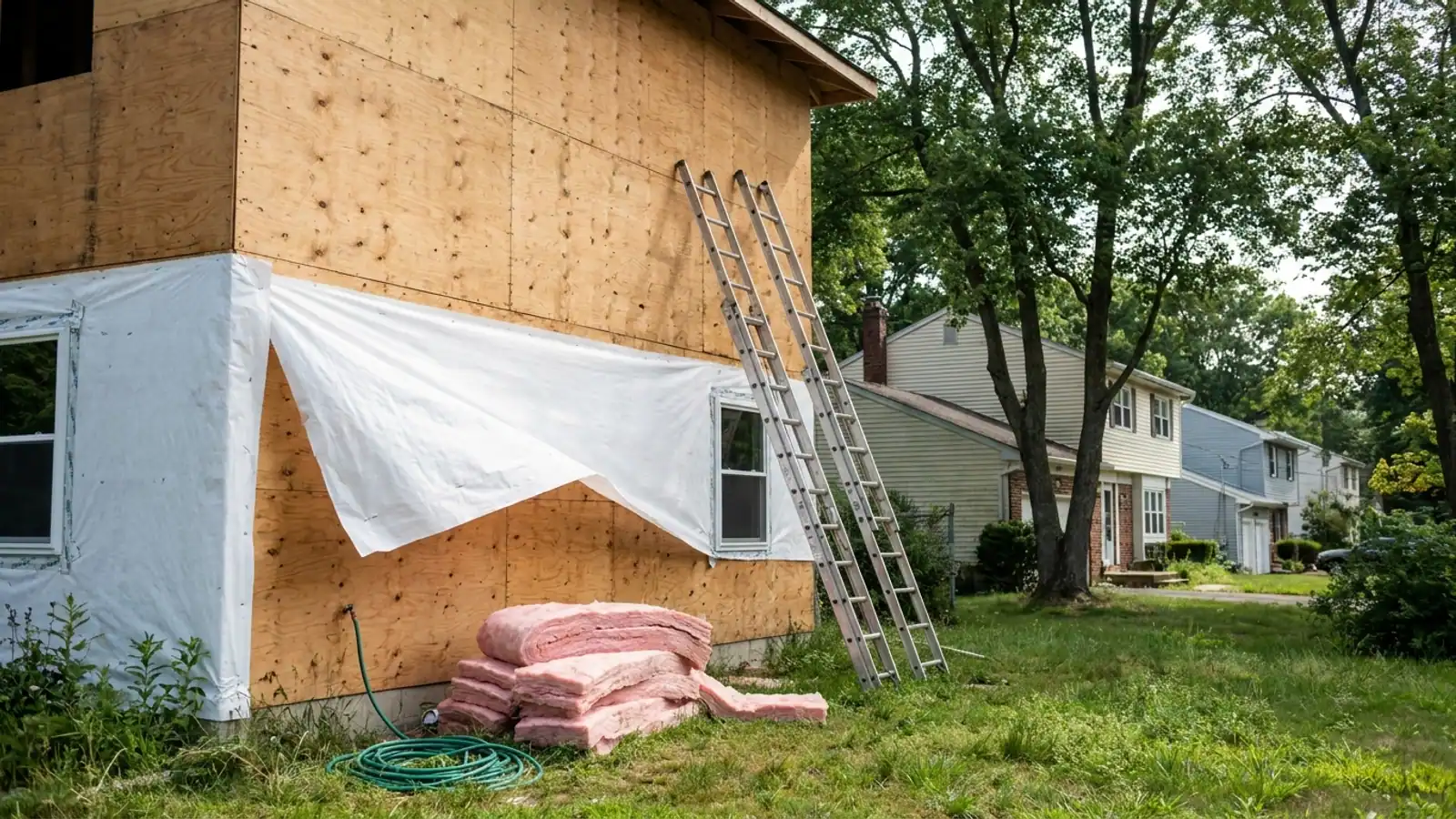
Once the old siding is in a dumpster and your walls are down to bare sheathing, you are looking at the one moment in the life of the house when the wall assembly is cheap to improve. Most of what makes insulation expensive is access. You already bought the access.
Whether it is worth spending more depends on what is behind the sheathing right now. On a house with empty stud cavities, filling them is one of the better dollars you will ever spend on the exterior. On a house whose cavities are already packed, the gain comes from air sealing and a continuous exterior layer, and the honest answer there is more mixed.
What insulating the walls during a siding job actually means
Three separate jobs get lumped under one phrase, and they do not cost the same or deliver the same thing.
Air sealing the sheathing. Caulk or sealant at the sheathing seams, around every penetration, at the band joist line and where the wall meets the foundation and the roof. This is the cheapest item on the list and often the one that changes how the house feels the most, because a drafty wall leaks heat regardless of how much insulation is stuffed in it.
Filling the stud cavities. With the siding gone, an insulation contractor drills each bay through the sheathing, dense-packs cellulose or blown fiberglass, plugs the holes, and the siding goes over top. No holes in your plaster, no furniture moved, no interior patching and painting.
Adding a continuous exterior layer. Rigid foam board or thin fanfold board applied over the sheathing before the house wrap and siding. Continuous means it runs across the studs too, which is the part cavity insulation cannot do, since a wood stud every 16 inches conducts heat straight through the wall.
Insulated vinyl siding is a fourth option that overlaps the third. The foam is bonded to the back of each panel, the R-value is real but modest, and the bigger benefits are a flatter wall and better impact resistance.
How to tell whether your walls are already insulated
You can get a rough answer before the estimate and a certain one on tear-off day.
Age is the first clue. A lot of New Jersey housing stock went up between the 1950s and the 1970s, and those walls usually have something in them, typically kraft-faced fiberglass batts that have settled or been cut around wiring. Houses from the 1930s and earlier frequently have nothing at all in the cavities. Clifton, Passaic, Trenton and Bloomfield are full of houses from that earlier era; Howell, Jackson and Monroe Township skew decades newer.
The practical checks:
- Shut off the breaker and pull the cover off an exterior-wall outlet. You can usually see and feel what is in the bay.
- Hold a hand on an exterior wall on a cold January morning and compare it to an interior wall. A big difference means little or no insulation.
- Ask the crew to open a test area at the inspection. One siding panel off the back wall answers the question for good.
That last one matters. Nobody can tell you what is inside your walls from the driveway.
Which option fits which house
| Upgrade | What it does | When it makes sense |
|---|---|---|
| UpgradeAir sealing the sheathing | What it doesStops air leaks at seams and penetrations | When it makes senseNearly every house, at nearly every age |
| UpgradeDense-pack cavity fill | What it doesFills empty or settled stud bays | When it makes senseCavities empty, partly filled or sagging |
| UpgradeFanfold board (about 1/4 inch) | What it doesFlattens the wall, adds a drainage layer, trivial R-value | When it makes senseWavy sheathing, standard vinyl going back on |
| UpgradeRigid foam, 1 inch or more | What it doesContinuous layer that covers the studs too | When it makes senseYou are willing to rebuild trim depth |
| UpgradeInsulated vinyl siding | What it doesModest R-value, flat and solid wall, quieter | When it makes senseYou want the look and feel more than the number |
What exterior foam does to trim, depth and detailing
This is where the idea gets expensive, and it is the part most homeowners do not see coming.
Every inch of foam pushes the siding plane out an inch. Window and door casings, corner posts, J-channel, the drip edge at the roof line, light fixture blocks, hose bibs, dryer vents, the electric meter and the outdoor receptacles all have to be extended or rebuilt to the new depth. Thicker foam also needs furring strips or longer fasteners so the siding is anchored into framing rather than into foam.
None of that is a reason to avoid it. It is a reason to have it drawn and priced before anyone starts, because a half-finished detail at a window head is where water gets in later. Lightning Construction writes no change orders, so the extra trim work has to be identified at the free inspection and included in the written estimate.
The moisture question, answered plainly
A wall needs to dry. Older New Jersey walls with kraft-faced batts already have a vapor retarder on the inside, which means they dry outward. Adding foam on the outside slows that outward drying, and thin foam over a cold sheathing can leave a surface where moisture condenses.
The way this is handled on a residing job is straightforward: keep the water-resistive barrier continuous, lap the house wrap correctly over flashings rather than behind them, flash every window head and every penetration, and give the siding a drainage path behind it. Fix rot before covering anything. If the crew finds soft sheathing or stained framing during tear-off, insulation is the second conversation and the water source is the first.
What it does to the price of the siding job
Siding in New Jersey runs $10,000 to $22,000 in standard-value towns, $16,000 to $38,000 in higher-value towns, and $30,000 to $70,000 for large or luxury homes. The band is set by the municipality's median home value from ACS 2024 five-year estimates, not by what you add behind the panels. Insulation work sits inside that estimate as a line item, not as a surprise later.
Two things about how that gets paid: there is no deposit on the job, and nothing is due until the work is finished and you have inspected it. If anyone tells you insulation under new siding earns you a tax credit, verify it with a tax professional before you count on it. Your siding contractor is not the right source for that.
For the material decision itself, the guide on siding options for New Jersey homes compares vinyl and fiber cement in depth, including how each one handles the furring and trim changes that thicker foam creates.
When it is not worth doing
A contractor who says yes to every upgrade is selling, not advising. Skip the wall insulation when:
- The cavities are already full and intact. Air seal the sheathing, use a thin fanfold board, and stop there.
- You are selling within a couple of years. Buyers see the siding. They do not see the cellulose.
- Your attic is underinsulated. Dollar for dollar, attic air sealing and insulation beat wall work on almost every New Jersey house, and a hot second floor or ice at the eaves is an attic and ventilation problem rather than a wall problem.
- The budget is tight and the siding itself would have to drop a grade to pay for it. A thicker, better-fastened panel is worth more over 25 years than a marginal R-value gain.
What to get in writing before the crew shows up
- Whether a test area will be opened at the inspection to confirm what is in the walls.
- The insulation method and material, written as a line item, and who performs it.
- The foam thickness, if any, and the furring or fastener plan that goes with it.
- Exactly which trim gets extended or replaced at the new wall depth, window and door casings included.
- The house wrap and flashing sequence at windows, penetrations and the roof-to-wall junction.
- That rotted sheathing found during tear-off is already priced, not billed later.
What to do next
Get the walls looked at before you pick a color. A free inspection and written estimate from Lightning Construction carries no obligation, and a salesperson does come to the house. Permits are pulled by Lightning and the municipal inspection is attended by Lightning, in every municipality in New Jersey.
Start with the siding page for what is included in a replacement, then book the free estimate and ask for the insulation options to be priced as separate lines so you can see what each one costs before you decide.