Short answer
A full siding replacement on a New Jersey ranch runs $10,000 to $22,000 in standard-value towns, $16,000 to $38,000 in higher-value towns, and $30,000 to $70,000 on large or luxury homes. The band is set by your municipality's median home value from ACS 2024 five-year estimates, not by the style of your house. Within that band, a ranch shifts money away from staging labor and toward trim, soffit and fascia, because the roof edge is long and the walls are low.
On this page
A full siding replacement on a New Jersey ranch runs $10,000 to $22,000 in standard-value towns, $16,000 to $38,000 in higher-value towns, and $30,000 to $70,000 on large or luxury homes. The band comes from your municipality's median home value in the ACS 2024 five-year estimates. The style of the house does not set the band.
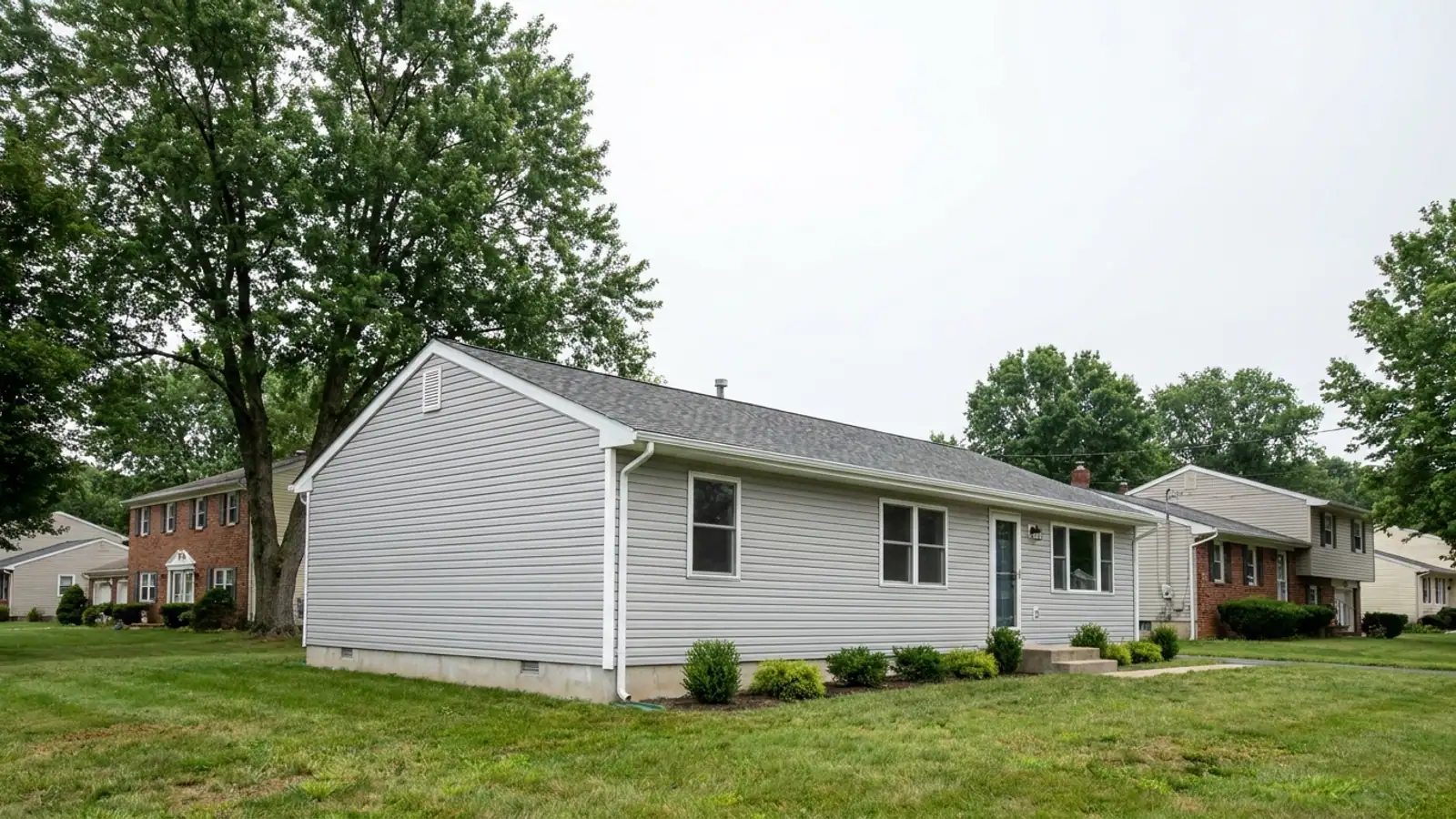
What the ranch shape does change is where the money goes inside that band. A ranch is wide and low. Every wall is reachable without a second-story lift, which is cheaper. But the roof edge wraps the entire perimeter at one height, which means more soffit, more fascia and more trim per square of actual siding. Those two facts pull in opposite directions, and on most New Jersey ranches they roughly cancel out.
Siding price bands in New Jersey
| Municipality band | Full siding replacement |
|---|---|
| Municipality bandStandard-value towns | Full siding replacement$10,000 to $22,000 |
| Municipality bandHigher-value towns | Full siding replacement$16,000 to $38,000 |
| Municipality bandLarge or luxury homes | Full siding replacement$30,000 to $70,000 |
These are ranges, not quotes. Nobody can tell you where in a range your house lands without measuring the walls, counting the corners and looking at what is behind the old siding. Treat a number given over the phone before anyone has seen the house as a guess.
Why a ranch is cheaper on labor
On a two-story colonial, a crew spends real time setting and moving staging, and a second-story wall is slower to install than a first-story wall because every panel has to go up a ladder. On a ranch, the top of the wall is usually within reach of a short ladder or a low plank. Panels get cut on the ground and carried ten feet. That is less setup and less lost time, and it is the main reason a ranch of a given size tends to come in lower than a taller house with the same floor area.
There is a second geometry point people miss. Take the same square footage of living space. Put it all on one floor and you get a long perimeter with eight-foot walls. Stack it on two floors and you get a shorter perimeter with sixteen-foot walls. The stacked version almost always has more total exterior wall. A ranch is not a small siding job, but it is often a smaller one than the two-story down the street with the same heated area.
Why a ranch is more expensive on trim
Field siding, meaning the long uninterrupted runs of panel across a plain wall, is the cheapest part of a siding job per square foot. Corners, J-channel, window and door trim, soffit and fascia are the expensive parts, because they are slow and they are where the water is controlled.
A ranch has a high ratio of edge to field. The eave runs the full length of the front and the back. The rakes run the full slope of both gable ends. Add a breezeway, a bump-out or a carport and you add more edge without adding much wall. So on a ranch, the soffit and fascia line is a larger share of the total than it would be on a taller house.
This is the line to watch on competing quotes. A cheap ranch siding quote very often means new siding on the walls and the original painted wood soffit and fascia left alone. It looks finished from the curb for about two years, then the wood keeps doing what it was already doing.
What actually moves the number on a ranch
- Material. Standard vinyl is the lowest cost. Insulated vinyl costs more and gives a flatter, more solid wall. Fiber cement costs the most to buy and the most to install, because it is heavy, it cuts slowly and it needs more hands. The siding options guide compares vinyl and fiber cement properly.
- Wall area and corner count. A plain rectangle ranch with four outside corners is the least expensive version of this job. An L-shaped ranch with a projecting garage, a bay and a rear addition can have twelve or more corners, and every corner is a post, a cut and a sealed joint.
- Soffit and fascia. Vented aluminum soffit and wrapped fascia around the full perimeter is normal scope on a ranch. Price it as its own line.
- What is behind the old siding. Sheathing condition, failed or missing house wrap, and rot at the sill or around penetrations are found when the old siding comes off. They are also found at a careful inspection beforehand, which is the point.
- Insulation board. Fanfold or rigid foam under the new siding adds material cost and changes how the trim is detailed.
- Accessories you may not be thinking about. Shutters, vent hoods, light blocks, hose bib blocks and the trim around a picture window all carry labor.
The masonry front most New Jersey ranches have
A large share of ranches built in this state from the 1950s through the 1970s have a brick or stone veneer across part of the front elevation and siding everywhere else. That reduces the field siding area, which sounds like savings, but the junction where siding meets masonry needs proper termination trim and flashing, and it is slow work. The gable ends on those houses carry the angled cuts, which is where the labor goes.
If your house is a raised ranch or bi-level rather than a true one-story ranch, the staging advantage largely disappears, because the upper level sits a full story above grade at the front.
Gutters on a ranch
A long low roof edge means a long gutter run, usually with fewer downspouts than the run really wants. If the siding crew is removing gutters to install fascia and soffit, that is the moment to replace them rather than rehang twenty-year-old aluminum on new wood. Seamless gutters run $1,200 to $3,500 in standard-value towns and $2,500 to $6,500 in higher-value towns, and doing them with the siding avoids paying twice for the same ladder work.
What should be in writing before you sign
Get these on the estimate, in words, not implied:
- Tear-off and disposal of the existing siding, or a clear statement that the quote is an overlay.
- The exact product, line and color, not just "vinyl siding."
- House wrap and any insulation board, named.
- Soffit, fascia, corner posts, J-channel and window trim as line items.
- Any sheathing or framing repair the inspection found, priced in.
- The permit, pulled by the contractor.
Lightning Construction prices that whole list at the free inspection. There is no deposit, nothing is due until the work is finished and you have inspected it, and there are no change orders, because the written estimate is the final price. The conditions that normally produce a surprise bill on a siding job, meaning rot behind the old panels, bad sheathing or failed house wrap, get found and priced before the contract is signed. Lightning pulls the permit from your municipality's construction office under the New Jersey Uniform Construction Code and attends the inspection.
Getting a real number for your ranch
The only way to know where your house sits in its band is to have someone measure it. Book a free siding estimate and a salesperson comes to the house, walks the walls, checks the soffit and fascia, and leaves a written price with no obligation and no deposit. If you want to see what the finished scope covers first, start with the siding page.