Short answer
Synthetic underlayment is the better product on a New Jersey asphalt roof, and it is what your quote should name. It is stronger, lays flatter, holds up far better if the roof sits open overnight, and it does not wrinkle under new shingles the way felt does. Felt is still code-compliant, but on a full replacement the cost gap is small enough that there is rarely a good reason to use it.
On this page
- What felt underlayment is and how it fails
- What synthetic underlayment does differently
- Synthetic vs. felt side by side
- Underlayment is not the same thing as ice and water shield
- What the underlayment line should say on your estimate
- Does synthetic underlayment move the price of a New Jersey roof
- When felt is a defensible choice
- What to do next
Put synthetic underlayment on the roof, and make sure the estimate names the product. On an asphalt replacement, underlayment is one of the cheapest components on the job and one of the few that quietly separates a careful contractor from a fast one. Felt is still legal and still gets installed every day in New Jersey, but it tears in wind, wrinkles when it gets wet, and gives you almost nothing if weather arrives before the shingles do.
Here is what each product actually is, how each one fails, and exactly what the line item should say before you sign anything.
What felt underlayment is and how it fails
Felt is a mat of organic or fiberglass fibers saturated with asphalt, sold as 15-pound or 30-pound rolls. It has been on roofs for a century. It works, in the narrow sense that a roof built with it passes inspection and keeps water out as long as the shingles above it are intact.
The problems are practical ones and they show up on the day of the job.
Felt tears. A gust catches a loose run before it is nailed off and the sheet splits from the fastener line. A crew member steps on an unsupported edge and his boot goes through.
Felt wrinkles. Asphalt-saturated felt absorbs moisture, and when it does it swells and then buckles as it dries. If rain hits an open roof covered in felt and shingles go down over it the next morning, those ripples telegraph through the finished roof. You see them from the street in low sun as long, soft waves running across the slope.
Felt does not last in the sun. Left exposed, it dries out, curls at the laps and starts releasing nails within days. That matters more than it sounds, because a torn-off roof is exposed until the new one is finished.
It is also slick when wet or dusty, which is a safety issue for the crew more than a performance issue for you, but it is part of why most serious crews stopped using it.
What synthetic underlayment does differently
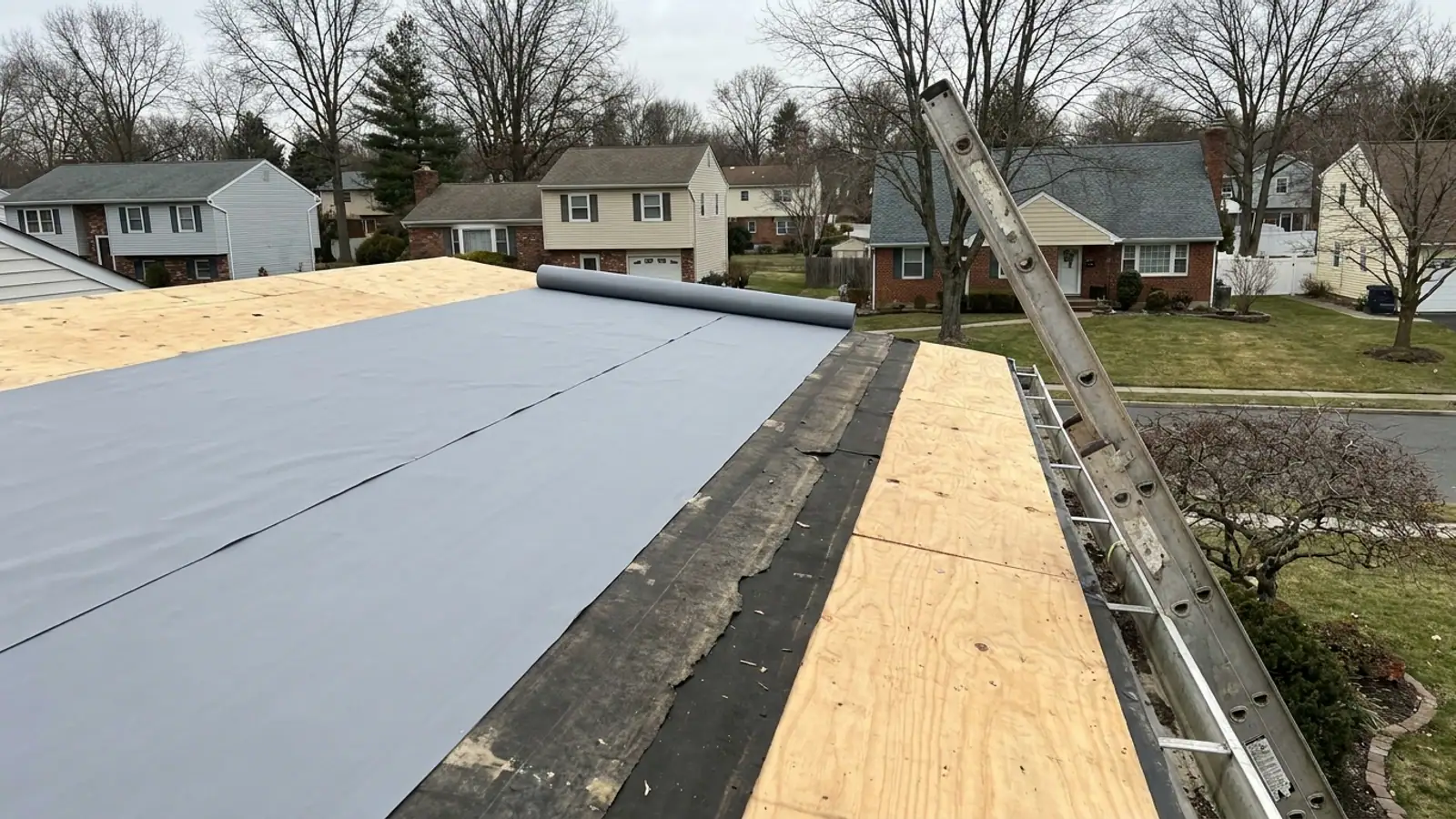
Synthetic underlayment is woven or spunbond polypropylene or polyethylene, usually with a coated walking surface. It is a plastic sheet, not an asphalt sheet, and that changes everything about how it behaves.
It is far stronger in tear and in fastener pull-through, so it stays put when the wind comes up and when boots and ladders move across it. It does not absorb water, so it does not swell, wrinkle or ripple, and a new shingle course lays flat over it. It is lighter per roll and covers more square footage per roll, so there are fewer laps and fewer places to get a lap wrong. Most products carry a printed lap line and a nailing line, which makes a correct installation obvious to anyone looking at the deck, including the municipal inspector.
And it holds up under sun exposure for a published period, commonly measured in months rather than days. If weather pushes the shingle work, the deck underneath is still protected.
Most New Jersey asphalt roof replacements are torn off and finished in a single day, so the exposure window on a normal job is short. The value shows up on the job that is not normal: the one where a thunderstorm rolls through at two in the afternoon, or where a steep cut-up roof takes longer than planned.
Synthetic vs. felt side by side
| 15 lb / 30 lb felt | Synthetic underlayment | |
|---|---|---|
| Material | 15 lb / 30 lb feltFiber mat saturated with asphalt | Synthetic underlaymentWoven polypropylene or polyethylene |
| Behavior when wet | 15 lb / 30 lb feltAbsorbs water, swells, then wrinkles | Synthetic underlaymentDoes not absorb water, stays flat |
| Tear and fastener resistance | 15 lb / 30 lb feltLow, splits at nail lines in wind | Synthetic underlaymentHigh |
| UV exposure tolerance | 15 lb / 30 lb feltDays | Synthetic underlaymentPublished limit, commonly months |
| Weight per roll | 15 lb / 30 lb feltHeavier, more rolls per roof | Synthetic underlaymentLighter, more coverage per roll |
| Walking surface | 15 lb / 30 lb feltSlick when wet or dusty | Synthetic underlaymentCoated or textured for traction |
| Lap and nail guides printed on it | 15 lb / 30 lb feltNo | Synthetic underlaymentUsually yes |
| Code-compliant in New Jersey | 15 lb / 30 lb feltYes | Synthetic underlaymentYes |
Underlayment is not the same thing as ice and water shield
This is where estimates get confusing, and where some of them get vague on purpose.
Ice and water shield is a self-adhering rubberized membrane. It sticks to the deck and seals around nail shanks. It belongs at the eaves, in the valleys, around chimneys and skylights and other penetrations, and often up sidewalls. Its job is to stop water that backs up under the shingles, which in New Jersey usually means ice damming at the eave after a freeze and thaw cycle. Our ice dam guide covers how that water gets where it gets.
Synthetic underlayment is mechanically fastened with cap nails and does not seal around fasteners. It covers the field of the roof above and beyond the membrane.
A complete roof has both. An estimate that lists only one of them is either leaving something out or hiding it inside a vague line. Ask which product goes where, and how many feet up from the eave the membrane runs.
What the underlayment line should say on your estimate
You want four things written down, not described verbally at the kitchen table.
- The product name and type, for example a specific synthetic underlayment rather than the words "underlayment included."
- Where the ice and water shield goes, listed by location: eaves, valleys, around chimneys, around skylights and pipe penetrations.
- Cap nails for the synthetic, not staples. Staples cut the sheet and pull through.
- Whether the underlayment is part of a single-manufacturer system, because the higher manufacturer warranty tiers usually require matched components. Our roof warranty guide explains what that coverage does and does not include.
If an estimate is one line and a number, you cannot compare it to anything, and you will not know what went on your deck after the shingles cover it.
Does synthetic underlayment move the price of a New Jersey roof
Barely, on a full replacement. Tear-off, disposal, labor, flashing, drip edge, ventilation, the shingles themselves and the permit are the bulk of what you are paying for. Underlayment is a small share of the total.
Most asphalt roof replacements in New Jersey run $9,000 to $22,000 in standard-value towns, $14,000 to $35,000 in higher-value towns, and $25,000 to $60,000 for large or luxury homes. The band comes from the municipality's median home value using ACS 2024 five-year estimates. Roof size, pitch, the number of valleys and penetrations, how many shingle layers are already up there and the condition of the decking move the number far more than the underlayment does. The New Jersey roof cost guide walks through what actually drives the total.
If a contractor tells you synthetic adds thousands, ask to see it broken out. It should not.
When felt is a defensible choice
There are a few, and an honest contractor will name them.
A small repair patch on an existing felt roof, where matching the existing layer is simpler than introducing a second material. A detached shed or outbuilding where the budget is the whole point. A low-slope section that is getting a different system entirely, where neither felt nor standard synthetic is the right answer.
On the main roof of a house you live in, on a job where the deck is open to the weather for a day, synthetic is the answer.
What to do next
Get the underlayment named in writing before you sign. Then look at the rest of the estimate the same way: flashing new or reused, drip edge included, ventilation specified, decking repair priced.
Lightning Construction finds the conditions that normally trigger a change order, extra shingle layers, rotted decking, failed flashing, at the free inspection and prices them into the written estimate, so the number on the page is the final price. There is no deposit; nothing is due until the work is finished and you have inspected it. Lightning pulls the permit from your municipality's construction office under the New Jersey Uniform Construction Code and attends the inspection, so you file nothing.
See what is included on a full roof replacement, or book a free inspection and written estimate. It is genuinely no-obligation, and a salesperson does come to the house.