Short answer
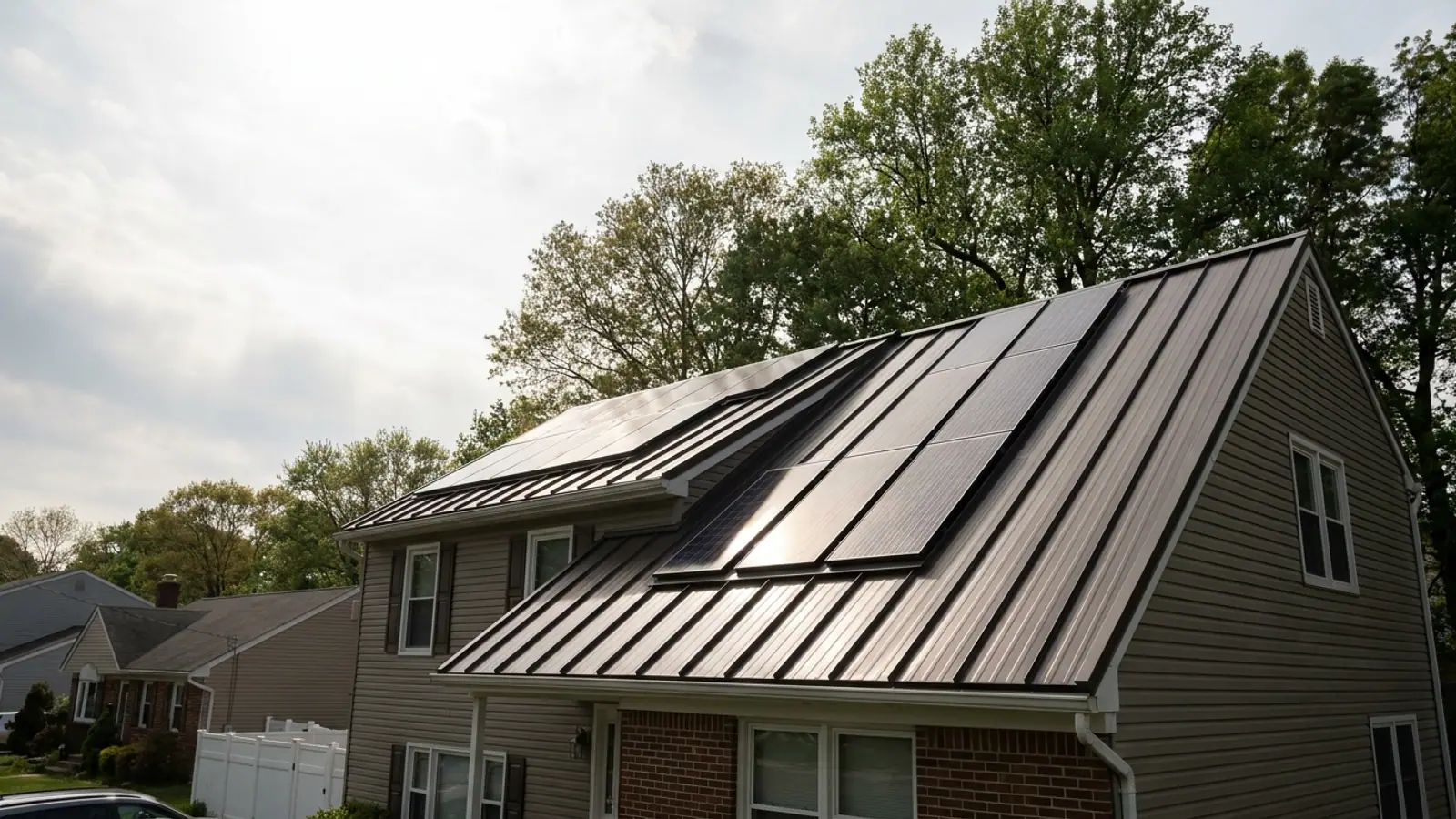
Yes, and a standing-seam metal roof is the easiest roof in New Jersey to put solar on. Clamps grip the raised seams and hold the racking without a single hole through the panel, which is the main way solar mounting causes leaks on other roof types. Exposed-fastener panels and metal shingles can also take solar, but those systems require penetrations and more care.
On this page
Yes, you can put solar panels on a metal roof in New Jersey, and standing seam is the best roof surface you can hand a solar installer. The raised seams let the racking clamp on without a single fastener going through the panel, so the mounting hardware never touches the underlayment or the decking. On an asphalt roof, every array is anchored by lag bolts driven through the shingles into rafters, and each one of those is a hole that has to be flashed and sealed correctly.
That difference is the whole answer. What follows is how the mounting actually works on each kind of metal roof, what order to do the work in, and what to get in writing before anyone gets on the roof.
How solar mounts to a standing-seam metal roof
Standing-seam panels run vertically from ridge to eave and are joined by raised seams every 12 to 18 inches. A seam clamp is a small machined block that slips over the seam and tightens with setscrews. The screws bite into the seam metal itself. Once a row of clamps is set, the installer bolts a horizontal rail across them, and the solar panels bolt to the rail.
Nothing is drilled. Nothing is caulked. There is no penetration to fail in ten years, which matters because sealant is the shortest-lived part of any roof assembly. The array load spreads across dozens of clamps and transfers into the panel clips and then into the decking, the same path the roof already uses for wind and snow.
A few details decide whether the clamps hold properly:
- Seam profile. Snap-lock, mechanically seamed and nail-strip panels all take clamps, but the clamp has to match the profile. A clamp made for a 1-inch snap-lock seam does not belong on a 2-inch mechanically seamed roof.
- Panel gauge. Thinner panels deform more under clamp pressure. The panel manufacturer publishes a torque spec for a reason.
- Clip spacing. The array adds uplift load, and the load path runs through the roof clips underneath. On a properly installed roof this is rarely a problem, but the solar engineer should know the clip spacing.
- Snow. Panels sit above the roof surface and change how snow slides. If the roof has snow guards, the array layout has to work around them, not fight them.
What about exposed-fastener panels and metal shingles?
Both can take solar. Neither gets the clamp advantage.
| Roof type | How solar attaches | What to watch |
|---|---|---|
| Roof typeStanding seam | How solar attachesNon-penetrating clamps on the seam | What to watchClamp must match the exact seam profile |
| Roof typeExposed-fastener panel | How solar attachesBrackets screwed through the panel rib into framing, sealed with butyl and a gasketed fastener | What to watchEvery bracket is a penetration that ages with the sealant |
| Roof typeMetal shingle | How solar attachesFlashed mounts that lift and tuck under the course above | What to watchRequires a shingle-specific mount, not a generic asphalt foot |
| Roof typeCorrugated over purlins | How solar attachesBrackets through the high rib into purlins | What to watchConfirm there is real framing where the bracket lands |
On an exposed-fastener roof, insist the brackets land on the high rib and never in the flat pan where water runs. Water sitting against a fastener is how those roofs leak. The standing-seam metal roofing guide covers how the panel systems differ if you are still choosing one.
Do the roof first, then the solar
This is the sequencing mistake that costs the most money. Solar arrays are designed to last decades. If the roof under one has fewer years left than the array does, somebody eventually pays to detach the panels, reroof, and reset them.
A sensible order:
- Get the roof inspected and find out honestly how much life is left in it. Age, decking condition and flashing all matter more than how it looks from the street.
- If the roof is near the end, replace it before the solar goes on. Standing-seam metal takes two to four days; most asphalt replacements are done in one.
- Have the solar contractor design the array to the finished roof, with the panel manufacturer's approved clamp or mount named in the proposal.
- Confirm in writing who is responsible if a leak shows up at a mount point later.
- Keep both sets of paperwork together, since a future buyer or insurer will ask for them.
If you are weighing metal against asphalt for a house you plan to put solar on, the asphalt vs. metal comparison lays out the cost and lifespan trade-off. Metal roofing in New Jersey runs $18,000-$35,000 in standard-value towns, $28,000-$55,000 in higher-value towns and $45,000-$120,000 on large or luxury homes, with the band set by the municipality's median home value.
Warranties, permits and who is responsible for a leak
Metal roof warranties usually say something specific about attachments. Non-penetrating clamps that the manufacturer lists as approved normally keep the finish and weathertightness coverage intact. Drilling through the panel can change that. Ask the solar contractor to name the mount in the proposal and ask the roof manufacturer's approved-attachment position in writing. The roof warranty guide explains why manufacturer coverage and workmanship coverage are separate things, and why a mount installed by a third party can sit in the gap between them.
Permits split the same way. Solar work is permitted and inspected by the solar contractor. When Lightning Construction does roofing work, Lightning pulls the permit from that municipality's own construction office under the New Jersey Uniform Construction Code and attends the inspection, in every one of the 544 municipalities served. You file nothing on the roofing side.
One more thing to settle before work starts: if water shows up at a ceiling under the array in three years, whose problem is it? Get the answer in the contract, not in a phone call afterward.
What Lightning Construction does and does not do here
Lightning Construction does not install solar. The company installs roofing, metal roofing, siding and gutters, and is GAF Certified, licensed and insured under New Jersey Home Improvement Contractor registration 13VH12437000. Where it fits into a solar project is the roof itself: replacing a roof before an array goes on, installing the metal roofing system the clamps will attach to, and repairing roof penetrations made by others.
On any of that work there is no deposit and no change order. Nothing is due until the job is finished and you have inspected it, and the written estimate is the final price. The conditions that normally trigger a change order mid-job, such as bad decking or unusable flashing, are found at the free inspection and priced into the quote before you sign.
If you are planning solar and are not sure the roof under it is ready, book a free inspection and written estimate. It costs nothing, there is no obligation, and a salesperson does come to the house. You will get photos of what the roof actually looks like and a straight answer on whether it needs replacing now or can wait.
On incentives, ask your solar contractor what programs are currently open and confirm any tax treatment with a tax professional. Do not build a budget on a number you read on a contractor's website, including this one.