Short answer
A metal roof makes sense on a small New Jersey home when you plan to stay in the house and the roof shape is simple, because the material life is 50 or more years and a simple roof keeps the trim and flashing work down. What it will not do is cost half of what a large roof costs, since a large share of the price is fixed no matter how small the roof is. If the budget is tight or the roof is cut up with dormers and penetrations, asphalt is the more honest answer.
On this page
- Why a small metal roof costs more per square than a large one
- A small house does not always mean a small roof
- What raises and lowers the price on a small metal roof
- What metal actually costs against asphalt in New Jersey
- When metal is the right call on a small New Jersey house
- When to stay with asphalt
- What to get in writing before you sign
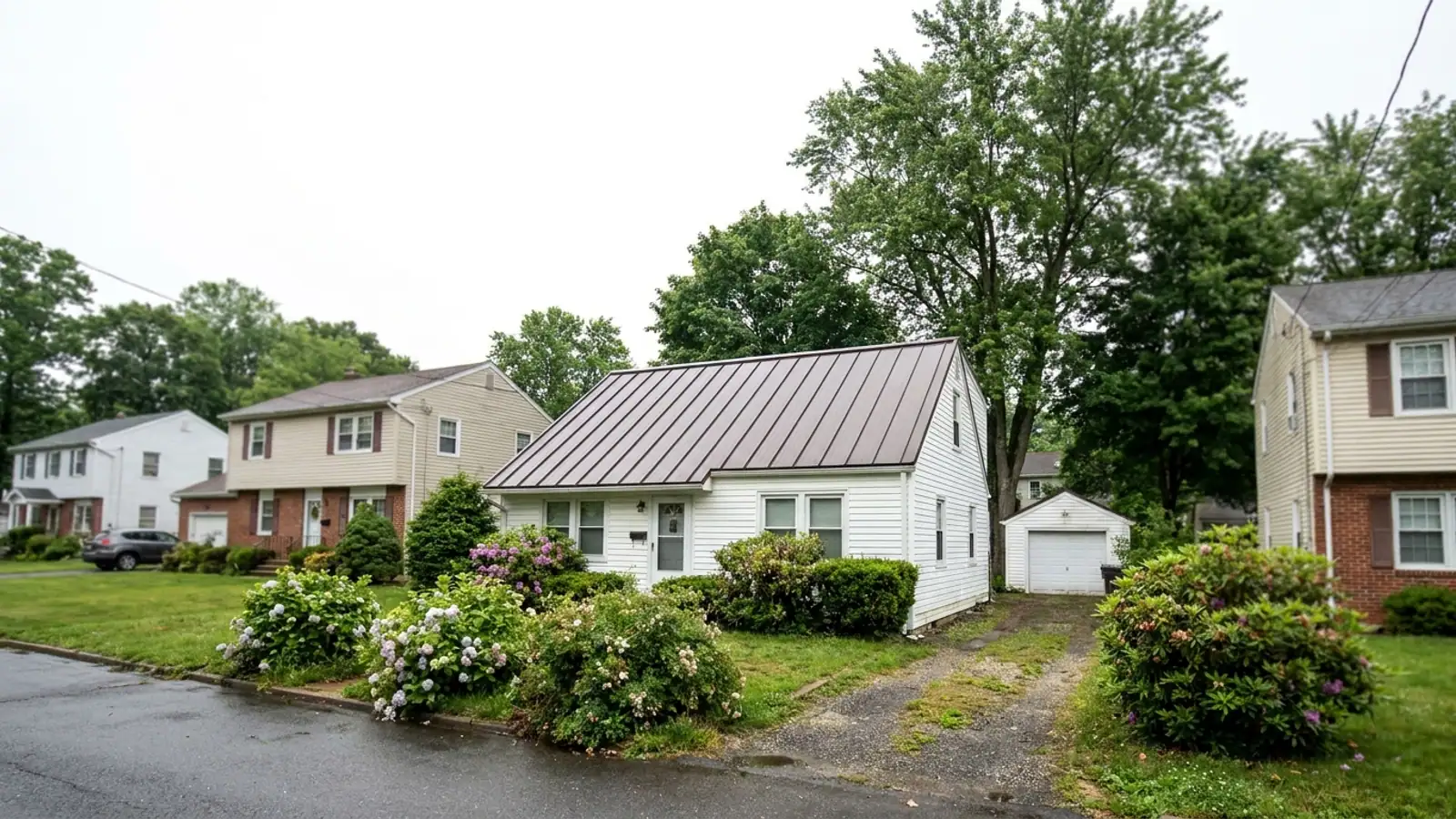
A metal roof makes sense on a small New Jersey home when you are staying in the house and the roof has a simple shape. The material life is 50 or more years, which is the whole argument for metal, and that argument only pays you back if you are there to collect it.
What a small house does not get you is a small price. Homeowners call expecting that half the roof means half the cost, and that is not how a metal roof is priced. Here is where the money actually goes on a small roof, and how to tell whether yours is a good candidate.
Why a small metal roof costs more per square than a large one
Roofing is measured in squares, which are 100 square feet of roof surface. On a metal roof, a large share of the cost has nothing to do with how many squares you have.
These items barely move when the roof gets smaller:
- Mobilization. The same crew, trucks, brake and staging show up whether the roof is 12 squares or 40.
- The permit and the municipal inspection. Lightning pulls the permit from your town's construction office under the New Jersey Uniform Construction Code and attends the inspection. You file nothing.
- Tear-off and disposal. A dumpster is a dumpster, and a small roof rarely fills enough of one to save you much.
- Eave, rake, ridge and valley trim. Trim follows the perimeter of the roof, not its area, and a small roof has a lot of perimeter relative to its field.
- Flashing at the chimney, the sidewalls and every pipe. Each one is a hand-fitted detail that takes the same time on a small house as on a large one.
The panels themselves are the part that scales down. They are the cheaper half of the equation. So when the field shrinks, the fixed work becomes a bigger share of the total, and the per-square number goes up even though the check gets smaller.
A small house does not always mean a small roof
Footprint and roof area are two different measurements, and homeowners usually quote the first.
Pitch multiplies area. A 6/12 roof surface is roughly 12 percent larger than the footprint it covers, and a steep 10/12 is substantially more than that. Overhangs add area beyond the walls. A two-story colonial with 2,000 square feet of living space can have less roof than a 1,200 square foot ranch, because the ranch puts its whole floor plan under one roof plane.
The other variable is shape. A cape with front and rear shed dormers has more valleys, more sidewall flashing and more cut panels than a plain gable of the same size. On metal, complexity costs more than area does.
What raises and lowers the price on a small metal roof
| Factor | Pushes the price down | Pushes the price up |
|---|---|---|
| FactorRoof shape | Pushes the price downSimple gable or shed, two planes | Pushes the price upHips, dormers, valleys, multiple ridges |
| FactorPenetrations | Pushes the price downOne or two pipes | Pushes the price upChimney, skylights, several vents, satellite mount |
| FactorPitch and access | Pushes the price downWalkable pitch, clear ground on all sides | Pushes the price upSteep pitch, tight lot, deck or landscaping under the eave |
| FactorSystem | Pushes the price downMetal shingle or panel over a straightforward deck | Pushes the price upStanding seam with custom-bent trim throughout |
| FactorExisting roof | Pushes the price downOne layer, sound decking | Pushes the price upMultiple layers, soft or delaminated sheathing |
| FactorEdge work | Pushes the price downShort, straight eave and rake runs | Pushes the price upLong perimeter relative to roof area, many trim transitions |
Every one of those is visible at the inspection, which is why Lightning prices them into the written estimate instead of discovering them on the day. There are no change orders here. The written estimate is the final price.
What metal actually costs against asphalt in New Jersey
Metal roofing runs $18,000 to $35,000 in standard-value towns, $28,000 to $55,000 in higher-value towns, and $45,000 to $120,000 for large or luxury homes. Asphalt runs $9,000 to $22,000 standard, $14,000 to $35,000 higher-value, and $25,000 to $60,000 for large or luxury homes. The band is set by your municipality's median home value from ACS 2024 five-year estimates, not by the size of your house.
That matters for a small home. A modest house in a higher-value town is still quoted in that town's band, though a small, simple roof lands toward the low end of it. Treat every one of those figures as a range and get a written number for your own roof before you plan around any of it. The asphalt vs. metal comparison walks through how the two systems differ beyond price.
One more honest point: the gap between asphalt and metal is a dollar gap, and on a small roof that dollar gap is smaller than it is on a big one. That is the real argument in favor of metal on a compact house. You are buying the longest-lived roof system available on the smallest roof you will ever pay for.
When metal is the right call on a small New Jersey house
- You are staying put. Material life of 50 or more years only pays off with time in the house.
- The roof is a simple gable, shed or low-complexity hip with few penetrations.
- Access is difficult enough that you do not want to be redoing this roof in 20 years, whether that is a steep pitch, a tight lot or mature plantings under the eaves.
- You want the look, and you have priced it rather than assumed it.
- Your attic ventilation is correct or is being corrected as part of the job.
When to stay with asphalt
If you expect to sell in the near term, the extra money goes into a roof you will not use. If the roof is cut up with dormers, multiple valleys and a chimney, the trim and flashing labor climbs fast and the small size stops helping you. And if the budget is the constraint, an architectural asphalt roof installed properly on a clean deck is a good roof, not a consolation. Financing is available through GreenSky and FTL, including 24 months at 0 percent interest and 120-month terms with no prepayment penalty, and the roof financing guide explains how homeowners here usually structure it.
What to get in writing before you sign
Ask for the panel system and profile, the metal and gauge, the finish system, the underlayment, how the eave, rake, ridge and valley trim are detailed, whether snow retention is included, what happens to the ventilation, and what the gutters tie into. A metal roof is a system of parts, and a thin estimate hides which parts are missing. The standing-seam guide covers each of those in depth.
Most asphalt roof replacements here are done in a single day. Standing seam takes two to four days, and a small simple roof sits at the shorter end of that.
If you want a real number for your house, book a free inspection and written estimate. It is free and genuinely no-obligation, and a salesperson does come to the house. There is no deposit, nothing is due until the work is finished and you have inspected it, and you can see the full scope of what Lightning installs on the metal roofing page.