Short answer
A metal roof carries three separate warranties that cover three different failures: the paint finish warranty covers fade, chalk and peeling, the panel or substrate warranty covers the metal itself rusting or perforating, and the workmanship warranty from your installer covers leaks caused by how the roof was put together. Only the workmanship warranty comes from the contractor, and it is the one most likely to matter in the first ten years. Ask for all three documents in writing before you sign anything.
On this page
A metal roof does not come with one warranty. It comes with three, from two different parties, covering three different ways the roof can disappoint you. The paint finish warranty covers color. The panel or substrate warranty covers the metal. The workmanship warranty covers the installation. Homeowners get burned when they assume a "50 year roof" means one piece of paper covering all of it.
Here is what each document actually says, what it does not say, and what to ask for before you sign.
The three warranties on a metal roof, and who issues each
Two of the three come from manufacturers and have nothing to do with your contractor. The third comes from your contractor and has nothing to do with the manufacturer.
- Finish (paint) warranty. Issued by the coil coater or the panel manufacturer. Covers the painted surface: fading beyond a stated limit, chalking beyond a stated rating, cracking, peeling and loss of adhesion.
- Panel or substrate warranty. Issued by the panel manufacturer. Covers the metal under the paint: rupture, structural failure or perforation from normal atmospheric corrosion.
- Workmanship warranty. Issued by the roofing contractor who installed it. Covers leaks and defects caused by how the roof was assembled.
A leak is almost never a manufacturer problem. Panels arrive straight and coated. What fails early is a seam that was not locked, a sidewall flashing cut short, a fastener driven through a panel where a clip belonged, or a valley with no room left for the metal to move. All three of those are workmanship. The general differences between manufacturer and workmanship coverage are laid out in the roof warranty guide, and the same split applies to metal with one extra layer on top.
What a metal roof paint finish warranty actually covers
The finish warranty is the one people misread most, because it is written in measurement terms rather than plain English.
Fade, chalk and film integrity are three separate promises
Fade is color change, measured in color units against an unexposed sample. The warranty does not promise no fade. It promises fade will stay under a stated number, and if it goes over, there is a remedy. Chalk is the powdery residue left when the resin at the surface breaks down, measured on a standard chalk rating scale. Film integrity covers cracking, checking, blistering and peeling.
Each of the three usually has its own term and its own limits, and the limits are often different on the roof plane than on vertical trim, and different again on dark and vivid colors. Reds, deep blues and some bronzes commonly carry shorter fade coverage than light grays and earth tones, because the pigments behave differently in sunlight.
The resin system drives all of it. PVDF finishes hold color and gloss longer than silicone-modified polyester, and their warranty paperwork reflects that with longer terms and tighter fade limits. If a quote names a color but not a finish system, that is the first question to ask.
Read the remedy paragraph, not the headline number
The headline on a finish warranty is a term in years. The paragraph that decides what a claim is worth is the remedy. Most finish warranties cover material only, often on a prorated basis, and specifically exclude the labor to strip the roof and reinstall it. On a metal roof, that labor is most of the cost. A finish claim that pays for paint or replacement coil and nothing else is still worth having, but it is not the same thing as a new roof.
What the panel or substrate warranty covers
This one covers the metal itself failing: rust through, perforation, structural rupture. Terms depend on the substrate. Aluminum does not rust and is the usual answer near salt air. Galvalume steel is coated steel, and its substrate warranty normally carries exclusions that matter in New Jersey.
The common exclusions to look for:
- A distance limit from salt water, which rules out a lot of Monmouth, Ocean, Atlantic and Cape May county addresses for steel substrate coverage.
- Contact with dissimilar metals, treated lumber or masonry runoff.
- Panels in standing water or on slopes below the manufacturer's minimum pitch.
- Cut edges, which are usually excluded entirely on steel.
- Roofs with no ventilation, or with trapped condensation under the panels.
That last one is why underlayment and venting show up in a warranty conversation at all. Substrate selection for coastal and inland New Jersey is covered in the standing-seam metal roofing guide.
Side by side
| Finish warranty | Panel warranty | Workmanship warranty | |
|---|---|---|---|
| Issued by | Finish warrantyCoil coater or panel maker | Panel warrantyPanel maker | Workmanship warrantyYour roofing contractor |
| Covers | Finish warrantyFade, chalk, peeling, cracking | Panel warrantyRust through, perforation, rupture | Workmanship warrantyLeaks and defects from installation |
| Does not cover | Finish warrantyLeaks, dents, substrate corrosion | Panel warrantyCosmetic color change | Workmanship warrantyProduct defects, storm damage |
| Typical remedy | Finish warrantyMaterial only, often prorated | Panel warrantyMaterial, often prorated | Workmanship warrantyLabor and materials to fix the work |
| When it matters | Finish warrantyYear 10 and beyond | Panel warrantyYear 15 and beyond | Workmanship warrantyThe first several years |
| Worth the most to you | Finish warrantyAppearance | Panel warrantyLongevity | Workmanship warrantyKeeping water out |
What voids a metal roof warranty
The exclusion lists are longer on metal than on asphalt, and most of them trace back to how the roof was handled rather than how it was made.
- Fasteners driven through the panel face where the system calls for concealed clips, which also blocks thermal movement.
- Mixing manufacturers across panels, clips, trim and sealant.
- Walking the panels wrong and denting the flats, which is damage, not defect.
- Mounting anything to the roof by drilling through a panel.
- Abrasive cleaning or the wrong cleaner on the finish.
- Leaving swarf, which is the metal filings from cutting, on the panel surface to rust in place.
Sweep and rinse requirements appear in more finish warranties than homeowners expect. Ask whether yours has one.
What to ask for in writing before you sign
Get these in the estimate packet, not promised verbally:
- The panel manufacturer, substrate, gauge and finish system named by product, not by color alone.
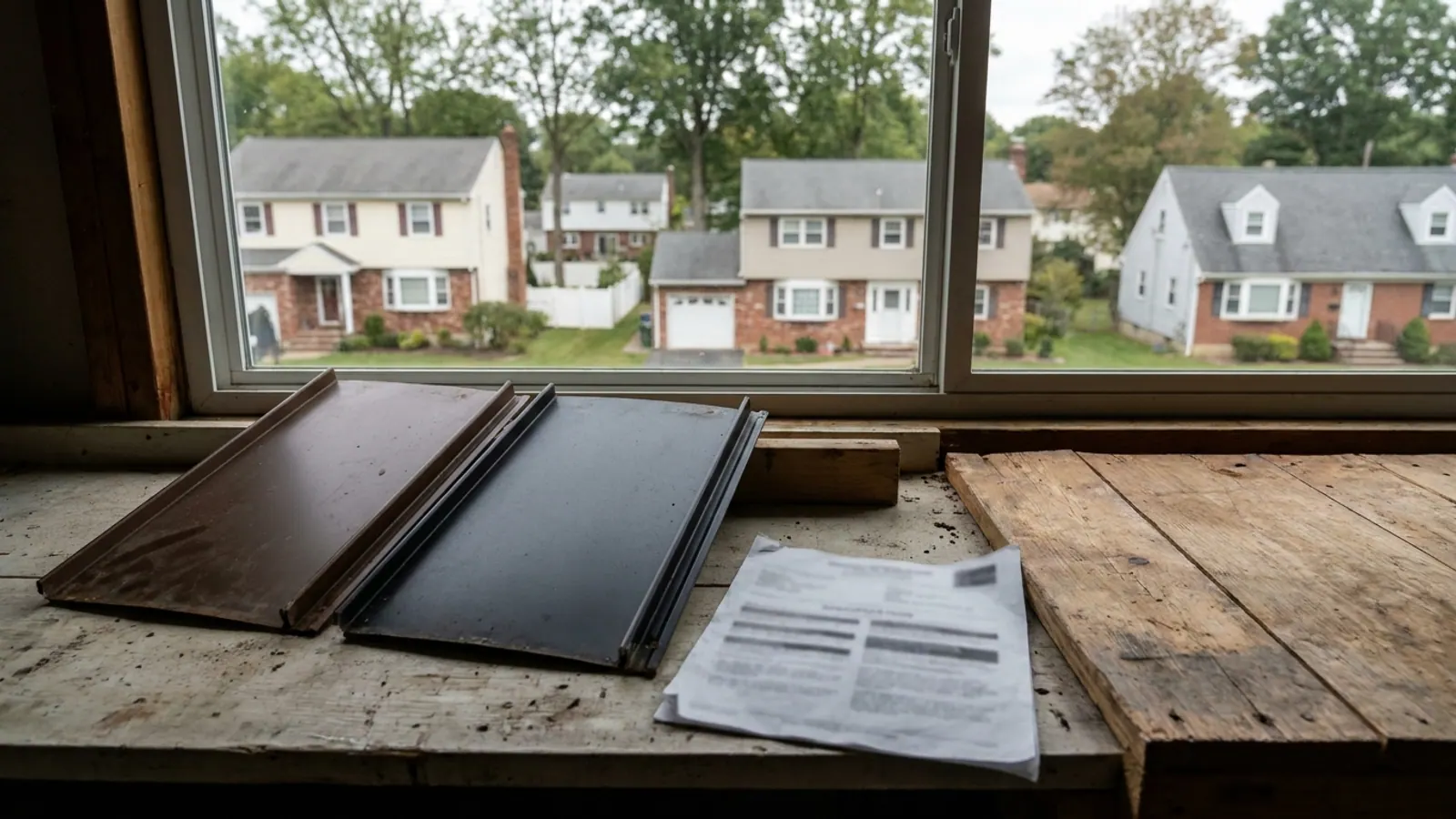
- The actual finish warranty document for that color, with its fade and chalk limits.
- The substrate warranty with its salt water distance limit and cut edge language.
- The contractor's workmanship warranty, in writing, with its term and what it covers.
- Whether the finish and substrate coverage transfers, and what the new owner has to do to keep it.
Metal roofing in New Jersey runs $18,000 to $35,000 in standard-value towns, $28,000 to $55,000 in higher-value towns and $45,000 to $120,000 for large or luxury homes, with the band set by the municipality's median home value from ACS 2024 five-year estimates. At that price, three warranty documents are a reasonable thing to ask for before a signature.
What to do next
Have the roof looked at and get the paperwork with the number. Lightning Construction's inspection and written estimate are free with no obligation, and a salesperson does come to the house. There is no deposit, nothing is due until the work is finished and you have inspected it, and the written estimate is the final price because there are no change orders. Lightning pulls the permit and attends the municipal inspection under the New Jersey Uniform Construction Code. Standing seam takes two to four days on a typical house.
See what systems and finishes are available on metal roofing, or book a free estimate and ask to see all three warranty documents at the appointment.