Short answer
Usually yes, but only in the right spots and only when the panels are dry. On a standing seam roof you step in the flat pan directly over a rafter or solid decking, never on the raised seams, the clips or the overhang past the fascia. On a steep, wet, frosted or snow covered metal roof, nobody belongs up there except a trained crew with fall protection.
On this page
Yes, you can walk on most residential metal roofs without damaging them, but only if you know what is under the panel where you are putting your foot, and only if the surface is dry. A standing seam panel is not a structural deck. It is a skin over plywood or over purlins, and whether your weight is harmless or leaves a permanent dish in the metal depends almost entirely on what is directly underneath.
The honest answer for most homeowners is simpler: stay off. Almost everything people climb up there for, including gutter cleaning, a look at a flashing, holiday lights and checking after a storm, can be done from a ladder, from the ground or by someone who does it for a living.
Where to step on a standing seam roof
On a standing seam roof over solid decking, the safe spot is the flat pan between the seams, with your foot placed over a rafter line when you can find one. Walk with your feet flat, step softly, and keep your weight low and spread out rather than landing on a heel.
Things not to step on:
- The raised seams. They are formed metal, they carry the panel's water management, and crushing one can open the fold.
- The clips. On a concealed fastener system the panels float on clips hidden under the seams. Standing on a clip location can distort the panel and interfere with the thermal movement the system depends on.
- The last foot of panel past the fascia. There is nothing under it except air and the drip edge.
- Ridge caps, hip caps, valley metal and any trim. Trim is lighter gauge than field panel and it dents first.
- Snow guards, pipe boots and skylight curbs. All of them are sealed, and your weight breaks seals.
On panels run over open purlins rather than a solid deck, which shows up on porch roofs, garages and outbuildings, the only place to step is directly over a purlin. Between purlins you are standing on unsupported metal and it will deform.
Metal shingles and panel roofs handle feet differently
Not every metal roof behaves the same under a boot. The panel profile and what is under it decide how much abuse it takes.
| Roof type | Where to step | Risk from foot traffic |
|---|---|---|
| Roof typeStanding seam over solid decking | Where to stepFlat pan, over a rafter, never on seams | Risk from foot trafficLow if done right, dents and oil canning if not |
| Roof typeStanding seam over open purlins | Where to stepDirectly over a purlin only | Risk from foot trafficHigh between supports |
| Roof typeMetal shingles over decking | Where to stepOn the lower flat part of each shingle course | Risk from foot trafficModerate, the stamped pattern adds stiffness |
| Roof typeExposed fastener panel over purlins | Where to stepOver a purlin, next to a rib, never on a rib | Risk from foot trafficHigh, and stepping near screws loosens washers |
| Roof typeCorrugated panel on a porch or shed | Where to stepOver framing only | Risk from foot trafficVery high, thin gauge with wide spans |
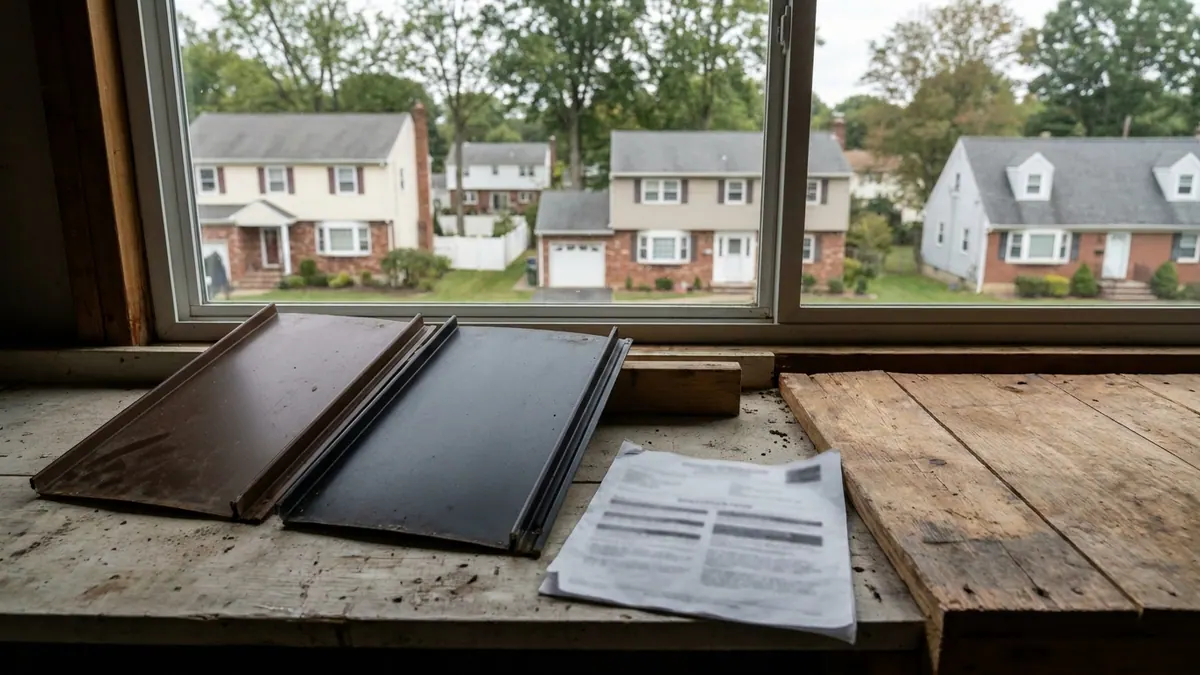
Heavier gauge helps. A 24 gauge panel resists denting better than 26 gauge, and steel takes a step better than aluminum of the same thickness. That is a reason to settle gauge at the estimate stage rather than after the roof is on. The standing seam metal roofing guide covers how the systems are built and what the parts are called.
What walking damage actually looks like
Dents and waviness
A foot placed between supports leaves a shallow dish. On a reflective finish in low afternoon sun, that dish is visible from the street for the life of the roof. Repeated traffic on the same path produces a run of waviness along a panel that no amount of cleaning will remove.
Scratched and scuffed finish
This is the damage that matters most, and it comes from grit in a shoe tread or from dragging a ladder, a toolbox or a bundle of anything across the panel. The paint system is the corrosion protection. Scratch through it on steel and you have exposed the substrate, and on a coastal roof taking salt air that becomes a rust streak.
Crushed seams and loosened fasteners
Stepping on a seam can flatten the fold enough to break the weather seal. On an exposed fastener roof, weight near a screw tips the washer and ends the gasket's seal, which is a slow leak that shows up a year later as a stain on a garage ceiling.
When nobody should be on the roof at all
Stay off a metal roof when any of these are true, and that includes contractors who shrug it off.
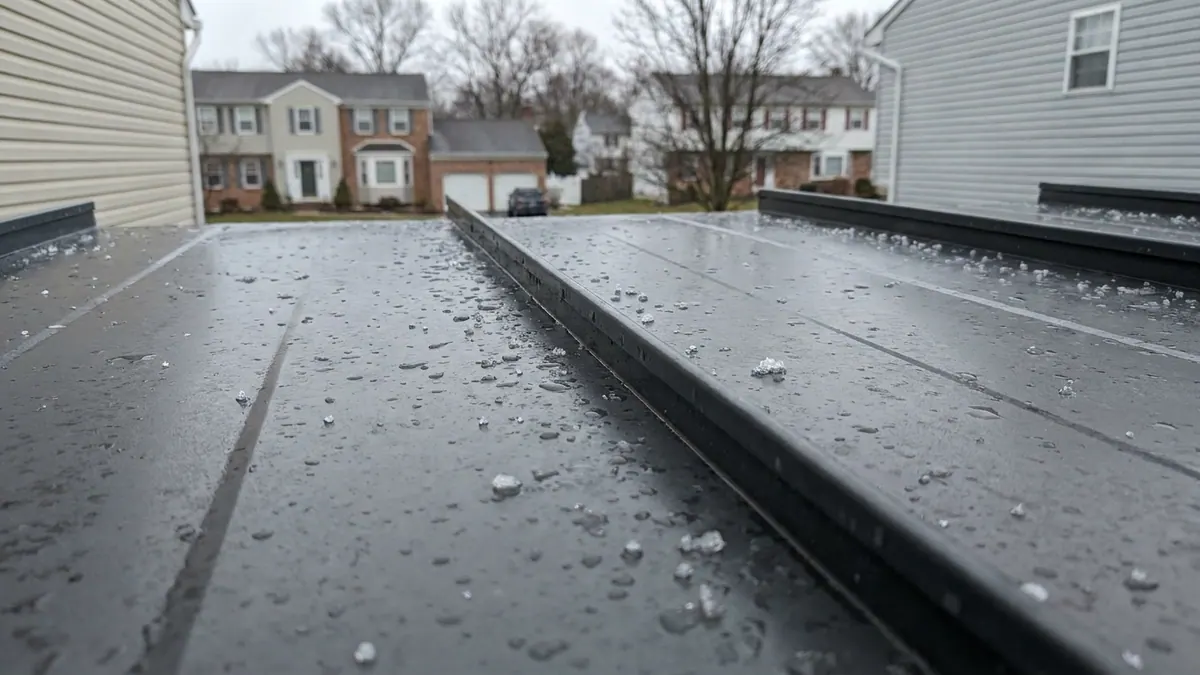
- The panels are wet, frosted, dewy or dusted with snow. Painted metal at a New Jersey pitch is genuinely slick, and frost forms on it on clear mornings well above freezing air temperature.
- The pitch is steep enough that you would need to brace with a hand. Metal gives you nothing to grab.
- There is no fall protection anchor. There is no safe improvised anchor on a standing seam roof.
- There are solar panels, snow guards or a crowded run of penetrations with no clean path between them.
- You are going up to find a leak you have not located. Hunting a leak by walking the field is how most of the dents get made.
What to do instead of walking on it
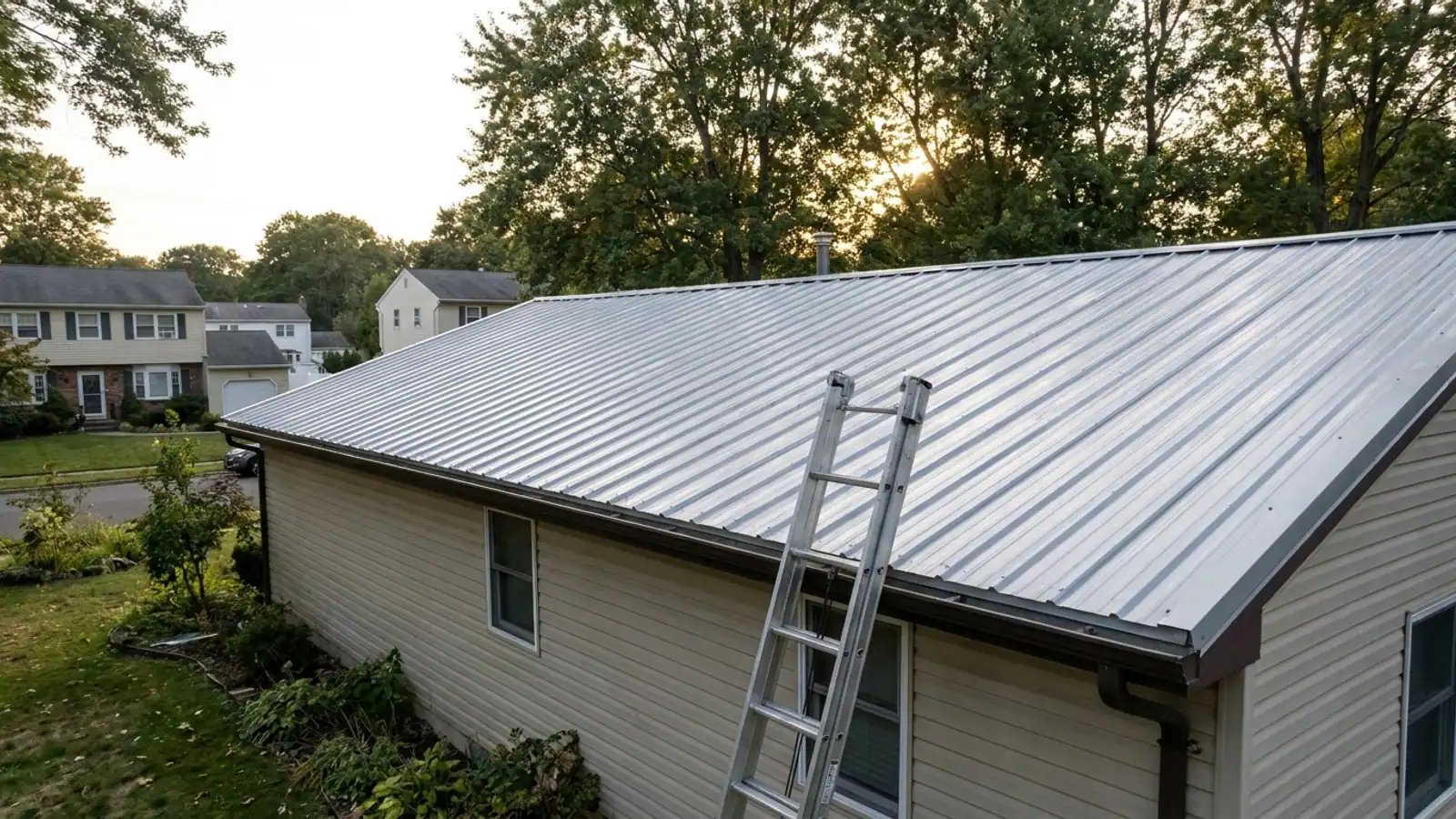
Most inspections of a metal roof can be done without stepping on the panels. From a ladder set at the gutter you can see the eave, the drip edge, the first few feet of panel and the gutter itself. Binoculars from the yard will show you a lifted ridge cap, a displaced trim piece or a boot that has gone brittle. A camera on a pole covers a dormer.
Gutter work is the big one. Clean the gutters from a ladder against the gutter line, not by leaning over the roof edge, and never by standing on the panel overhang. The seasonal gutter maintenance guide spells out the schedule. If debris loads up on a metal roof because the panels shed whatever lands on them straight into the trough, that is normal and it means more frequent cleaning, not a roof problem.
For snow, let it go. Metal sheds snow on its own, which is why snow guards exist above doors, walkways and driveways. Do not climb up with a shovel. A metal shovel on a painted panel does more damage in ten minutes than a decade of weather.
Who does need to walk on it, and how they should
Chimney sweeps, antenna installers, solar crews and roofers all end up on metal roofs. What a careful crew does: soft clean soles, foam or padded roof pads laid down on the traffic path, tools carried in a bucket rather than dragged, weight kept over supports, and no ladder set directly against a panel face. Ask anyone you hire how they plan to protect the finish before they put a ladder up. If the answer is vague, that is your answer.
If a panel does get dented or scratched badly, the repair is usually touch-up paint for the coating or replacing the affected panel. Panel replacement on a concealed fastener roof is not a simple swap because the panels interlock, so it is worth not creating the problem.
If you are still choosing a roof
Foot traffic is a real consideration if your house has a chimney that gets swept, roof mounted equipment, or a service path somebody uses every year. Say so at the estimate. Heavier gauge, solid decking rather than purlins, and a walkable access route planned around the penetrations all get decided before fabrication, not after.
Lightning Construction installs standing seam, metal shingle and panel systems across all 21 New Jersey counties, and metal roofing runs $18,000 to $35,000 in standard-value towns, $28,000 to $55,000 in higher-value towns, and $45,000 to $120,000 on large or luxury homes, with the band set by the municipality's median home value from ACS 2024 five-year estimates. A standing seam roof takes two to four days to install. There is no deposit, nothing is due until the work is finished and you have inspected it, and there are no change orders because the written estimate is the final price. Lightning pulls the permit and attends the municipal inspection under the New Jersey Uniform Construction Code.
If something on your metal roof looks wrong from the ground, do not go check it yourself. Book a free inspection and written estimate. It is no obligation, a salesperson comes to the house, and you get photographs of whatever is up there without putting a dent in your own roof.