Short answer
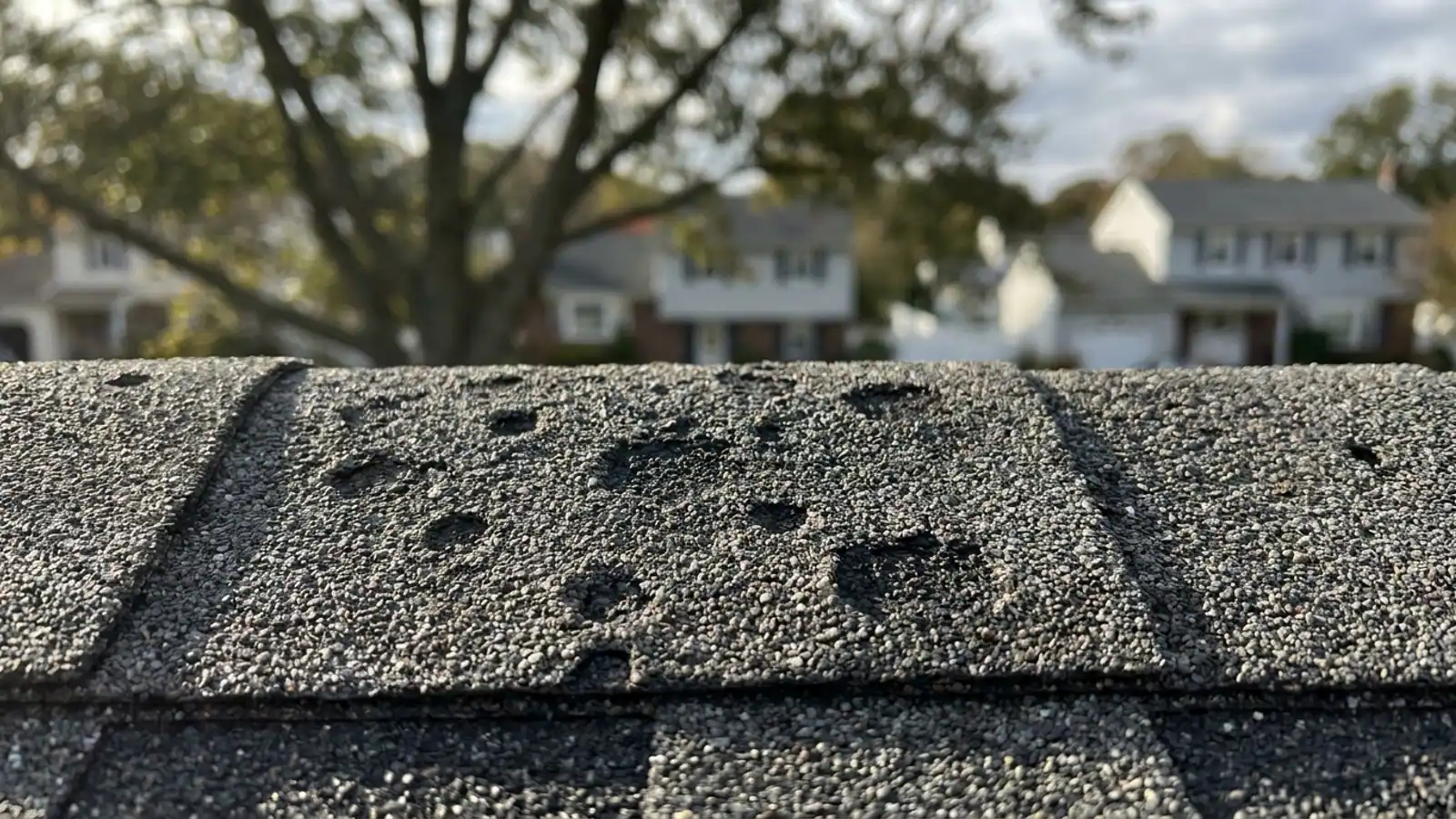
Blisters are small, round, sharp-edged craters that form when gas or moisture trapped inside the shingle expands in heat and pushes out, and they appear scattered evenly over whole slopes. Hail leaves randomly spaced dents with a soft center, no sharp rim, and it almost always marks soft metal nearby such as gutters, vents and flashing. If the only damage is on the shingles and there is nothing on the metal, you are looking at blistering, not hail.
On this page
Blisters are round, sharp-edged pockmarks spread fairly evenly over entire slopes. Hail damage is randomly spaced dents with soft centers, concentrated on the slopes that faced the storm, and it always leaves marks on soft metal nearby. Once you know what each one does to a shingle, telling them apart from a ladder takes about a minute.
This matters because the two lead to completely different conversations. One is a claim. The other is an aging roof and a ventilation question.
What a shingle blister actually is
A blister is a bubble inside the asphalt shingle that opened up. Gas or moisture gets trapped in the asphalt when the shingle is made. On a hot roof, that pocket expands, pushes the surface outward, and eventually breaks through. What is left is a small crater, usually somewhere between the size of a pencil eraser and a dime, with bare black asphalt in the middle and granules still clinging around the rim.
The tells are consistent:
- The edge of the crater is crisp and circular, not pushed in.
- The shingle is not dented. Press on it and it feels the same as the shingle beside it.
- The blisters are scattered across the whole slope, including under eaves and in shaded spots where hail never reaches.
- Blisters appear on south and west slopes first, because those run hottest.
- The mat under the asphalt is intact. Nothing is fractured.
Heat drives it. A roof deck over a sealed, under-vented attic runs much hotter than one with balanced intake and exhaust, and blistering tends to show up sooner on those houses. That is why a blistered roof should always be followed by someone putting a head into the attic. The attic ventilation guide explains what balanced intake and exhaust actually means and why a bathroom fan dumping into the attic ruins it.
What hail damage actually looks like
Hail hits leave a dent, not a bubble. The stone strikes, knocks granules loose in a rough circle, and compresses the asphalt and the fiberglass mat underneath. Run a thumb across a fresh hit and the center gives slightly. On an older shingle, the mat may be cracked under the strike, which is the part that eventually leaks.
The pattern is the giveaway. Hail falls at an angle, driven by wind, so it marks the slopes that faced the storm and leaves the opposite slopes nearly clean. Within a hit slope, the strikes are random. Three inches apart in one spot, two feet apart in another. Blisters do not do that.
Then there is the collateral damage, and this is the single most reliable check a homeowner can do from the ground. Hail big enough to hurt a shingle also marks:
- Gutters and downspouts, which take round dings on the top edge and the front face.
- Aluminum or vinyl roof vents, ridge vent caps and turtle vents.
- Chimney caps, flashing and drip edge.
- The fins on the outdoor air conditioner condenser.
- Window screens, the grill lid, the mailbox and the deck rail.
- Fresh spatter marks, which look like clean spots where oxidation was knocked off painted metal.
If the gutters are smooth and the AC fins are straight and the shingles are covered in round pockmarks, it is not hail.
Blisters vs. hail, side by side
| Shingle blisters | Hail damage | |
|---|---|---|
| Shape | Shingle blistersRound crater, sharp rim | Hail damageDent with soft, compressed center |
| Feel | Shingle blistersFirm, same as surrounding shingle | Hail damageGives slightly under thumb pressure |
| Granules | Shingle blistersLoose around the rim, asphalt exposed in the middle | Hail damageKnocked out of a rough circle, driven into the mat |
| Mat underneath | Shingle blistersIntact | Hail damageCan be fractured |
| Spread | Shingle blistersEven across whole slopes, including shaded areas | Hail damageRandom spacing, worst on storm-facing slopes |
| Slope bias | Shingle blistersHottest slopes, usually south and west | Hail damageWhichever direction the storm came from |
| Metal nearby | Shingle blistersUntouched | Hail damageGutters, vents, flashing and caps dented |
| Timing | Shingle blistersAppears gradually over years | Hail damageAll at once, on a date you can name |
| Usual cause | Shingle blistersTrapped gas and heat, often with a hot attic | Hail damageA single storm |
Why the difference decides what happens next
Hail is sudden accidental damage from a storm. Blistering is a condition of the shingle that developed over time. Carriers treat those two things differently, and an adjuster who climbs up and finds blisters on all four slopes with clean gutters is going to say so. Nobody is doing you a favor by calling blisters hail on a claim form.
If you do have real hail, document it properly before anyone touches the roof. Note the storm date. Photograph the dented gutters and vents from the ground. Keep any repair receipts. The New Jersey storm damage guide covers the first 48 hours, and the roof insurance claim guide walks through filing, the adjuster visit and what to do with a partial approval.
What a real inspection covers
A roofer checking for hail should not stop at the shingles. He marks test squares on each slope and counts hits inside them, checks the soft metals, looks at the ridge cap separately because it takes the worst of any hailfall, and then goes into the attic to look for daylight, staining and fractured sheathing. Photos of all of it, shown to you on a screen before any paperwork comes out.
Does a blistered roof need to be replaced?
Not on its own, and not immediately. An open blister exposes bare asphalt that then weathers faster than the shingle around it. The slope ages quicker and gives up some of its remaining service life. On a roof with eight or ten good years left, that is something to watch, not something to replace.
What changes the answer is how much of the roof is open, how old the shingles are, and what else is failing at the same time. Widespread blistering on a 20-year-old roof that is also curling at the edges, shedding granules into the gutters and showing worn ridge cap is a roof at the end of its life, and blistering is just one of the symptoms. The signs you need a new roof guide lists all ten and is honest about which ones a repair handles.
If you do replace, fix the ventilation in the same job. Putting new shingles over the same hot, dead attic sets the new roof up for the same problem.
What to do about it
- Look at your gutters, downspouts, roof vents and AC condenser from the ground. Dents mean hail. No dents strongly suggests blistering.
- Check whether the marks are on every slope or only the one facing the direction a storm came from.
- If you suspect hail, find the storm date and photograph the metal before any work is done.
- Get the roof inspected rather than guessing from the driveway, and ask for photos of the shingle surface, the flashing and the attic.
- If the answer is replacement, get the full scope in writing, including decking, flashing and ventilation.
Lightning Construction is veteran-owned, GAF Certified, licensed and insured under New Jersey Home Improvement Contractor registration 13VH12437000, and rated 4.9 out of 5 from 264 Google reviews. The inspection and the written estimate are free with no obligation, and a salesperson does come to the house. There is no deposit on any job, nothing is due until the work is finished and you have inspected it, and the written estimate is the final price because extra layers, bad decking and failed flashing are found at the inspection and priced in. Lightning pulls the permit and attends the municipal inspection. Most asphalt replacements are torn off and finished in a single day.
If you want someone to tell you which of these is on your roof, book a free roof inspection and get the photos to go with the answer.