Short answer
The rubber collar on a plumbing vent boot dries out, cracks and splits where it wraps the pipe, and water then runs down the outside of the pipe into the attic. It is one of the cheapest parts on a roof and it almost always fails before the shingles around it do. On a roof with service life left, replacing the boot is a real repair; on a roof being replaced, every boot should be new rather than reused.
On this page
The part that leaks first on most New Jersey roofs is not a shingle. It is the rubber collar around a plumbing vent pipe, and it usually fails a decade or more before the roof covering it sits in does.
Every house has vent stacks coming through the roof: the plumbing vents that let drain lines breathe, plus exhaust pipes for furnaces, water heaters and bath fans. Each one is a hole cut through the sheathing. The thing that keeps water out of that hole is a small flashing with a flexible collar, and the collar is the shortest-lived component on the entire roof.
What a pipe boot actually is
A standard pipe boot is a flat aluminum or galvanized flange, roughly a foot square, with a molded rubber or neoprene cone bonded to the middle. The flange gets nailed to the deck and woven into the shingle courses, so shingles lap over the top half of the flange and the bottom half laps over the shingles below it. The cone slides down over the pipe and its top edge seals against the pipe wall.
That is the whole system. Water hitting the roof runs onto the flange, over the shingles below and into the gutter. Nothing about it depends on caulk when it is installed right.
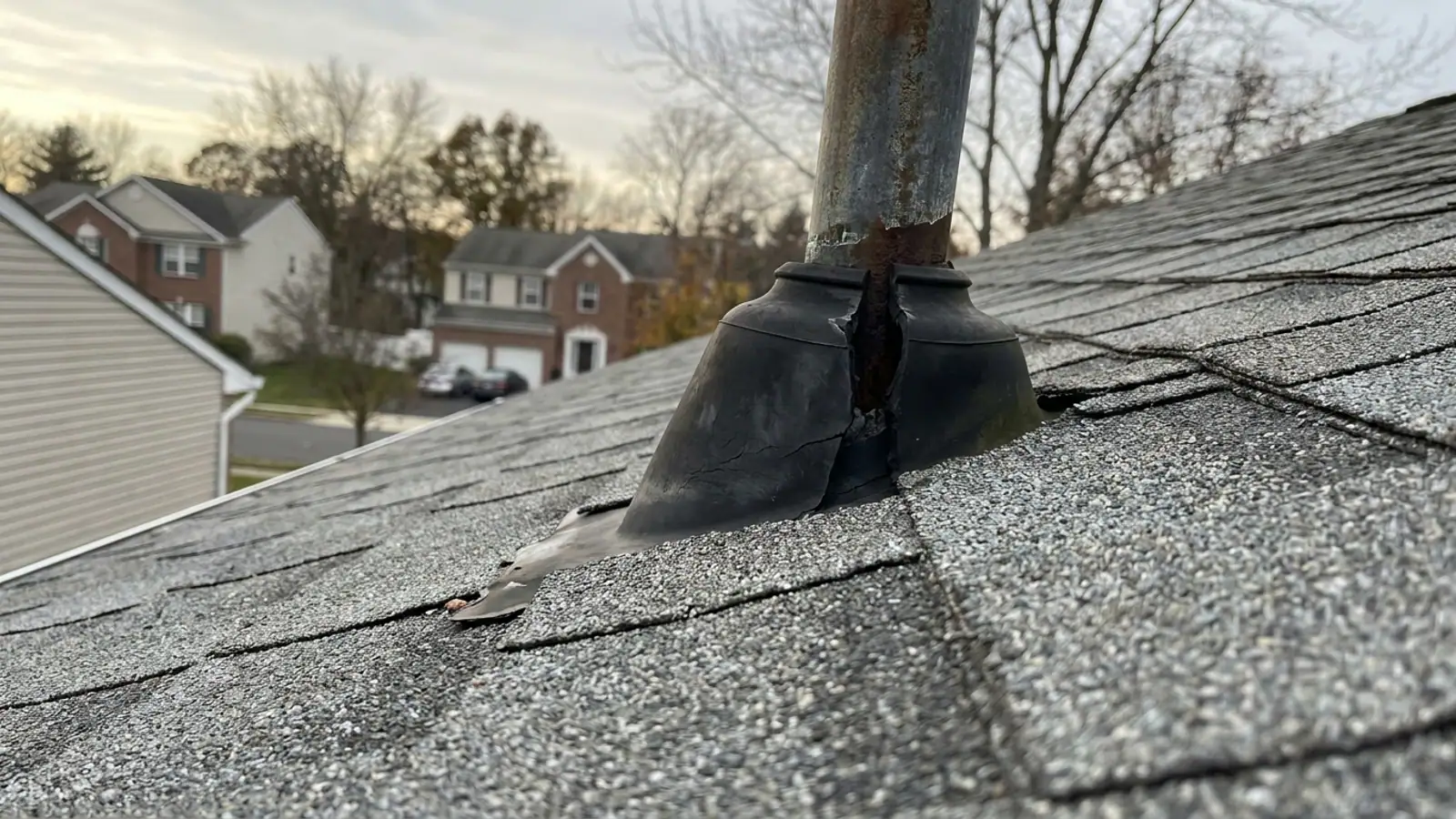
The weak link is the rubber. It sits in full sun, unshaded, at the top of a pipe that gets warm from the inside. Ultraviolet exposure and heat cycling harden it. It loses flexibility, then it splits, and the split almost always runs vertically from the top edge down the cone.
Why the collar fails before the shingles do
Shingles are made to take sun. The granule surface exists specifically to shield the asphalt from UV. A rubber pipe collar has no granules, no shielding and no mass. It is a thin flexible part in the harshest position on the roof.
Three things push it along:
- Sun. South- and west-facing slopes lose boots first, and on the same house you will often find a cracked boot on the front slope and an intact one on the back.
- Movement. The pipe expands and contracts at a different rate than the roof deck, and the collar absorbs that movement every day.
- Animals. Squirrels chew rubber and soft lead. Birds sit on the pipe. A boot that is already brittle tears easily.
By the time you can see a crack from the ground with binoculars, water has usually been getting in for a while. It follows the outside of the pipe down through the deck, runs along the pipe inside the attic and shows up on a ceiling several feet from where the actual hole is.
How to tell a pipe boot is the leak
Start inside, not on the roof.
- Pick a dry day and go into the attic with a flashlight.
- Find every pipe that comes through the roof and look at the sheathing where it passes through.
- A boot leak leaves a dark ring or a chalky white mineral stain on the wood right at the penetration, and the stain runs down the pipe rather than spreading sideways across the deck.
- Feel the framing next to the pipe. Boot leaks are slow and they rot the nearest rafter or the sheathing edge before they ever stain a ceiling.
- Check whether the stain lines up above the ceiling spot you are worried about. It often will not, which is exactly why homeowners chase the wrong slope.
From the ground, look for a collar that is gray and cracked rather than black and tight, or a top edge that has pulled away and left a gap around the pipe. If the crack is visible from a driveway, the boot is well past done.
A leak at a pipe is one item on a longer list. The guide to 10 signs you need a new roof covers which findings mean a repair and which mean the roof is finished.
Boot types, and how long each one holds up
| Type | How it seals | Holds up | Notes |
|---|---|---|---|
| TypeRubber or neoprene collar on metal flange | How it sealsMolded cone stretches over the pipe | Holds upShortest service life of any roof component | NotesThe standard builder part, and the one that cracks |
| TypeLead flashing | How it sealsSoft lead sleeve folded down inside the pipe | Holds upVery long, no UV cracking | NotesAnimals can chew or peck the folded lip open |
| TypeSilicone or EPDM collar with stainless clamp | How it sealsFlexible cone plus a mechanical band at the pipe | Holds upLonger than standard neoprene | NotesClamp can be re-tightened without pulling shingles |
| TypeRetrofit or two-piece collar | How it sealsSlips over an existing flange and clamps down | Holds upDepends on what is under it | NotesFine as a repair when the metal flange is still sound, not a substitute for a failed flange |
There is no single right answer. What matters more than the material is whether the flange is woven into the shingles correctly, because a boot surface-mounted on top of finished shingles and sealed with caulk will leak no matter what the collar is made of.
What a correct replacement looks like
Replacing a boot is straightforward work when it is done properly, and it is not a caulk job.
- The shingles lapping over the top of the old flange are carefully lifted and their nails pulled.
- The old boot is removed whole, and the deck around the penetration is checked for soft or delaminated plywood.
- Any rotted sheathing gets cut back to framing and replaced before anything new goes on.
- The new flange goes down under the upper shingle courses and over the lower ones, nailed at the top corners only.
- The lifted shingles are set back down and resealed so the water path runs over the flange, not under it.
The part itself is one of the least expensive things on a roof. Nearly all of what you pay is access, labor and doing it without damaging the shingles around it, which is why a single boot on an otherwise healthy roof is a repair worth making and four cracked boots on a twenty-year-old roof is a different conversation.
When the boot is telling you something bigger
If the collar is cracked and the shingles around it have lost their granules and the flashing at the chimney is rusted, the boot is not the problem. It is the first thing on a roof that is aging out as a unit. Lightning Construction inspects the whole roof and the attic before quoting anything, and the written estimate is the final price. Extra shingle layers, rotted decking, failed flashing and worn boots are found at the free inspection and priced in, so there is no change order on the day. There is also no deposit, and nothing is due until the work is finished and you have inspected it.
On a full replacement, every boot comes off and a new one goes on. Reusing a boot under a new roof puts a part that is already at the end of its life under a covering meant to last decades, and it is the single most common reason a brand-new roof leaks in its first few years. Ask whether new boots are on the estimate in writing, the same way you would check for drip edge and ice and water shield. The roof warranty guide explains why workmanship coverage, not the shingle warranty, is what covers a detail like this.
Does insurance pay for it
Normally not. A collar that dried out and cracked is wear and tear, and wear is excluded under most New Jersey homeowners policies. If a storm tore the boot open or a falling limb crushed the pipe, that is sudden damage and worth reporting. The roof insurance claim guide walks through how those claims are handled and what an adjuster looks for.
Either way, do not wait on an answer from the carrier while water runs down a pipe into your attic. The rot happens in the framing, out of sight, and it costs more to fix than the boot ever would.
What to do next
If you have a ceiling stain, a musty smell upstairs or a collar you can see cracking from the ground, get eyes on it. Lightning Construction is veteran-owned, GAF Certified, licensed and insured under New Jersey Home Improvement Contractor registration 13VH12437000, and serves all 21 New Jersey counties. The inspection and the written estimate are free with no obligation, and a salesperson does come to the house.
See what is covered under roofing, or book a free estimate and have every penetration on the roof checked at once rather than one leak at a time.