Short answer
A few nail pops on an otherwise sound roof are a repair, and a good roofer can reseat and seal them in an hour. Nail pops spread across multiple slopes are not a repair, because they mean the decking is moving, the nails were wrong or short, or attic moisture is working on the sheathing from below. Exposed nail heads on the shingle field are a separate issue: they are face nails somebody drove through the surface, and every one of them is a hole waiting to leak.
On this page
A handful of nail pops on a roof that is otherwise flat, sealed and holding is a repair. A roofer lifts the shingle, pulls or reseats the fastener, patches the hole in the deck line and reseals the tab. It takes minutes per nail. What makes nail pops worth paying attention to is the pattern. When they show up in rows, across more than one slope, or on a roof that is under ten years old, the nails are telling you something about the decking, the attic or the installation underneath them.
Here is how to tell the two situations apart from the ground, what is actually happening under the shingle, and what a real fix looks like.
What a nail pop on a shingle roof actually is
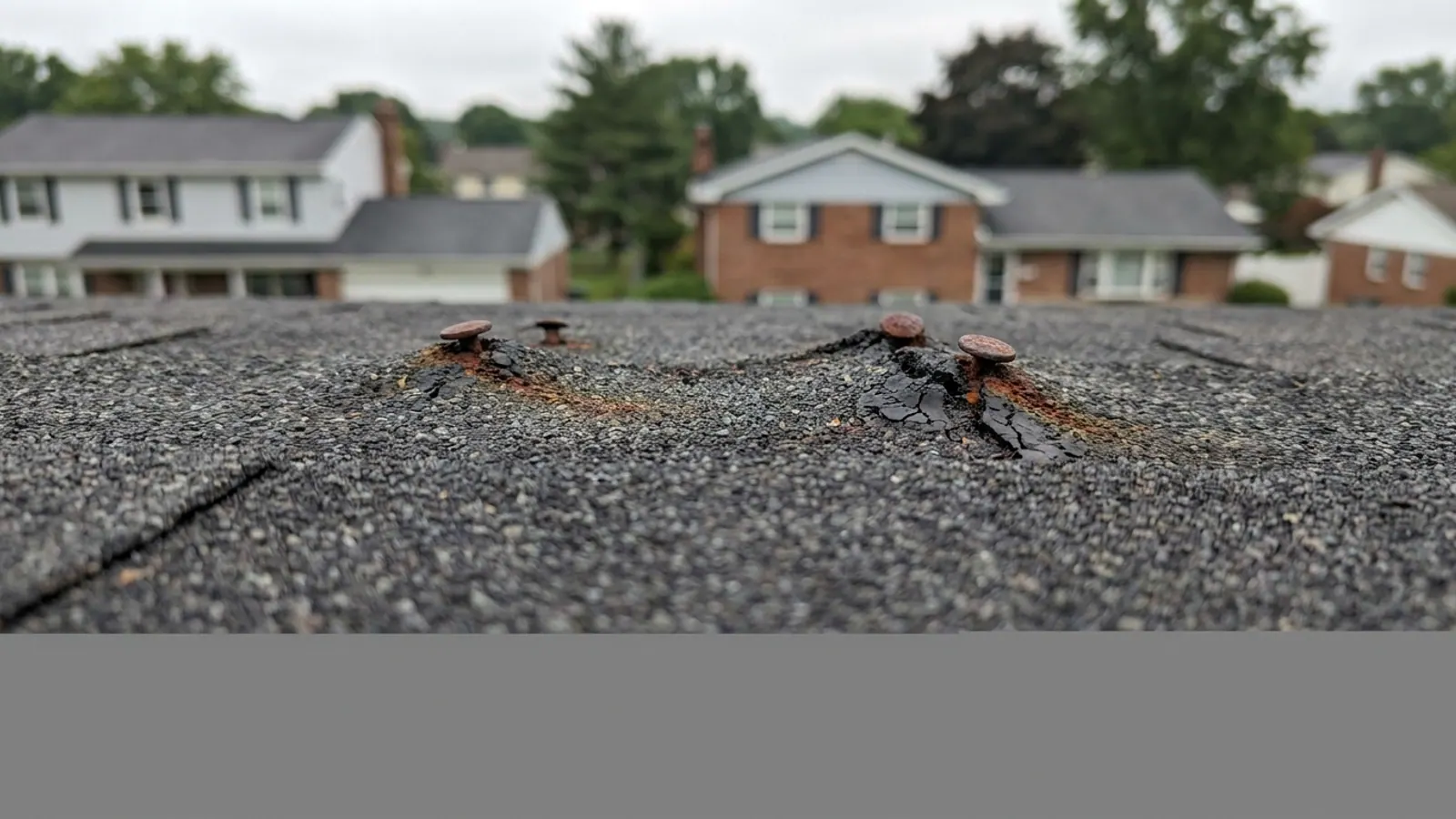
A nail pop is a roofing nail that has backed partway out of the decking and pushed up on the shingle sitting over it. From the street you see a small bump or a tented spot in an otherwise flat course. Up close you often see a rust ring where the head has worn through the granules, and the sealant strip on that shingle has let go.
The nail does not climb out on its own. It is pushed. Wood sheathing swells when it takes on moisture and shrinks when it dries, and that cycle works the shank loose a fraction at a time. Plank decking from the 1950s moves more than plywood. Plywood that has been damp from poor attic ventilation moves more than dry plywood. Over enough seasons the head comes up far enough to lift the shingle above it.
The leak risk is twofold. The lifted shingle has lost its seal, so wind-driven rain gets under it. And the nail hole itself is now an open path through the underlayment.
Exposed nail heads are a different problem
Exposed nail heads are not nail pops. They are fasteners somebody drove through the visible surface of the shingle instead of under the course above it. You find them in a few predictable places.
- Along ridge caps, where a repair crew replaced a cap and face nailed it instead of nesting the fasteners.
- Around a vent boot or a flashing, where someone chased a leak with nails and a dab of roof cement.
- At the rake edge, where a strip was lifting in wind and got tacked down.
- Anywhere a satellite dish, a bracket or a holiday light clip was screwed into the field.
Every exposed fastener is a penetration through the shingle and the underlayment. Sealant over the head buys time, and in New Jersey a few freeze and thaw cycles crack it. By the time the dab has split, the nail has usually rusted and the hole has widened. Face nailing on the field is one of the clearest signs a roof has been repaired by someone who was in a hurry.
The four reasons nail pops happen
The nails were too short or missed solid wood
Roofing nails have to penetrate through the decking or at least three quarters of an inch into it. A nail that stops short, lands on a seam between sheathing panels, or goes in at an angle has almost nothing holding it. These pop early, sometimes within a few years.
The shingles were nailed high
Every shingle has a nail line printed on it. Nailing above that line puts the fastener through only one layer instead of two, and leaves the head sitting in the exposed part of the course rather than under the shingle above. High nails pop and they let wind lift tabs.
The attic is wet
This is the one homeowners miss. Warm moist air from the living space moves into an underventilated attic, condenses on the cold underside of the decking in winter and keeps the wood damp all season. Wet wood swells, dry wood shrinks, the nails walk out. If nail pops are showing up all over a roof, look in the attic before blaming the roofer. The attic ventilation guide covers what balanced intake and exhaust actually looks like on a New Jersey house.
There is more than one layer up there
On an overlay roof the second layer of shingles is nailed through the first. The fasteners have to be longer, and the asphalt underneath gives the shank something soft to work against. Overlay roofs pop nails more than tear-offs do.
Repair or replace: how to read the pattern
| What you see | What it usually means | Likely answer |
|---|---|---|
| What you seeFive or ten pops on one slope, roof under 15 years old, shingles flat elsewhere | What it usually meansIsolated short or high nails | Likely answerRepair |
| What you seeExposed nail heads around one vent or one ridge section | What it usually meansA past repair done badly | Likely answerRepair, redo that detail properly |
| What you seePops in regular rows across two or more slopes | What it usually meansSystemic nailing problem or decking movement | Likely answerReplacement is the honest call |
| What you seePops plus curling tabs plus granule loss in the gutters | What it usually meansThe roof is at the end of its life | Likely answerReplacement |
| What you seePops concentrated on the north slope with attic frost in winter | What it usually meansMoisture in the attic driving the wood | Likely answerVentilation work, then evaluate the roof |
| What you seeDeck feels spongy underfoot near the pops | What it usually meansSheathing has failed | Likely answerReplacement with decking repairs priced in |
If you are weighing the whole roof rather than one defect, the guide on signs you need a new roof walks through the rest of the checklist, including when a repair is genuinely enough.
What a proper nail pop repair looks like
- The roofer gently breaks the sealant bond on the shingle above the pop, usually with a flat bar, working on a mild day so the shingle does not crack.
- The popped nail comes out, or gets driven back down into solid wood if there is solid wood to take it.
- The old hole gets sealed, and a new fastener goes in beside it, through the nail line, into framing or sound decking.
- If the shingle is torn or the head wore a hole through it, that shingle is replaced rather than patched.
- The tab above is hand sealed back down with a small bead of asphalt sealant placed under the shingle, not smeared on top of it.
- For exposed face nails, the fastener comes out, the hole is sealed, and the shingle or cap is replaced so no head is left in the weather.
What a proper repair does not look like: a line of silver sealant painted across the roof, or a fresh nail driven through the surface next to the old one.
How to keep the next roof from doing this
The fix lives in the specification, not in maintenance. On a replacement, ask for these in writing:
- Nailing in the manufacturer's nail line, with the full nail count per shingle for the wind rating you are paying for.
- Fasteners long enough to penetrate the decking fully, with any deteriorated sheathing replaced rather than nailed over.
- A tear-off rather than an overlay, so the nails go into wood instead of old asphalt.
- Balanced attic ventilation sized to the attic, because dry decking holds a nail.
- Ridge caps and flashings fastened so no head is left exposed on the finished surface.
Lightning Construction finds the conditions that drive this work at the free inspection and prices them into the written estimate, including extra shingle layers, damaged decking and flashing that cannot be reused. There is no change order on the day and no deposit, so nothing is due until the job is finished and you have looked at it. Lightning pulls the permit from your municipality's construction office under the New Jersey Uniform Construction Code and attends the inspection. Most asphalt roof replacements are torn off and finished in a single day.
On price, most New Jersey asphalt roof replacements run $9,000 to $22,000 in standard-value towns, $14,000 to $35,000 in higher-value towns, and $25,000 to $60,000 for large or luxury homes. The band comes from the municipality's median home value in the ACS 2024 five-year estimates, not from the number of nail pops on the roof.
What to do next
If you can count the pops from the driveway and the rest of the roof looks flat, get them repaired before winter and check the attic for frost or damp sheathing while you are at it. If they are everywhere, or the roof already has curling, missing tabs or bare spots, stop paying for repairs on a roof that has told you it is finished.
Either way, start with eyes on it. See what Lightning Construction's roofing work covers, or book a free inspection and written estimate. It is free, there is no obligation, and a salesperson does come to the house. You get photos of what is actually on your roof and a price that does not move.