Short answer
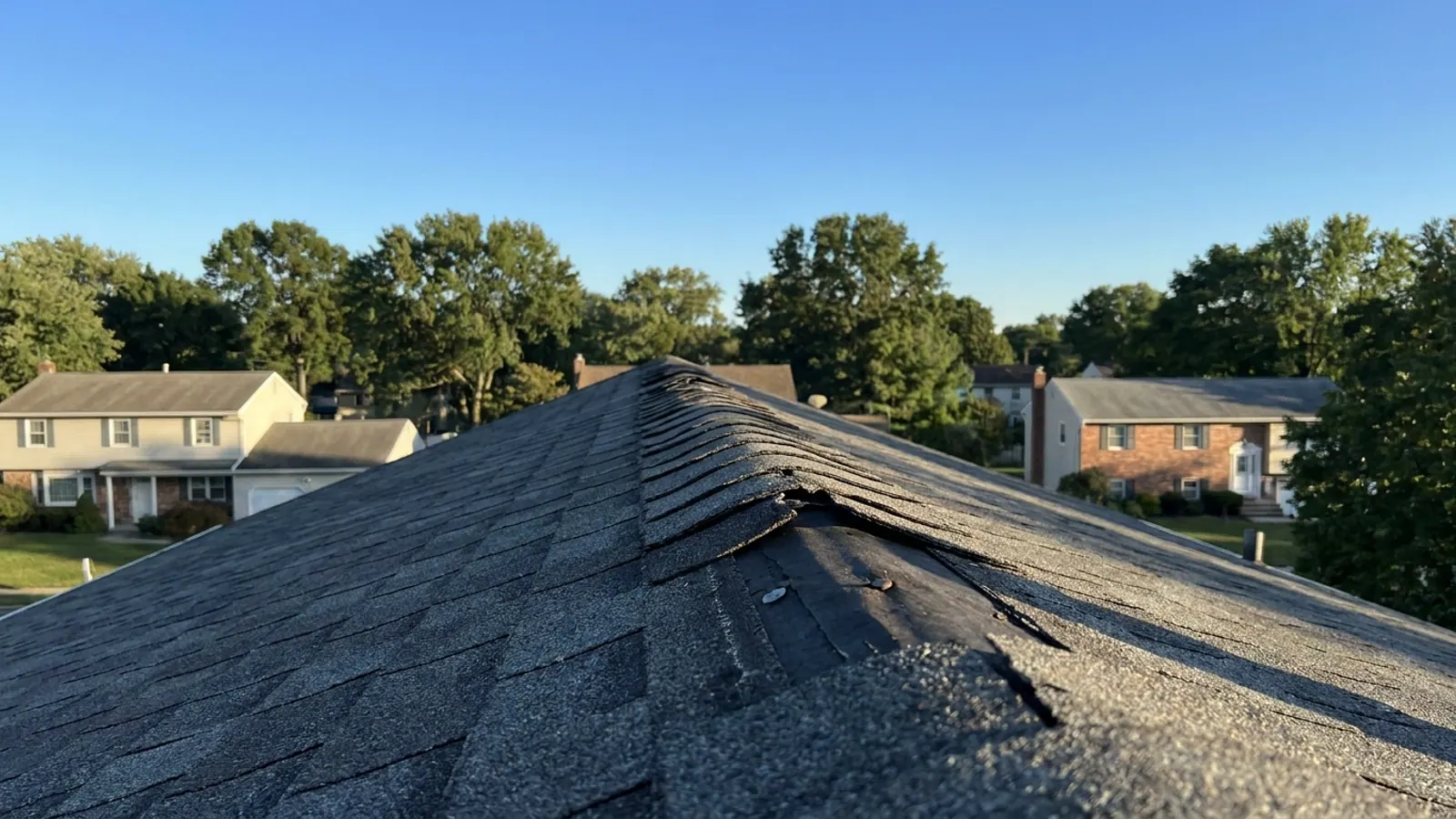
Ridge caps fail first because they are bent over a sharp angle, fully exposed on both sides, and hit by wind from every direction at the highest point on the house. That bend puts the asphalt under permanent tension, so it dries out, cracks and lets go years before the field shingles are worn out. Cut-up three-tab shingles used as caps fail fastest, and on a roof with a ridge vent, too-short nails make it worse.
On this page
- Why ridge cap shingles fail before the field shingles
- What a failing ridge cap looks like from the ground
- Cut-up three-tab caps versus factory hip and ridge
- Ridge caps over a ridge vent: the nail length problem
- Can you replace just the ridge caps?
- What to get in writing on a roof replacement
- What to do next
Ridge caps crack and blow off before the rest of the roof because they live in the worst spot on the house. They are bent over a sharp angle, which puts the asphalt under permanent tension. They are exposed on two faces instead of one, so they bake longer each day. And they sit at the highest line on the roof, where wind hits from every direction and has an open edge to get under.
That is the whole answer. The rest of this explains what the failure looks like, why cut-up shingles used as caps fail fastest, what a ridge vent has to do with it, and when you can replace just the caps instead of the roof.
Why ridge cap shingles fail before the field shingles
Three things are happening at once at the peak.
The bend. A cap shingle is folded over the ridge line, often at a tight angle on a steeper roof. Asphalt does not like being held in a bend for twenty years. As the volatile oils in the asphalt cook off, the mat gets stiff, and the stiffest, most stressed point is exactly where the fold is. That is why you see cracks running the length of the ridge rather than across it.
The heat. Field shingles face one direction. Caps face two, plus the top edge. They get sun earlier and hold it later, and the attic air directly under a ridge is the hottest air in the house. More heat cycles means faster granule loss and faster drying.
The wind. Wind traveling up a roof slope accelerates and separates at the ridge. Every cap has a free edge facing the oncoming wind on one side of the peak, and the sealant strip is the only thing holding that edge down once the asphalt has hardened. One cap lifts, the next one loses its cover, and a short line of them peels off in a single storm.
None of that means the roof is finished. It means the most stressed component on the roof reached the end of its life first, which is normal.
What a failing ridge cap looks like from the ground
You can read most of this from the driveway with binoculars. Look at the ridge line against the sky, which is where the profile shows.
- A wavy or notched silhouette instead of a straight line. That is curled or lifted caps.
- A lighter stripe along the peak. That is granule loss exposing the asphalt underneath.
- A visible gap or a dark slot where one cap is gone and the seam or vent below is showing.
- Caps that look thinner or flatter than the shingles below them, which usually means cut-up three-tab caps on a laminated shingle roof.
- Granules collecting in the gutters after a dry week, with no storm to explain it.
Inside, check the attic on a bright day. Light coming through along the ridge line is either the ridge vent doing its job or a missing cap, and those look different up close. Dark staining on the underside of the sheathing at the peak, or nails at the ridge with rust rings, tells you water has been getting in.
Cut-up three-tab caps versus factory hip and ridge
For decades, the standard practice was to cut a three-tab shingle into three pieces and bend each piece over the ridge. It is cheap, it uses material already on the roof, and it is still done. On a modern roof it is the single most common reason the peak fails early.
| Cut-up three-tab caps | Factory hip and ridge caps | |
|---|---|---|
| Thickness | Cut-up three-tab capsSingle layer, same as a three-tab | Factory hip and ridge capsThicker, made to be folded |
| Behavior at the bend | Cut-up three-tab capsCracks along the fold as it ages | Factory hip and ridge capsBuilt with a pre-scored or thicker bend area |
| Appearance on a laminated roof | Cut-up three-tab capsThin, flat line that does not match the field | Factory hip and ridge capsProfile matched to the shingle line |
| Wind and warranty coverage | Cut-up three-tab capsUsually disqualifies the higher tiers | Factory hip and ridge capsRequired for enhanced coverage |
| Cost on the estimate | Cut-up three-tab capsLower line item | Factory hip and ridge capsHigher line item, small share of the total |
If your roof has architectural shingles and a flat, thin-looking ridge, you almost certainly have cut-up caps. Manufacturers publish which hip and ridge product goes with which shingle line, and using the wrong one quietly drops the roof to a lower coverage tier without anyone telling you. The GAF shingles guide covers how the lines and accessories pair up.
Ridge caps over a ridge vent: the nail length problem
If you have a ridge vent, the caps are not nailed into decking directly. They go through the cap, through the vent material, across the open slot cut in the sheathing, and into the deck on either side of that slot.
That stack is thicker than a plain ridge, and it needs longer nails. Standard-length roofing nails through a ridge vent often catch nothing but vent plastic or a quarter inch of plywood edge. The caps look fine on installation day. Two or three winters later they come off in a line, and the homeowner is told it was an unusual wind event.
Ask what length fastener is being used at the ridge and whether it penetrates solid decking. Ask it before the crew is on the roof. Ventilation itself is a separate decision and the attic ventilation guide explains how intake and exhaust need to be balanced, but the fastening detail at the cap is what keeps the vent on the house.
Can you replace just the ridge caps?
Often, yes. This is one of the repairs where the honest answer is that you do not need a new roof.
Replacing caps alone makes sense when the field shingles still have meaningful life, the decking at the peak is solid, and the caps failed because they were the wrong product or were nailed poorly. It is a contained repair: strip the old caps, check the sheathing along the ridge, replace anything soft, and set new matched caps with the correct nail length and pattern.
It does not make sense when the field shingles are also curling, when granule loss is widespread, or when the ridge is one of several problems on the same roof. Patching the peak on a roof that is twenty-five years old buys a year and costs money you would rather put toward the replacement. The signs you need a new roof guide lays out where that line sits.
The one thing to be clear-eyed about is color. New caps on an old roof will not match. Asphalt weathers, and a fresh cap line reads as a stripe across the peak from the street. That is cosmetic, and most people accept it on a repair, but nobody should be surprised by it afterward.
What to get in writing on a roof replacement
When the caps are going on as part of a full replacement, four items belong on the estimate in words, not implied:
- The specific hip and ridge product by name, matched to the shingle line, not "ridge cap" as a generic line item.
- The fastener length at the ridge, and confirmation that it penetrates the decking.
- Whether a ridge vent is being installed, replaced, or left alone, and the length of the slot.
- Decking repair at the peak, priced before the work starts rather than discovered on the day.
That last one is where most of the friction happens in this trade. At Lightning Construction the free inspection is where extra shingle layers, soft decking and failed flashing get found, and they go into the written estimate. There are no change orders, and there is no deposit. Nothing is due until the work is finished and you have inspected it. Lightning pulls the permit from your municipality's construction office under the New Jersey Uniform Construction Code and attends the inspection, so you file nothing. Most asphalt roof replacements are torn off and finished in a single day.
What to do next
If the ridge line on your house looks wavy, patchy or bare against the sky, get eyes on it before winter. A cracked cap is a small repair. The same cap gone through a February nor'easter, with snow blowing into an open seam over the hottest, most humid part of your attic, is a decking job.
Start with a free inspection and a written estimate with no obligation, and understand that a salesperson does come to the house. You can see what the work covers on the roofing page or request the estimate directly. Lightning Construction is veteran-owned, GAF Certified, licensed and insured under New Jersey Home Improvement Contractor registration 13VH12437000, and works in all 21 counties.