Short answer
An open valley runs a metal liner down the center of the valley with the shingles cut back on both sides, so water hits metal and leaves fast. A closed valley carries shingles across the valley, either woven together or cut along one line, so no metal shows. Both work when they are built right, but on steep New Jersey roofs, roofs that shed onto a valley from a large slope, and roofs that ice up at the eaves, open metal is the more forgiving choice.
On this page
An open valley puts a metal liner down the center where two roof slopes meet, with the shingles cut back a few inches on each side so the metal stays exposed. A closed valley carries shingles straight across the joint, either woven from both sides or cut in a line over the top, so you see nothing but shingles. Both are legitimate. The difference shows up in how each one handles volume, ice and debris, and in how much workmanship it takes to get right.
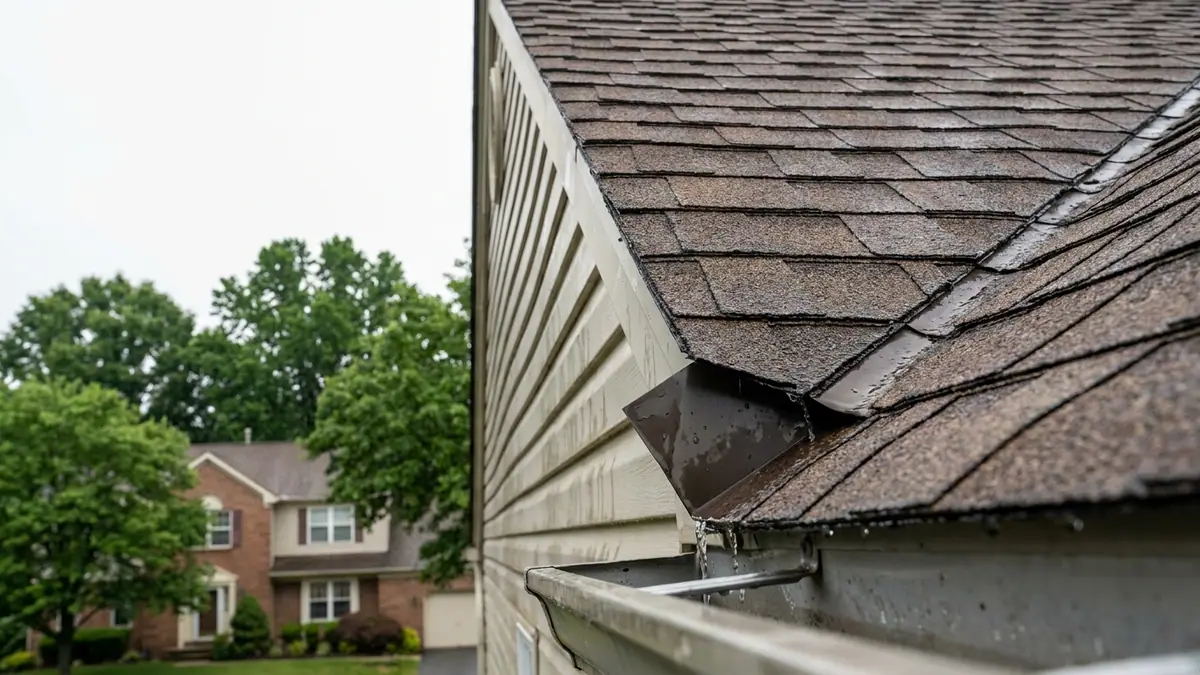
Valleys carry more water than any other part of a roof. Two planes drain into one channel, so a valley moving runoff from a large rear slope is handling several times the water hitting an equivalent strip of open field. That concentration is why valleys and flashing points, not shingle surfaces, are where most roofs fail.
What sits under the valley before any shingle goes down
The valley type is the last decision, not the first. Under either one, the sequence on a properly built New Jersey roof is the same.
- The old shingles and old metal come off and the decking in the valley gets inspected. Valleys are the most common place to find soft plywood, because a valley that has been leaking slowly rots the sheathing under it long before a ceiling stain shows up.
- A self-adhering leak barrier runs the full length of the valley, centered on the joint, stuck directly to clean decking. This is the layer that saves you if water ever backs up.
- Field underlayment goes on over the slopes and laps onto the valley barrier, never under it.
- On an open valley, the metal liner is set into the valley and fastened only along its outer edges, so no nail sits in the water path.
- Shingles are cut and set to the layout the valley type calls for.
If a quote does not mention step 2, ask about it. A valley without a leak barrier under it is one ice event away from a problem, and ice at the eaves feeding back into a valley is a specific New Jersey failure — the ice dam guide covers how that backup happens.
Open valleys: metal in the middle
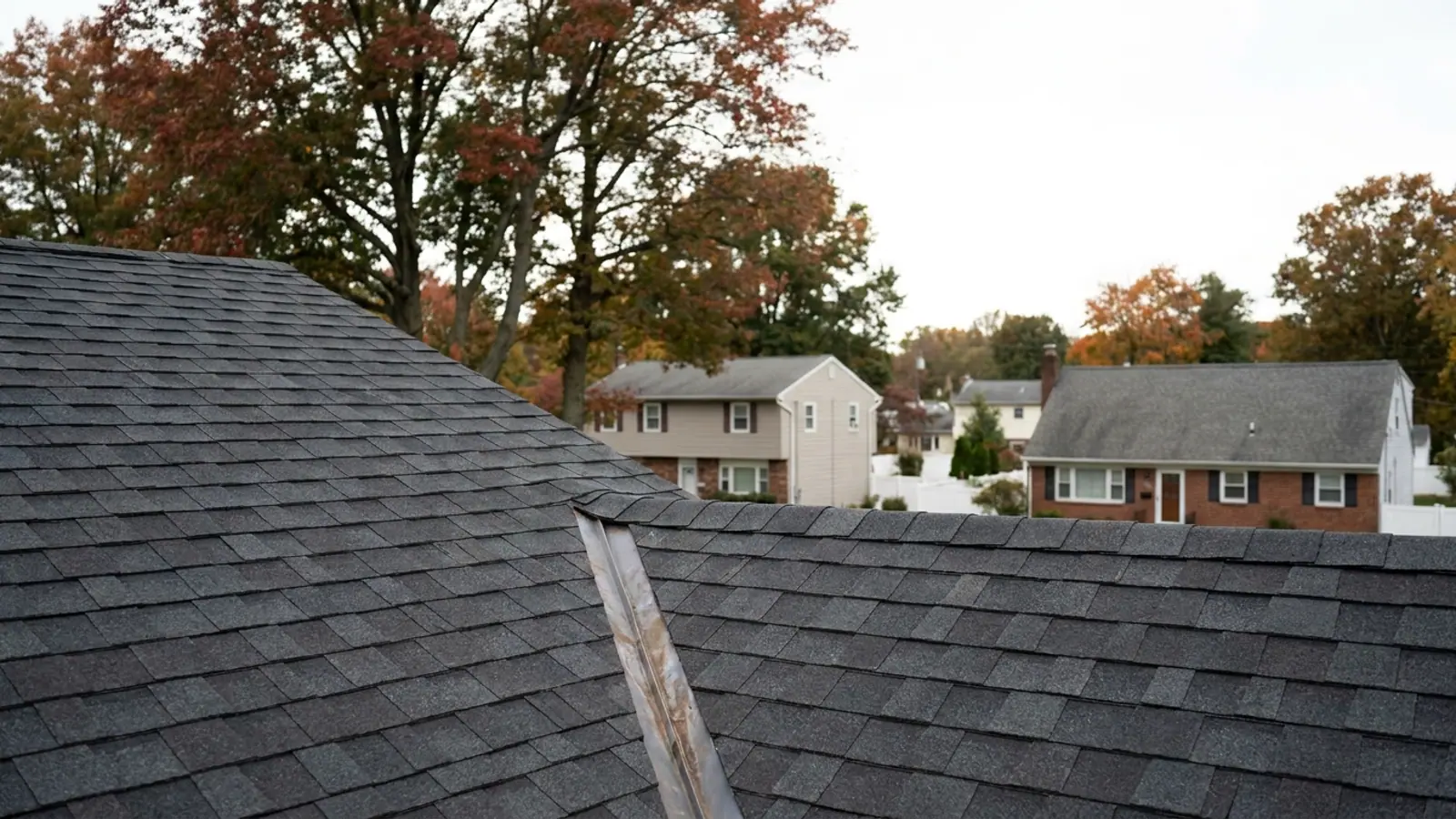
An open valley uses a preformed metal liner, usually aluminum, galvanized steel or copper, often with a small raised rib down the center to keep water from crossing under the shingles on the other side. The shingles stop short on both sides and the cut edges are clipped and sealed.
What it does well: water leaves fast, on a hard smooth surface that does not hold anything. Pine needles, maple seeds and roof grit wash out instead of packing into the granules. Snow and ice release earlier from metal than from shingle. And because no shingle edge lies in the flow path, there is nothing for water to work sideways under.
The trade-offs are real. The metal is visible, so the color choice matters and a mismatched liner looks wrong from the street. The cut lines have to be straight and parallel or the roof looks sloppy from fifty feet away. And a thin, cheap liner will oil-can and dent.
Closed valleys: shingles all the way across
A closed valley hides the joint. There are two ways to build one.
Woven valley
Shingles from both slopes alternate across the valley, each course overlapping the other. It is fast and it leaves a continuous shingle surface. It also forces every woven shingle to bend through the valley angle, which is hard on stiff, thick architectural shingles and can leave a shingle bridging instead of lying flat. Most manufacturers of laminated architectural shingles do not want them woven at all.
Closed-cut valley
One slope runs its shingles fully through the valley and up onto the other side. The second slope is then cut in a clean line a couple of inches off the center, and that cut edge is sealed. This is the standard closed detail on most New Jersey roofs and it works well when the roofer runs the larger, higher-volume slope underneath and cuts the smaller one on top. Reversing that puts the cut edge in the path of the heaviest flow.
Open vs. closed valleys compared
| Open metal valley | Closed-cut valley | |
|---|---|---|
| Water path | Open metal valleyBare metal, nothing in the way | Closed-cut valleyOver shingle granules and one cut edge |
| Debris | Open metal valleyWashes through | Closed-cut valleyCollects against the cut line |
| Ice and snow | Open metal valleySheds sooner | Closed-cut valleyHolds longer |
| Look | Open metal valleyMetal stripe, must be color-matched | Closed-cut valleyUninterrupted shingle |
| Install difficulty | Open metal valleySlower, cut lines must be exact | Closed-cut valleyFaster, but the layering order matters |
| Cost | Open metal valleySlightly higher | Closed-cut valleySlightly lower |
| Common failure | Open metal valleyFasteners placed in the water path | Closed-cut valleyWater crossing under the cut edge |
Which one belongs on your roof
Go open metal when any of these apply: a large slope drains into a short valley, the pitch is steep enough to move water fast, trees drop heavily onto that side of the house, the valley ends over a doorway or a walkway, or the roof has a history of ice at that eave. Go closed-cut when the valleys are short, the drainage areas on both sides are similar, the shingle is a laminated product the manufacturer wants cut rather than woven, and the appearance of a metal stripe is not wanted.
One more case decides itself. Where a valley dumps into a low-slope or flat section, or where two dissimilar roof systems meet, the detail needs metal. Shingle-on-shingle at a slope transition is not a detail to improvise.
Shingle line matters here too, because the weight and stiffness of the product changes what can be woven and what has to be cut. The GAF shingles guide covers the lines and what their warranties cover; installation that does not follow the manufacturer's instructions is the fastest way to void the material side of a warranty, and the warranty guide explains where workmanship coverage picks up.
What the estimate should actually say
A valley is a line item, not an assumption. Before you sign, the written estimate should state:
- The valley type — open metal, closed-cut, or woven — for every valley on the house, not just "valleys as needed."
- The liner material and gauge if it is open, and the color.
- That a self-adhering leak barrier runs the full length of every valley.
- That the valley decking will be inspected and any rotted sheathing replaced, with that price already included.
- Whether old valley metal is being removed or reused. Reused valley metal under new shingles is one of the reasons a low bid is low.
That last point is where change orders normally get born. Lightning Construction does not write them. The free inspection is where extra shingle layers, soft decking and worn-out valley metal get found, and those conditions are priced into the written estimate, which is the final price. There is no deposit either — nothing is due until the work is done and you have looked at it. Lightning pulls the permit from your municipality's construction office and attends the inspection under the New Jersey Uniform Construction Code, so you file nothing.
Signs the valley you have is already failing
Stand at the bottom of the valley and look up. Shingle edges lifting along the cut line, granules stripped bare in a stripe down the center, metal that is pitted through or has fasteners driven straight through the middle of the pan, debris packed in a wedge halfway up, or a rust line where two different metals were put in contact — any of those means the valley is at or near the end of its service. Inside, look at the ceiling and attic sheathing directly below the valley line for staining that runs, rather than a round spot.
A single failing valley on an otherwise sound roof is worth repairing. A failing valley on a roof that is also curling, shedding granules into the gutters and out of warranty is a replacement conversation.
Next step
Get the valleys looked at before you compare bids, and get the type written down. Lightning Construction is GAF Certified, licensed and insured under New Jersey Home Improvement Contractor registration 13VH12437000, and rated 4.9 out of 5 from 264 Google reviews. Most asphalt roof replacements, valleys included, are torn off and finished in a single day. See what is covered under roofing, or book a free inspection and written estimate — it costs nothing, there is no obligation, and a salesperson does come to the house.