Short answer
A roof vent almost never leaks through its opening. It leaks at the metal flange around it, at the nails holding that flange down, or at the deck opening that was cut too large or in the wrong place. Find the failure point first, because sealing the louver face does nothing and buys you another winter of water in the attic.
On this page
A roof vent almost never leaks through the vent. It leaks at the sheet metal flange around its base, at the nails driven through that flange, or at the hole cut in the decking underneath it. The louvers, the turbine blades and the fan grille are not the problem. Chasing them with a tube of sealant is the most common wasted afternoon in New Jersey attics.
Here is what actually fails on each of the three vent types, how to tell which one is wetting your insulation, and when it is worth repairing versus replacing with the roof.
Where a roof vent actually leaks
Every roof-mounted vent is a hole in your deck with a metal collar over it. That collar, the flange, has to be layered into the shingles the same way any other flashing is: the upslope edge tucked under the course above, the downslope edge lapped over the course below, and the sides woven in. Water coming down the slope has to run over the top of the flange and back onto shingles.
Four things break that.
- The flange was installed on top of the shingles all the way around, then caulked. Water runs down the slope, hits the raised upslope edge, and goes under it.
- Nails were driven through the exposed upslope portion of the flange instead of under the shingle course. Every one of those nails is a hole in the water path.
- The deck opening was cut larger than the vent throat, so part of the hole sits outside the flange's protection.
- The sealant that was substituted for correct lapping has shrunk, cracked and pulled away from the metal, which is what sealant does after a handful of New Jersey freeze-thaw cycles.
If a vent is leaking on a roof that is otherwise sound, one of those four is almost always the reason.
Box vents: the quiet failure
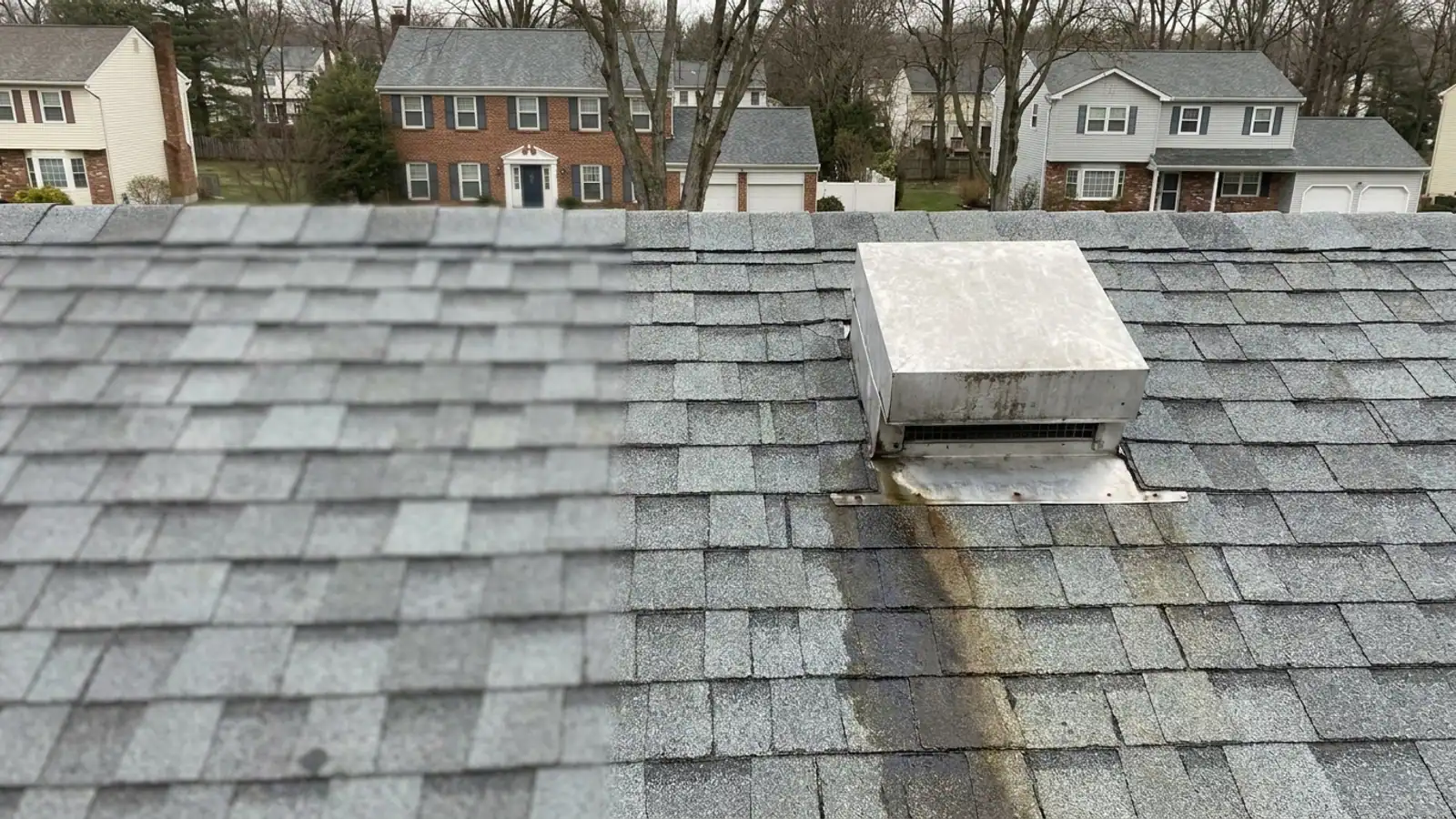
Box vents, also called louvered vents or static vents, are the low square or rectangular aluminum boxes you see in a row near the ridge. They have no moving parts, so homeowners assume they do not fail. They fail at the edges and at the fasteners.
What to look for:
- Rust streaks or a dark stain on the shingles directly below the vent, which is often visible from the ground with binoculars.
- Nail heads sitting proud of the upslope flange with a crumbly ring of old sealant around each one.
- A dented or bowed flange from someone stepping on it, which lifts the metal off the shingles and opens a gap.
- Screened openings packed with wasp nest material or wind-blown leaf litter, which backs water up behind the baffle.
Box vents are also the ones most often damaged during a tear-off and then reinstalled anyway. A flange that already has a dozen nail holes in it has no business going back on a new roof.
Turbines: the base, not the spinning part
A turbine, the spinning aluminum head, draws air out of the attic as wind turns it. The head itself is rarely the leak. Two things are.
The first is the base flashing, which has the same failure modes as a box vent. The second is the bearing. When a turbine's bearing seizes or goes dry, the head stops spinning, wobbles under load, and works the whole unit against its base. A wobbling turbine loosens fasteners and opens the seam between the head and the flashing collar. A turbine that squeals, grinds or sits still on a windy day is on its way out.
If you are replacing a seized turbine anyway, that is the moment to rethink the ventilation layout for the whole roof rather than bolting the same thing back down. The attic ventilation guide covers how intake and exhaust have to balance, and why mixing exhaust types on one attic can short-circuit airflow.
Power fans: three separate problems
A powered attic fan adds a motor, a housing with a larger deck opening, and electrical wiring to everything above.
The motor is the first thing to go. When it fails, the fan becomes a large static vent with a wide throat and no baffle, which is worse at shedding wind-driven rain than a purpose-built box vent. Owners often do not know the motor has stopped, because nothing about a dead attic fan is audible from the living room.
The housing is the second. A power fan has a bigger dome and more sheet metal to flex, and the fasteners holding it down see more movement than those on a static vent.
The third is the thermostat or humidistat housing, usually mounted on the rafter inside with a wire run up through the deck. A sloppy install can leave that wire penetration unsealed, which is a leak path independent of the vent.
How to tell which vent is leaking
Go into the attic on a dry day with a bright flashlight before you call anyone. You are looking for the top of the trail, not the bottom.
- Find the stain on the ceiling or insulation, then look straight up at the underside of the deck.
- Trace the dark or discolored sheathing uphill. Water runs down rafters and along the deck, so the entry point is always at or above the highest stain.
- Look specifically at the perimeter of each vent opening. Rusted nail shanks, blackened plywood edges or a white mineral crust at the cut edge means water has been coming through there for a while.
- Note whether the wood is soft. Soft, delaminated decking around a vent opening gets cut out and replaced, which is why that opening needs to be seen before anyone prices the job.
- Check the date and weather of each appearance. Wetness that shows up on cold, clear days instead of during rain is condensation, not a leak.
After a storm, do the same walk-through before assuming the vent was the original problem. A lifted or missing vent cap is a classic wind casualty, and the storm damage guide walks through what to document and when to involve your insurer.
Repair, or replace it with the roof
| Box vent | Turbine | Power fan | |
|---|---|---|---|
| Usual leak source | Box ventFlange nails, failed sealant | TurbineBase flashing, worn bearing | Power fanHousing fasteners, wire penetration |
| Moving parts | Box ventNone | TurbineHead and bearing | Power fanMotor, bearing, control |
| Warning sign you can hear | Box ventNone | TurbineSqueal, grind, no spin in wind | Power fanSilence when the attic is hot |
| Repairable in place | Box ventUsually, if shingles are pliable | TurbineUsually | Power fanOften, motor separate from flashing |
| Reuse on a new roof | Box ventNo | TurbineNo | Power fanNo |
The honest answer on a roof with ten or more good years left is to repair the vent. The crew pulls the shingle courses above it, removes the vent, inspects and repairs the deck, sets a new vent, and weaves the courses back in. Sealant is used where the manufacturer calls for it and nowhere else.
If the shingles around the vent crack when they are lifted, or granule loss has the mat showing through, a repair will create more damage than it fixes. At that point you are looking at the roof, not the vent. The signs you need a new roof guide sets out where that line sits.
What happens when vents go on with a new roof
On a replacement, every vent comes off and new ones go on. Old vents are dented, pre-drilled and the wrong age for the roof around them. The deck opening is re-cut clean to the manufacturer's dimension, the flange is layered into the courses, and the fastening follows the vent maker's instructions rather than the installer's habit.
Two Lightning policies matter here. Rotted decking around a vent opening is found at the free inspection and priced into the written estimate, so it does not become a change order on the day. And nothing is due until the work is finished and you have inspected it. Lightning pulls the permit from your municipality's construction office under the New Jersey Uniform Construction Code and attends the inspection, in every town. You file nothing.
If the stain only shows up in deep winter, read the ice dam guide before replacing any vent. Water backing up under shingles from an ice dam can appear at a vent opening simply because that is the nearest hole in the deck.
What to do next
Get the vent looked at before the next freeze. A small, long-running vent leak rots sheathing, soaks insulation and loses it most of its value, and shows up on the next buyer's home inspection. Lightning Construction inspects the roof surface, the flashing points and the attic, photographs what is found, and gives you a written estimate at no cost with no obligation — a salesperson does come to the house, and that visit is free.
See what is covered on the roofing page, or book the free inspection and have someone up there with a camera this week.