Short answer
Look at the point where the garage roof runs into the second-story wall before you look anywhere else, because that junction and the kickout flashing at the bottom of it cause most leaks over a garage or bonus room. After that, check any low-slope section of the garage roof and the gutter at the transition. The stain on your ceiling is almost never directly below the hole.
On this page
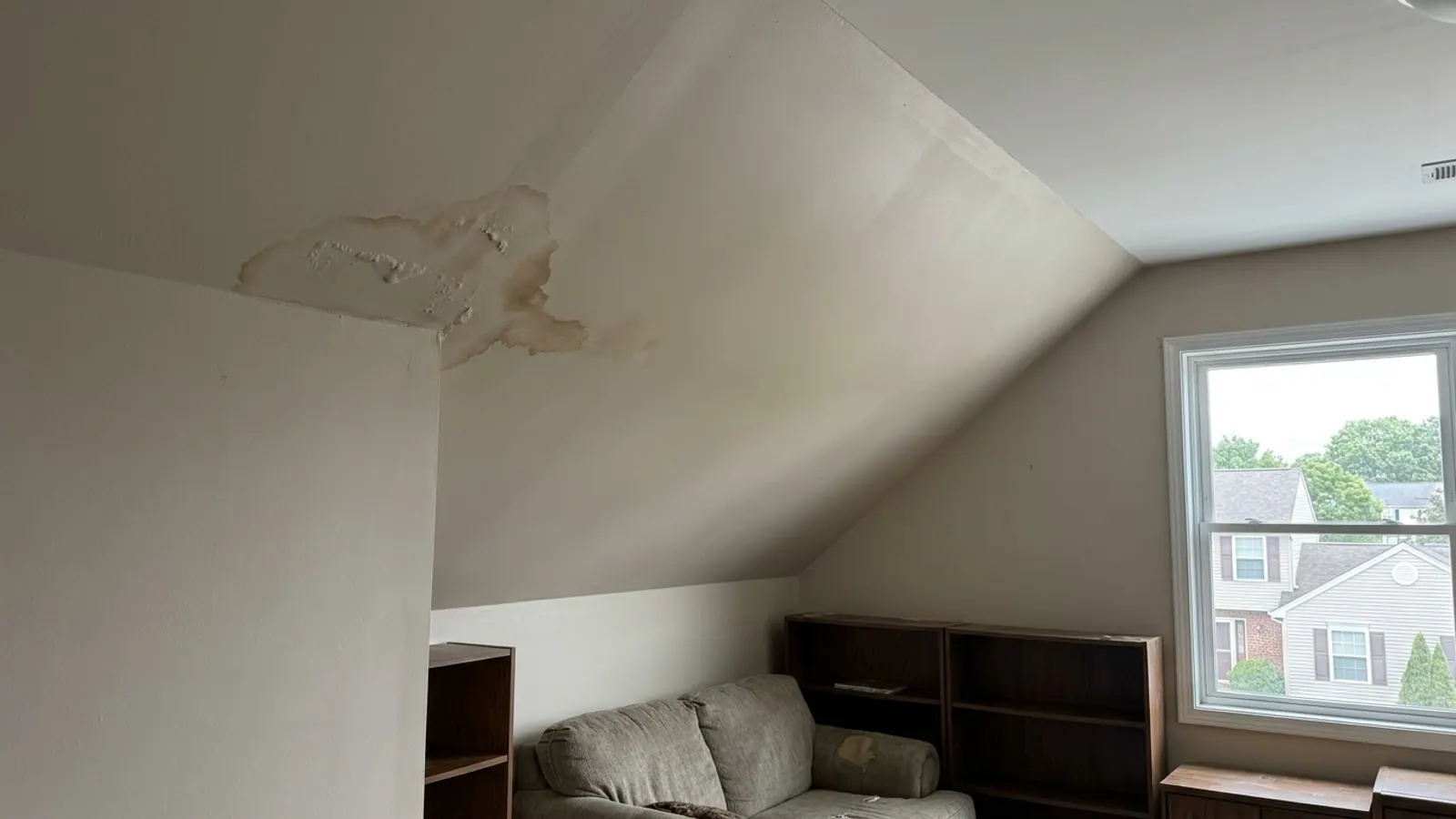
Start at the wall. On a finished garage or a bonus room over a garage, the leak almost always begins where the lower roof runs into the second-story wall above it, and the water travels sideways and downward inside the wall before it shows on your ceiling. The stain you are looking at is where the water stopped, not where it got in.
This is one of the few leaks in a New Jersey house that is genuinely predictable. The geometry is the same on split levels, colonials with an attached garage, and any house with a bonus room over the bays. A roof plane ends against a vertical wall. That junction is sealed by flashing, and flashing is the part that gets rushed, reused or left out.
The roof-to-wall junction above the garage
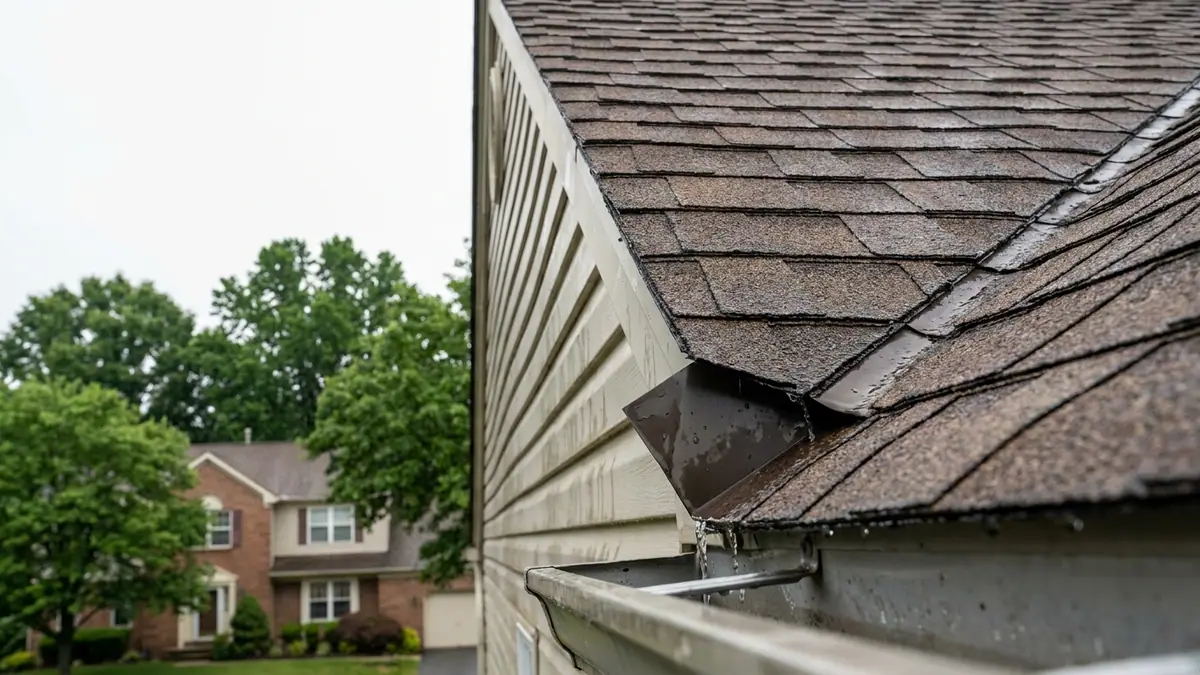
Where the garage roof meets the house wall, there should be step flashing: individual L-shaped metal pieces, one per shingle course, each lapped over the one below and running up behind the siding or housewrap. Caulk is not flashing. A continuous strip of aluminum bent into the corner is not step flashing either, and it fails as soon as the joint moves.
What goes wrong:
- The old step flashing was reused on the last roof instead of replaced, so the nail holes and the bends no longer line up with the new courses.
- The siding was installed tight to the roof instead of held up off it, so water wicks behind the bottom course of siding and never reaches the shingles.
- The flashing runs up behind the siding but the housewrap was lapped the wrong way over it, which sends water inside the wall instead of out onto the roof.
From the ground you cannot see any of this. From a ladder at the end of the garage roof you can see most of it. That junction line is the first thing a roofer should photograph.
Kickout flashing at the bottom of the line
At the very bottom of that roof-to-wall run, where the roof edge meets the gutter, there needs to be a kickout: a piece of flashing bent out at an angle to push water away from the wall and into the gutter. Leave it off and every gallon that runs down that junction dumps straight behind the siding at the corner.
A missing kickout is the single most common cause of rot in the wall next to a garage roof. It shows up as a stain at the corner of the bonus room ceiling, soft trim at the bottom of the siding, or peeling paint on the inside of the garage wall below. If you have a repeat leak in the same corner after two repairs, look here.
Low-slope sections of the garage roof
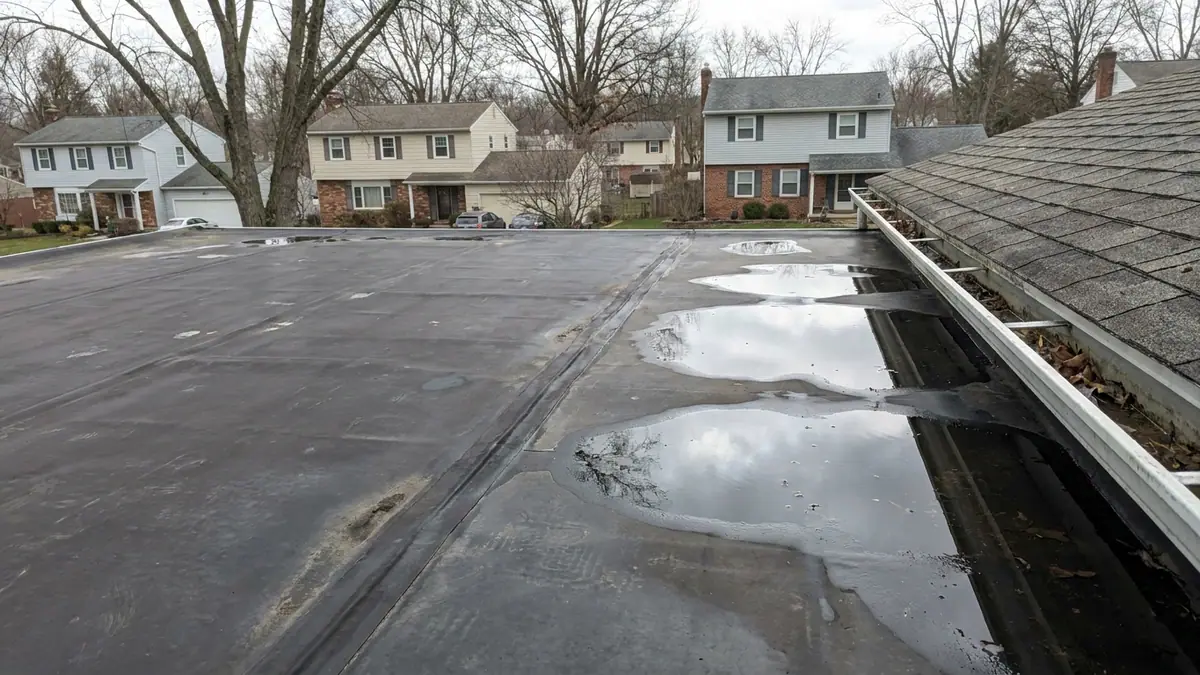
Garage roofs often run flatter than the main roof, especially where a bonus room dormer eats into the plane or where the roof extends out over a porch. Asphalt shingles are not a low-slope product. Below about 2:12 they are not an acceptable covering at all, and between 2:12 and 4:12 they require doubled underlayment to be installed correctly.
If a previous contractor shingled a section that should have been membrane, it will leak in wind-driven rain and in melting snow, and no amount of sealant fixes it. The correct repair is a proper low-slope system on that section, tied into the shingles above with a real transition detail. The guide to flat and low-slope roofing in New Jersey covers what those systems are and where each belongs.
Ice dams over a heated bonus room
A bonus room over a garage is heated. The garage below it is not. That combination produces ice dams in a way a plain attic often does not, because the finished ceiling has insulation packed against the roof deck with no air channel above it, and the heat pushes straight through.
Snow melts over the warm room, the water runs down to the cold overhang past the exterior wall, and it freezes into a ridge. The next melt backs up under the shingles. Ice and water shield at the eaves is the defense, and on a bonus room it should run well past the interior wall line, not the minimum strip. Ventilation is the other half of the answer. The ice dam guide explains how the cycle works and what actually stops it.
Condensation that is not a leak at all
Some bonus room stains have nothing to do with rain. If the ceiling cavity has no intake at the soffit and no exhaust at the ridge, warm indoor air condenses on the cold underside of the deck and drips back through the drywall. The clue is timing: it appears in cold weather, not after storms, and it often shows as a general dampness or a row of small stains rather than one running drip.
This is a ventilation problem and it is fixed with ventilation, not with sealant on the roof. Read the attic ventilation guide before anyone sells you a roof repair for it.
Match the symptom to the source
| What you see | Most likely source |
|---|---|
| What you seeStain at the corner where ceiling meets the exterior wall | Most likely sourceMissing kickout flashing at the bottom of the roof-to-wall line |
| What you seeStain along the whole length of the ceiling-wall joint | Most likely sourceStep flashing reused, caulked or buried behind siding |
| What you seeLeak only in heavy, wind-driven rain | Most likely sourceLow-slope section shingled, or siding set tight to the roof |
| What you seeLeak only during a thaw after snow | Most likely sourceIce dam over the heated room, thin ice and water shield |
| What you seeDamp ceiling in cold weather with no storm | Most likely sourceCondensation from a sealed, unvented ceiling cavity |
| What you seeWater at the front wall above the garage door | Most likely sourceGutter overflowing or back-pitched at the transition |
How to trace it without guessing
- Note the weather that triggers it. Storm, wind direction, thaw or cold snap narrows the list before anyone gets on a ladder.
- Photograph the stain and date it, then photograph it again after the next rain to see whether it grew.
- Look at the outside corner where the garage roof meets the wall. Check for a kickout, for siding resting on the shingles, and for staining or soft trim below.
- Open the gutter at that corner and confirm it is clear and pitched toward a downspout. Water sheeting over a blocked gutter runs straight back into the wall.
- If the bonus room has an access hatch or a knee wall door, open it and look at the sheathing with a flashlight. Dark streaks show the path.
- Get a real inspection with photos before you authorize any work.
What to get in writing
Ask for photos of the flashing, not a description of it. Ask whether the fix is new step flashing and a kickout or a sealant repair, and if it is sealant, ask how long that is expected to hold. Ask whether the siding has to come off at the junction, because on most of these it does, and that should be in the written price rather than discovered later.
At Lightning Construction the inspection and the written estimate are free with no obligation, and a salesperson comes to the house. The conditions that normally trigger a change order on a job like this, extra shingle layers, rotted decking behind the wall, flashing that cannot be reused, are found at that inspection and priced into the quote. The written estimate is the final price, there is no deposit, and nothing is due until the work is finished and you have inspected it. Lightning pulls the permit and attends the municipal inspection under the New Jersey Uniform Construction Code.
If the shingles above the bonus room are near the end of their life, do the flashing as part of the replacement rather than twice. Most asphalt roof replacements are torn off and finished in a single day. See the roofing page for what is included, or book a free inspection and have someone put a ladder on that corner before the next storm.