Short answer
A letter about roof age is an underwriting decision, not a claim, so the carrier is telling you it will not keep insuring the roof as it is. Read it closely to see whether it is a non-renewal, a conditional renewal with a deadline, or a switch to actual cash value on the roof only. Then get an independent inspection with photos, because age and condition are not the same thing and a documented sound roof sometimes changes the answer.
On this page
- The three letters carriers send about roof age
- Why carriers act on roof age at all
- Age and condition are not the same thing
- What to do in the response window, in order
- What the carrier wants versus what to send
- If there is real storm damage, that is a different path
- If replacing is the right answer
- What to do this week
A letter about roof age is an underwriting decision, not a claim. Your carrier is not saying the roof is leaking; it is saying it no longer wants to carry the risk of a roof that old, and it has given you a deadline to do something about it. Nothing in that letter obligates the insurer to pay for the work, and nothing in it means you have to use the contractor they mention if they mention one.
What you do next depends entirely on which of three letters you actually received. Homeowners tend to skim and panic. Read the document line by line first.
The three letters carriers send about roof age
They look similar and mean very different things.
Notice of non-renewal. The policy ends on a stated date and the carrier will not write it again. Roof age is the stated reason. You have until that date to replace the roof, satisfy the carrier some other way, or move to another company.
Conditional renewal. The policy continues only if you complete stated work by a stated date. This is the most common version and it is the one with a real deadline printed on it. Miss the date and it converts to a cancellation.
Coverage change on the roof only. The policy renews, but roof claims move from replacement cost to actual cash value. That means a future wind claim gets paid at depreciated value instead of what a new roof costs. Your premium may not move at all, which is why this one gets signed without being read.
Find which one you have, write the deadline on the calendar, and note whether the letter names a specific defect or only an age.
Why carriers act on roof age at all
Because age is cheap to measure and condition is not. A carrier can pull the permit history, look at aerial imagery, and estimate the install year without sending anyone to the house. Thresholds vary by company and change over time, and some carriers now run automated imagery reviews on every renewal, which is why letters arrive on houses nobody has visited in years.
The practical effect in New Jersey is that plenty of these notices land on roofs that are aging but still working, and a smaller number land on roofs that genuinely failed three winters ago and the homeowner never looked. The letter cannot tell the difference. An inspection can.
Age and condition are not the same thing
Two roofs installed the same year in the same town can be in completely different shape, and the reasons are usually under the shingles rather than on top of them.
Attic ventilation is the biggest one. A roof deck that bakes all summer because there is no balanced intake and exhaust dries out the shingle mat early, and those shingles curl years ahead of schedule. The attic ventilation guide covers what balanced ventilation actually looks like and how to check yours from inside the attic.
A second existing layer of shingles is another. Layered roofs run hotter and hold heat longer, and the top layer ages faster than the same product installed over bare decking. Flashing matters too: a roof surface can be sound while the chimney and sidewall flashing is finished, and that is a repair, not a replacement.
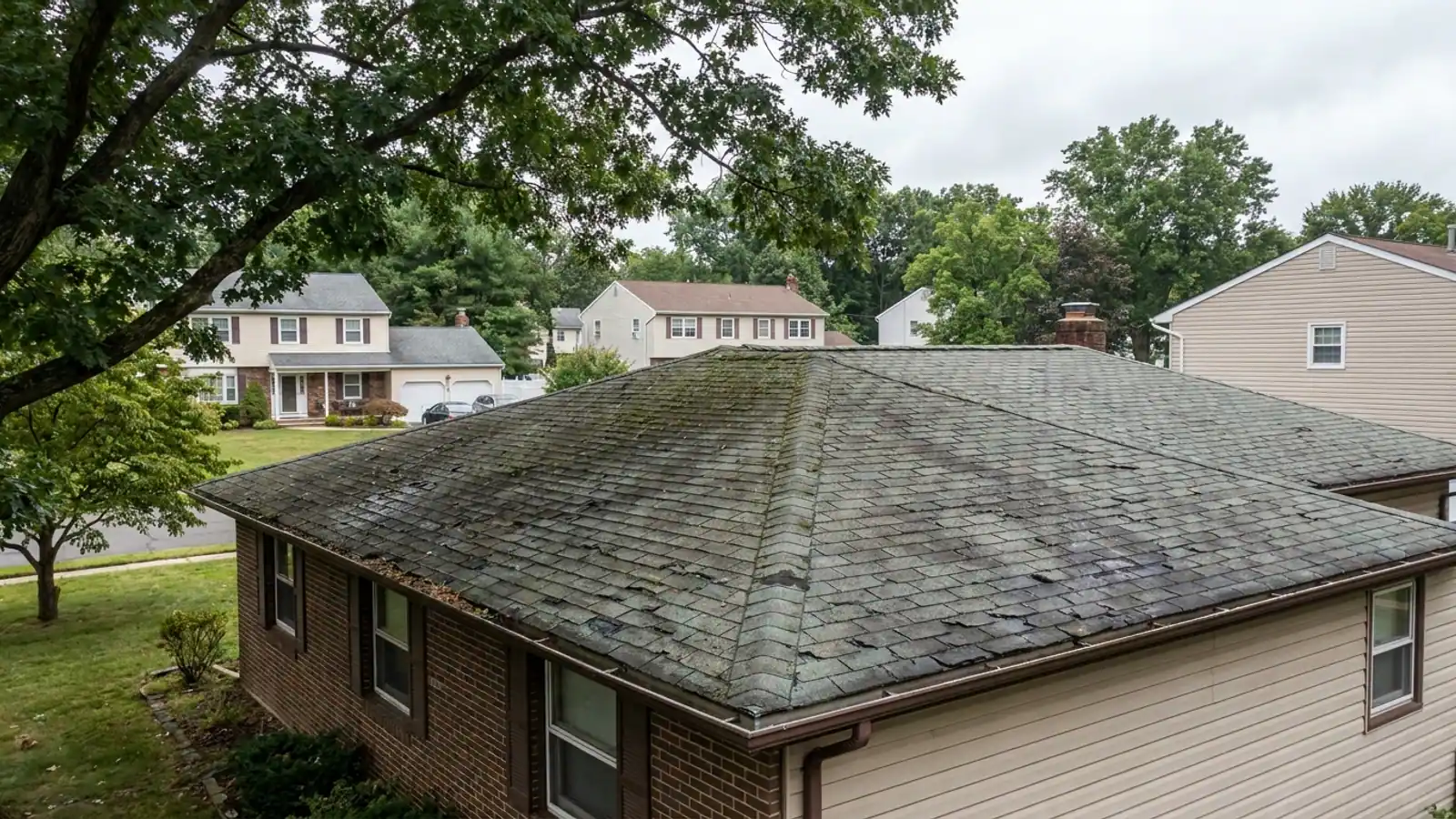
What separates a roof with life left from one that is done is curling and cupped edges, bald patches where the granules are gone, granules filling the gutters after every rain, and soft spots in the decking. The signs you need a new roof guide goes through each of those and through the ones only visible from the attic.
What to do in the response window, in order
- Read the notice and write down the exact deadline and the exact reason stated.
- Call your agent and ask, in plain terms, what the carrier will accept. Ask whether a dated inspection report with photos satisfies them, whether repairs to specific items are enough, and whether an invoice for a completed replacement restores replacement cost coverage.
- Get that answer in writing, by email. Agents are helpful on the phone and the underwriting department is not bound by a phone call.
- Have the roof inspected by a roofing contractor, not by the carrier's imagery. Ask for photographs of the field, every flashing point, the roof edge and the attic, and ask which items are failing now versus simply aging.
- Send the report and photos to the agent if the roof is sound, or get a written estimate for replacement if it is not.
- Shop other carriers in parallel. Thresholds differ, and a documented roof in good condition sometimes places without trouble somewhere else.
What the carrier wants versus what to send
| What the notice says | What it usually means | What to send back |
|---|---|---|
| What the notice saysRoof exceeds maximum age | What it usually meansAutomated age screen, no one looked | What to send backDated inspection report with photos and a contractor statement on condition |
| What the notice saysRoof shows visible deterioration | What it usually meansAerial or drive-by imagery flagged something | What to send backClose-up photos of the flagged slope, plus a repair invoice if work was done |
| What the notice saysRepairs required by date | What it usually meansSpecific defects listed | What to send backItemized invoice matching each listed defect |
| What the notice saysReplacement required for renewal | What it usually meansThe carrier will not insure the roof as is | What to send backSigned contract with a scheduled date, then the final invoice and permit record |
| What the notice saysRoof coverage moving to actual cash value | What it usually meansPolicy stays, roof payout shrinks | What to send backDecide whether to accept it or replace and ask for replacement cost back |
If there is real storm damage, that is a different path
If the inspection turns up wind or hail damage from a dated storm event, you are no longer in an underwriting conversation. That is a claim, and it runs on its own rules and its own deadlines. Do not fold it into the renewal discussion, and do not let a contractor tell you an old worn roof can be presented as storm damage. The roof insurance claim guide walks through how a legitimate claim is documented and filed in New Jersey.
If replacing is the right answer
Then the useful questions are cost, timing and how the price is protected.
Most New Jersey asphalt roof replacements run $9,000 to $22,000 in standard-value towns, $14,000 to $35,000 in higher-value towns, and $25,000 to $60,000 on large or luxury homes. The band comes from the median home value of your municipality. Standing-seam and metal shingle systems start higher, at $18,000 to $35,000 in standard-value towns, and carry a material life of 50 years or more, which takes the age conversation off the table for the rest of the time you own the house.
Timing is the other half. Most asphalt replacements are torn off and finished in a single day. Standing-seam metal takes two to four days. That matters when a conditional renewal gives you a deadline measured in weeks.
Lightning Construction takes no deposit; nothing is due until the work is done and you have inspected it. There are no change orders, because the conditions that normally cause them, extra shingle layers, rotted decking and unusable flashing, are found at the free inspection and priced into the written estimate. Lightning pulls the permit from your municipality's construction office and attends the inspection under the New Jersey Uniform Construction Code. You file nothing, and the permit record is exactly the documentation an underwriter wants to see afterward.
Financing is available through GreenSky and FTL, including 24 months at 0% interest and 120-month terms with no prepayment penalty. The roof financing guide explains how those work and what to compare.
What to do this week
Call your agent, get the requirement in writing, and get eyes on the roof before the deadline gets close. A free inspection and written estimate from Lightning costs nothing and carries no obligation, and yes, a salesperson comes to the house, which is worth knowing before you book it. If the roof has years left, you leave with photographs to send the carrier. If it does not, you leave with a fixed price and a date.
Start with a free roof inspection and estimate, or read what a full roof replacement in New Jersey includes before you call.