Short answer
The fastest answer is your municipality's construction office, which keeps a record of the roofing permits pulled on your address. If no permit turns up, you date the roof from physical evidence instead: the number of layers, the wear pattern, the age of the flashing and any markings on the decking in the attic. No single method gives an exact year, but together they usually put the roof inside a two or three year window, which is close enough for a sale, a purchase or a claim.
On this page
Call the construction office in the municipality where the house sits and ask for the permit history on the address. A roof replacement in New Jersey requires a permit under the Uniform Construction Code, and when a permit was pulled there is a dated record with the contractor's name on it. That is the only method that gives you a real date rather than an estimate.
When nothing comes back, you date the roof from the roof. Below are the five methods that actually work, in the order you should try them, and what each one can and cannot tell you.
Method 1: the municipal permit record
This is the first call, and it is free.
Ask for the permit and inspection history on your block and lot. You are looking for a roofing or re-roofing permit, the date it was issued, the date the final inspection was signed off, and the contractor listed. Some New Jersey towns put this in an online portal. Some want a phone call. Some want a short open public records request, which the clerk's office will walk you through.
Two things to understand about the result. First, the permit date is the date the work was approved, not always the date the shingles went on, though in practice those are usually within a few weeks of each other. Second, plenty of roofs in this state were replaced without a permit, especially before the current online systems existed. A blank record is not proof the roof is original, and it is not proof it is new.
If you want the full picture of how permits and inspections work on a replacement, the New Jersey roof permit guide covers who files what. On every job Lightning Construction runs, Lightning pulls the permit and attends the municipal inspection, so a future owner of your house will find the record.
Method 2: go into the attic
The attic tells you more than the street does, and it costs nothing but a flashlight.
What to look for on the underside of the decking
Plywood sheathing is often stamped with a mill date or a production code. If the house has original decking, that code dates the house, not the roof. What dates the roof is the pattern of nail points coming through. One dense, consistent field of nail tips means one roof. Two offset patterns, or old nail holes with no nail in them next to a newer set, means the deck has been through more than one covering.
What the wood color tells you
Fresh plywood installed during a partial deck repair reads lighter than the boards around it. A patch of newer sheathing in one corner means somebody opened that area up at some point, and that is a clue to a repair date rather than a full replacement.
Chalk lines, labels and leftover materials
Roofers write on things. Dates, square counts and bundle labels show up on rafters and on the back of the deck more often than you would think. Homeowners also leave a bundle or two of leftover shingles in the attic or the garage, and the wrapper carries the product line and sometimes a plant code.
Method 3: read the shingles
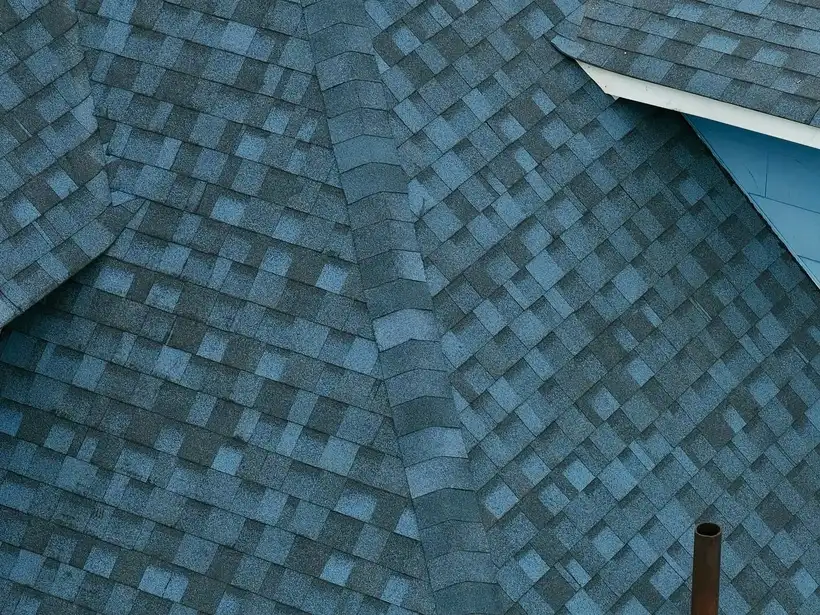
Shingles age in a visible order, and the order is fairly reliable on New Jersey roofs.
| What you see | What it usually means |
|---|---|
| What you seeSharp edges, full granule coverage, flat lay | What it usually meansRoof is young, generally under ten years |
| What you seeGranules collecting in the gutters, color lightening on south and west slopes | What it usually meansRoof is into the middle of its life |
| What you seeCurling or cupping at the shingle corners, exposed black mat in spots | What it usually meansRoof is late in its life |
| What you seeCracking across the shingle face, bald patches, shingles that crumble when lifted | What it usually meansRoof is at or past the end |
| What you seeTwo distinct layers visible at the rake edge | What it usually meansAt least one overlay, so the covering is older than the top layer looks |
The caveat is exposure. A north slope under tree cover and a south slope in full sun on the same house can look a decade apart. Judge the age from the worst slope, not the best one, because the worst slope is what leaks first. The guide on signs you need a new roof walks through which of these conditions still justify a repair and which do not.
Flashing is a second clock. Step flashing at a sidewall, counterflashing at the chimney and the drip edge at the eaves are all replaced during a proper tear-off. If the shingles look recent but the chimney flashing is tar-patched and pitted, somebody did a cheap job, and the shingle age is not the whole story.
Method 4: the paperwork you may already have
Check these before you climb anything.
- The closing file from when you bought the house. The seller's property condition disclosure asks about the age of the roof, and the home inspection report from that purchase usually estimates remaining life.
- Old invoices, canceled checks and credit card statements. A five figure payment to a roofing company is not hard to spot once you know the year to look in.
- Insurance records. If a prior roof was replaced on a storm claim, the carrier has a file with a date on it.
- Manufacturer warranty registration. GAF and other manufacturers register qualifying installations, and the registration carries an install date. The homeowner, not the contractor, usually holds that certificate.
- Real estate listing history. Old listing copy for your own address often states the roof age at the time of sale.
If a warranty certificate turns up, read it before you assume it still applies. Coverage terms, proration and transferability vary, and the roof warranty guide explains what the manufacturer covers versus what the contractor covers.
Method 5: have a roofer date it in writing
When the record is blank and the house is changing hands or a claim is open, get a dated inspection with photographs. A contractor on the roof can count layers at the rake, check nail pattern and exposure, look at the condition of the flashing and the pipe boots, and compare the shingle profile against products that were being sold in a given era. That produces a defensible range rather than a guess.
At Lightning Construction, the inspection and the written estimate are free, there is no obligation, and a salesperson comes to the house. Anything that would normally become a change order later, such as a second shingle layer, soft decking or flashing that cannot be reused, gets found at that inspection and priced into the quote. The written estimate is the final price, and nothing is due until the work is finished and you have inspected it.
Why the date matters for each situation
Buying
A roof with eight good years left and a roof with two are different purchases, and the difference is real money. Get the permit record during attorney review, not after closing.
Selling
Buyers' inspectors estimate age, and their estimates skew conservative. A permit record or a dated invoice in your disclosure packet removes the argument before it starts.
Filing a claim
Age drives how a carrier settles storm damage. An old roof can be depreciated hard or excluded by a cosmetic or actual cash value endorsement. Documentation of the install date, plus dated photographs from before the storm if you have them, is what keeps the conversation factual. The roof insurance claim guide covers the sequence.
What to do next
Call the construction office first, then spend ten minutes in the attic, then look at the worst slope from the ground with binoculars. If those three leave you unsure, book a free inspection and get the age, the condition and the price in one document. You can request a free estimate for any address in New Jersey. Most asphalt replacements are torn off and finished in a single day, so if the answer turns out to be that the roof is done, the disruption is shorter than most people expect.