Short answer
Curling and cupping mean the asphalt in the shingle has dried out and the mat underneath is no longer flat, and that is a wear condition rather than a repairable defect. Once curling is spread across a whole slope rather than confined to a few shingles, you are generally in the last few years of that roof's useful life. The honest way to judge what is left is to check whether the curled shingles are also losing granules and whether the attic underneath is hot and damp.
On this page
Curling and cupping are wear, not damage. The asphalt in the shingle has lost the oils that kept it flexible, the fiberglass mat underneath has stopped lying flat, and the shingle is now pulling away from the deck at its edges or its center. No sealant, coating or repair puts that back. The only real question is how much time is left before water finds a way in, and that depends on how far the condition has spread and what is happening in the attic below it.
Here is how to read your own roof, what causes it in New Jersey specifically, and when waiting is still the right call.
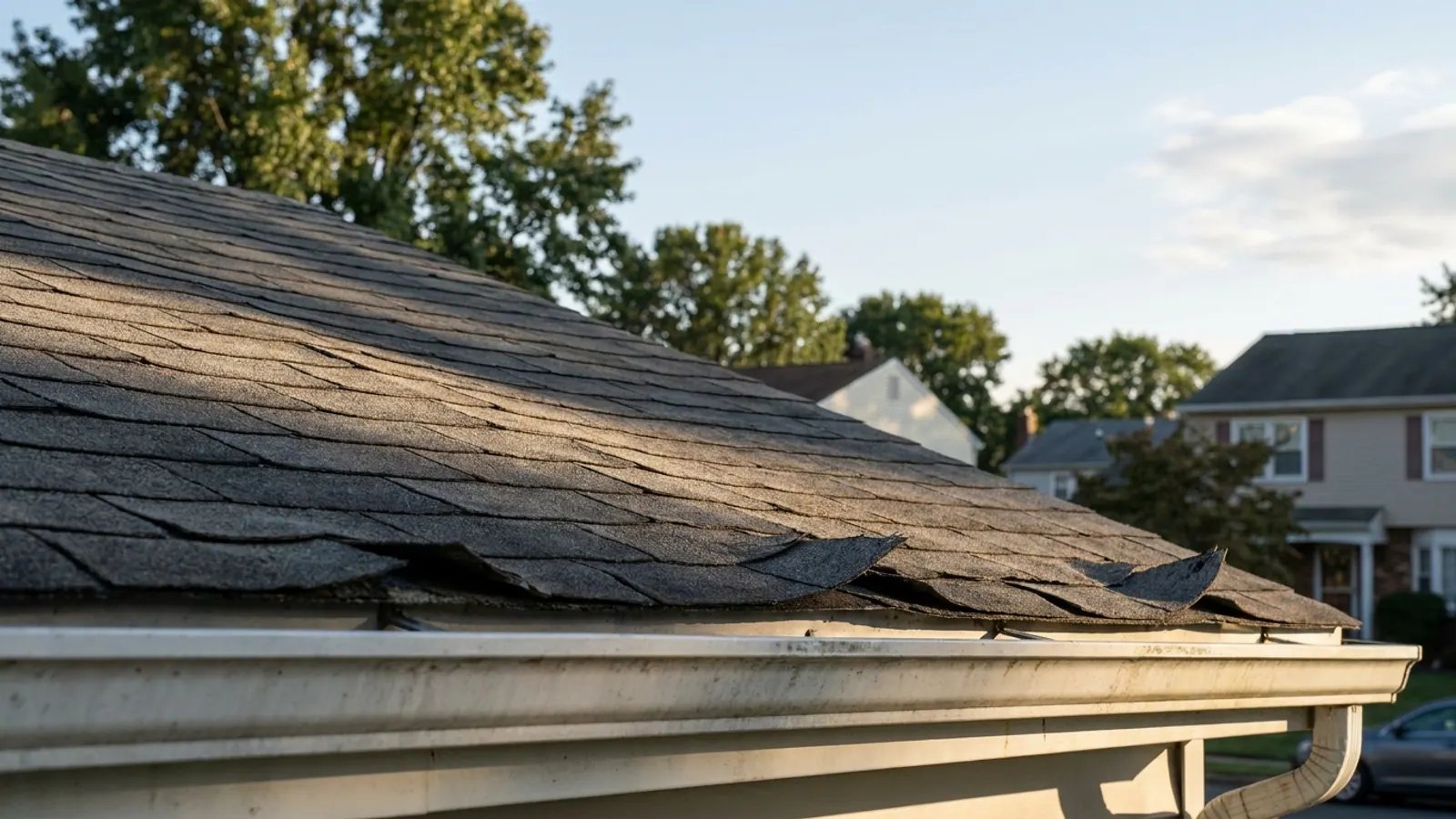
What curling, cupping and clawing actually look like
All three describe a shingle that is no longer flat, and roofers use the words loosely. The distinction matters because the direction of the distortion tells you something about the cause.
| Condition | What you see | Usual cause |
|---|---|---|
| ConditionCupping | What you seeCorners and side edges turn up, center sits low | Usual causeDried-out asphalt, heat from an underventilated attic, age |
| ConditionClawing | What you seeCenter lifts, edges stay held down by the course above | Usual causeMoisture swelling the mat or the decking from below |
| ConditionEdge lifting | What you seeOne or two tabs lifted along a rake or ridge | Usual causeWind, a failed sealant strip, or nails driven too high |
Cupping across a whole sunny slope is an aging roof. Clawing is more often a ventilation or moisture problem, and it shows up on roofs that are not old enough to be failing. A few lifted tabs after a windy week are a different problem entirely and are usually repairable.
Look at the slope in low side light, early morning or late afternoon. Flat shingles disappear. Curled ones throw shadows and the whole plane reads as wavy from the driveway.
Why New Jersey roofs curl before their rated age
Shingles are rated in a laboratory. Your roof lives on a house with an attic, and that attic decides a lot.
The common causes here, in rough order of how often they turn up at an inspection:
- No working ventilation. Summer attic air with nowhere to exhaust drives deck temperatures up and cooks the asphalt from underneath. The south and west slopes curl first. The attic ventilation guide explains the intake and exhaust balance that prevents it.
- A second layer of shingles. An overlay puts new shingles on top of an uneven, heat-holding old roof. Those shingles almost always curl early.
- Moisture from the living space. Bath fans dumped into the attic, an unsealed attic hatch and missing insulation push humid air into the roof assembly all winter. The deck absorbs it, swells, and the shingles distort with it.
- Age. A roof that is twenty-plus years old and curling is simply finished. Nothing went wrong; the asphalt is spent.
- Installation problems. Nails driven high above the nail line, or shingles applied over a deck with uneven planking, give the shingle nothing holding its middle down.
Much of this state's housing stock went up between the 1950s and the 1970s and has been reroofed at least once. Older houses often got ridge vents without matching soffit intake, or got intake vents that insulation later covered. That combination is the single most common reason a roof curls at fifteen years instead of twenty-five.
How to judge how much life is left
Curling alone is not the whole picture. Check three things together.
How much of the roof is affected
Scattered curling on one hot slope while the rest of the roof lies flat is a slope-specific problem, often ventilation. Curling on every slope, including the north side, is the material giving out.
Whether granules are going with it
Run your eye along the gutters and the splash area below the downspouts. Heavy granule accumulation plus curling means the shingle has lost both its flexibility and its protective surface, and the black mat underneath is now taking ultraviolet exposure directly. That shortens whatever is left considerably.
What the attic shows
Go up with a flashlight on a clear day. Daylight through the deck, dark staining around nails, damp or compressed insulation, or rusted nail shanks all mean water is already moving through. A roof that is curling on top and staining underneath is not a watch-and-wait roof.
If all three are present, plan the replacement. If only the first is, you likely have time, and the right move is to fix the ventilation so the next roof does not do the same thing.
When a repair is still the honest answer
A repair makes sense when the curling is confined to a small, identifiable area and the rest of the roof is sound. Replacing a dozen shingles on one dormer face, or tearing off and redoing a single small slope, is legitimate work. The color will not match exactly, because granule blends change and existing shingles have weathered, and anyone promising an invisible match is overselling it.
A repair does not make sense when curling is general. Walking a brittle, curled roof to patch it breaks more shingles than it fixes, and you are paying for labor on a surface that is coming off within a couple of years anyway. The signs you need a new roof guide lays out the full set of conditions that separate the two cases.
What a replacement has to include if the curling is not going to repeat
New shingles on an unchanged assembly will age the same way. Make sure the estimate covers:
- Full tear-off to the deck, so the crew can see the sheathing and so the new roof is not sitting on an old heat-holding layer.
- Decking replacement priced in writing for any sheathing that is soft, delaminated or will not hold a nail.
- A balanced ventilation system, with intake at the soffits sized to match the exhaust at the ridge. Exhaust alone does nothing without intake.
- New flashing, not reused step flashing, at every chimney, sidewall and skylight.
- Proper nail placement on the manufacturer's nail line, which is also what the wind rating depends on.
At Lightning Construction, the conditions that usually produce a change order mid-job — extra layers, rotted decking, unusable flashing — are found at the free inspection and priced into the written estimate, and that estimate is the final price. There is no deposit; nothing is due until the work is finished and you have looked at it. Lightning pulls the permit from your municipality's construction office under the New Jersey Uniform Construction Code and attends the inspection. You file nothing.
Timing it
Curling gets worse in heat and shows its consequences in wind. A roof that is cupping in August is more likely to lose tabs in the first strong nor'easter of the season, because curled shingles have lifted edges for wind to catch and the sealant strips have long since let go.
If the roof is curling but not leaking, you have scheduling flexibility, and the best time of year to replace a roof in New Jersey covers what each season does to the job. If it is curling and the attic is stained, do not wait for a better month.
What to do next
Get eyes on it before you decide. Photograph the slope from the ground in raking light, check the gutters for granules, and look in the attic. Then have someone inspect it who will show you photographs of what they found and tell you plainly whether you are looking at a repair or a replacement.
Lightning Construction's inspection and written estimate are free with no obligation, and a salesperson does come to the house. Most asphalt replacements are torn off and finished in a single day. See the roofing services page for what the work includes, or book a free estimate and get a straight answer on how much life your roof has left.