Short answer
A bathroom fan that ends inside the attic pumps warm, wet air straight at the underside of your roof deck, where it condenses on the cold sheathing and nails every winter night. Over a few seasons that moisture darkens the plywood, rusts the fasteners, mats the insulation and can soften the decking enough that it no longer holds a nail. The fix is to run the duct all the way to a roof cap or a gable wall and terminate it outside, not into the attic or a soffit.
On this page
A bathroom fan that ends loose in the attic is pumping warm, wet air directly onto the coldest surface in your house. Every shower sends a few pints of water vapor up there. In a New Jersey winter it hits sheathing that is sitting near outdoor temperature, condenses, and runs back down the plywood or freezes to it.
That is the whole mechanism. What follows from it is stained decking, rusted nails, flattened insulation, mold on the rafters and, in bad cases, sheathing that has to be replaced during the next roof job.
How to check your own attic in ten minutes
Take a flashlight and go up when it is cold out, ideally early in the morning before the sun warms the roof.
- Find the bathroom fan housing from above. It will be a metal or plastic box sitting between the ceiling joists, with a round duct collar on one side.
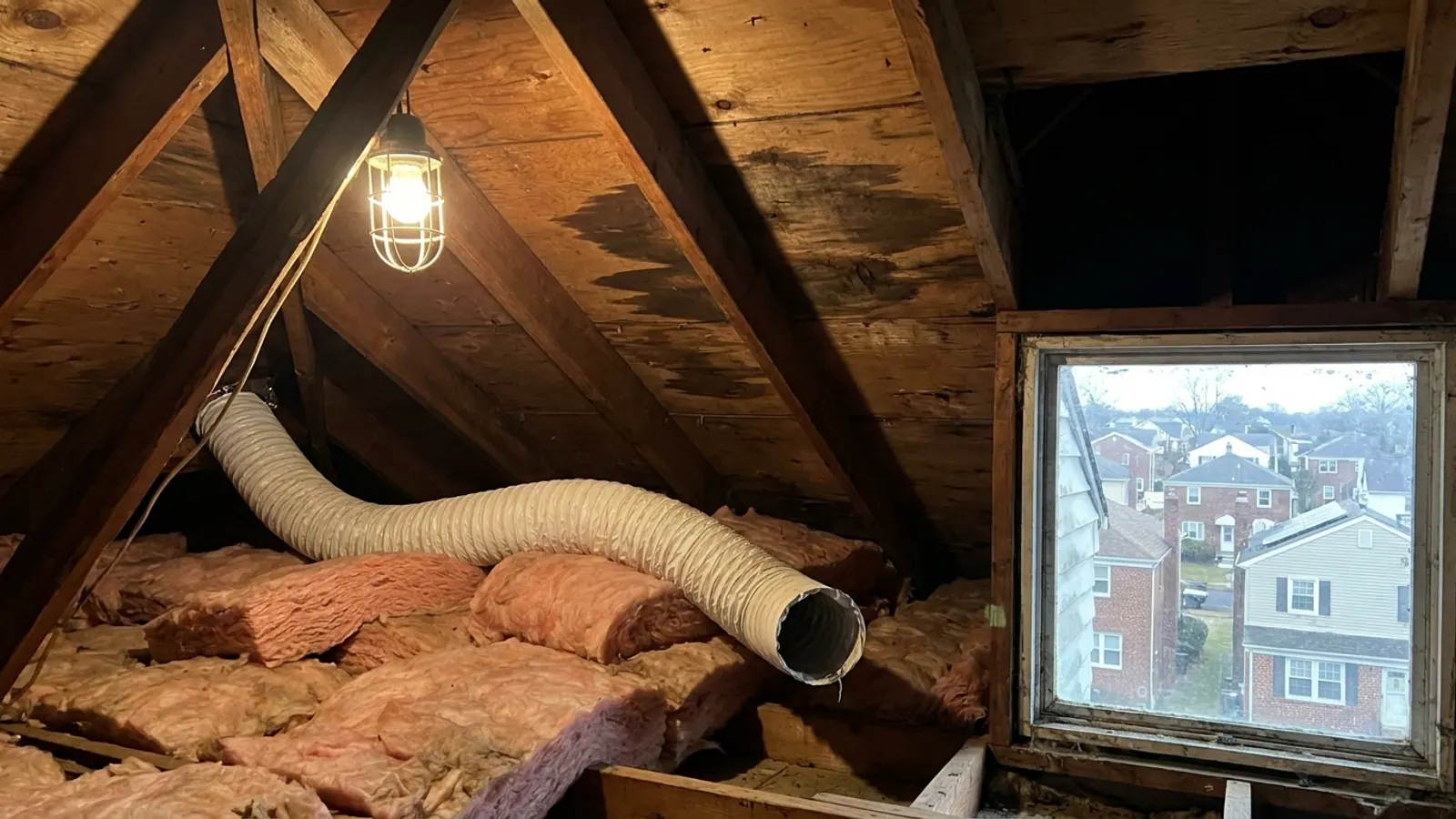
- Follow the duct. If it ends in open attic air, if it has pulled off the collar, or if it runs a few feet and simply stops under the insulation, that is your problem.
- Look straight up at the sheathing above and downwind of the duct end. Dark gray or black staining, white frost, or beads of water on the nail points all mean condensation is happening there regularly.
- Press on the stained plywood with the heel of your hand. Firm is fine. Spongy, or separating into layers, means the deck is going.
- Check the insulation under the duct. Matted, compressed, discolored insulation has been getting wet.
If you find frost on the nails and clean, dry wood everywhere else in the attic, the fan is the cause. Attic condensation and frost can also come from air leaks around recessed lights and the attic hatch, so note anything else that looks wet while you are up there.
What the moisture actually does to the roof
It works through the assembly from the inside out.
The sheathing goes first. Repeated wetting and drying delaminates plywood and swells OSB at the edges. Once a sheet has swelled and dried a few cycles, the surface no longer grips a roofing nail the way it did. Nails back out and telegraph through the shingles.
The fasteners rust. Those shiny nail points you can see from the attic are what the condensation lands on first. Rust stains running down the underside of the deck are a reliable sign of a long-running moisture source.
The insulation stops insulating. Wet fiberglass compresses and loses most of its value, so the ceiling below gets colder, which makes the room feel drafty and makes the next shower condense even faster.
Mold shows up on the rafters. Usually as black or gray spotting on the north slope, where the wood stays coldest and dries slowest.
Ice dams get worse. Warm moist air leaking into the attic warms the deck, melts the snow above it, and the water refreezes at the cold eave. A bathroom duct dumping heat and water vapor into the attic is a direct contributor. The ice dam guide covers the full chain of causes if you are seeing icicles and interior stains at the exterior walls.
None of this shows up on the shingles for years. It shows up when a roof is torn off and the crew finds a dark, soft patch of deck in one spot while the rest of the roof is sound.
Why the soffit is not an acceptable place to vent it
This is the most common bad fix, and plenty of builders did it on purpose.
A soffit vent is intake. The attic is designed to pull air in low at the eaves and push it out high at the ridge. If you dump bathroom exhaust into or next to a soffit vent, the attic immediately draws that same wet air back in through the vents around it. You have moved the discharge point twelve inches and changed nothing.
The same goes for blowing the duct at a gable louver from across the attic, or ending it near a ridge vent and hoping the air finds its way out. Exhaust has to be connected to its own termination.
The terminations that actually work
| Termination | Where it goes | Notes |
|---|---|---|
| TerminationRoof exhaust cap | Where it goesThrough the roof deck, flashed into the shingle courses | NotesThe shortest run on most houses, installed with the roof so the flashing is right |
| TerminationGable wall cap | Where it goesThrough the gable end wall, above the insulation line | NotesGood when the bathroom is near a gable and the run stays short |
| TerminationSoffit-mounted exhaust cap | Where it goesThrough the soffit panel, with a dedicated hooded outlet | NotesWorkable only with a sealed duct to a real exterior hood, and it still sits in the intake stream |
| TerminationLoose in the attic | Where it goesNowhere | NotesNot a termination, and not allowed |
On most New Jersey houses the roof cap is the clean answer, because the bathroom is usually under a roof slope rather than against a gable.
What a correct duct run looks like
- Rigid or insulated flexible duct, sized to the fan collar, with no crushed sections and no long sagging bellies where water can pool.
- The shortest practical path, pitched slightly toward the outside so any condensate inside the duct drains out rather than back into the fan.
- Insulated duct, or duct buried under attic insulation along its length, so the air inside stays warm enough not to condense before it exits.
- Mechanical clamps or foil tape at every joint, not cloth duct tape, which dries out and lets the duct fall off the collar.
- An exterior hood with a backdraft damper that closes when the fan is off.
- Nothing discharging within a few feet of an intake vent.
Fixing it when the roof is being replaced
The roof-side work belongs with the roof. A proper exhaust cap is cut in, set on the deck and woven into the shingle courses with its own flashing, which only happens cleanly when the old roof is off. Doing it later means cutting into a finished roof.
The same visit is when the decking question gets settled. Plywood that has been rained on from underneath for ten winters may need to come out, and that is found by looking at it, not guessing. At Lightning Construction, the free inspection includes the attic, and bad decking, failed flashing and extra shingle layers get priced into the written estimate before anything starts. There are no change orders, so a soft sheet found over the bathroom on tear-off day does not become a new invoice. There is also no deposit, and nothing is due until the work is finished and you have looked at it.
While you are getting quotes, ask each contractor what the estimate includes for the exhaust duct itself, not just the cap. Some roofing scopes cover connecting the existing duct to the new cap and some do not. Get the answer in writing either way.
The rest of the attic has to work too
A correctly vented bathroom fan does not rescue an attic with blocked soffits and no exhaust at the ridge. If the attic cannot move air, every other moisture source in the house still ends up on the sheathing. Our attic ventilation guide explains how intake and exhaust are supposed to balance and what the common failures look like from inside.
If the decking is already stained and soft in more than one area, you are past the point where ventilation alone fixes anything. The signs you need a new roof guide walks through what is a repair and what is not.
What to do next
Go look. If the duct ends in the attic, you have a known cause and a known fix, and the sooner the sheathing starts drying out the less of it you lose.
Lightning Construction inspects the attic as part of every free roofing inspection, photographs what is on the underside of the deck, and shows you the pictures. A salesperson comes to the house, the inspection and written estimate are free, and there is no obligation. If you want that on the calendar, request a free estimate or call (862) 860-6254.