Short answer
Frost in your attic means warm, humid air from inside the house is leaking up into a cold attic and freezing on the underside of the roof deck and the nail points. It is a moisture and air-leak problem first and a ventilation problem second, and left alone it soaks the sheathing, flattens the insulation and rots the decking your shingles are nailed to. Fix the air leaks and the exhaust fans, then correct the intake and exhaust venting, and the frost stops forming.
On this page
- Why frost forms on the underside of a roof deck
- Condensation or an actual leak: how to tell them apart
- Where the warm air is getting in
- Ventilation is the second half of the fix, not the first
- What condensation does to your roof over time
- How to check your attic in winter without wrecking anything
- Fixing it with a roof replacement, and what to get in writing
- What to do next
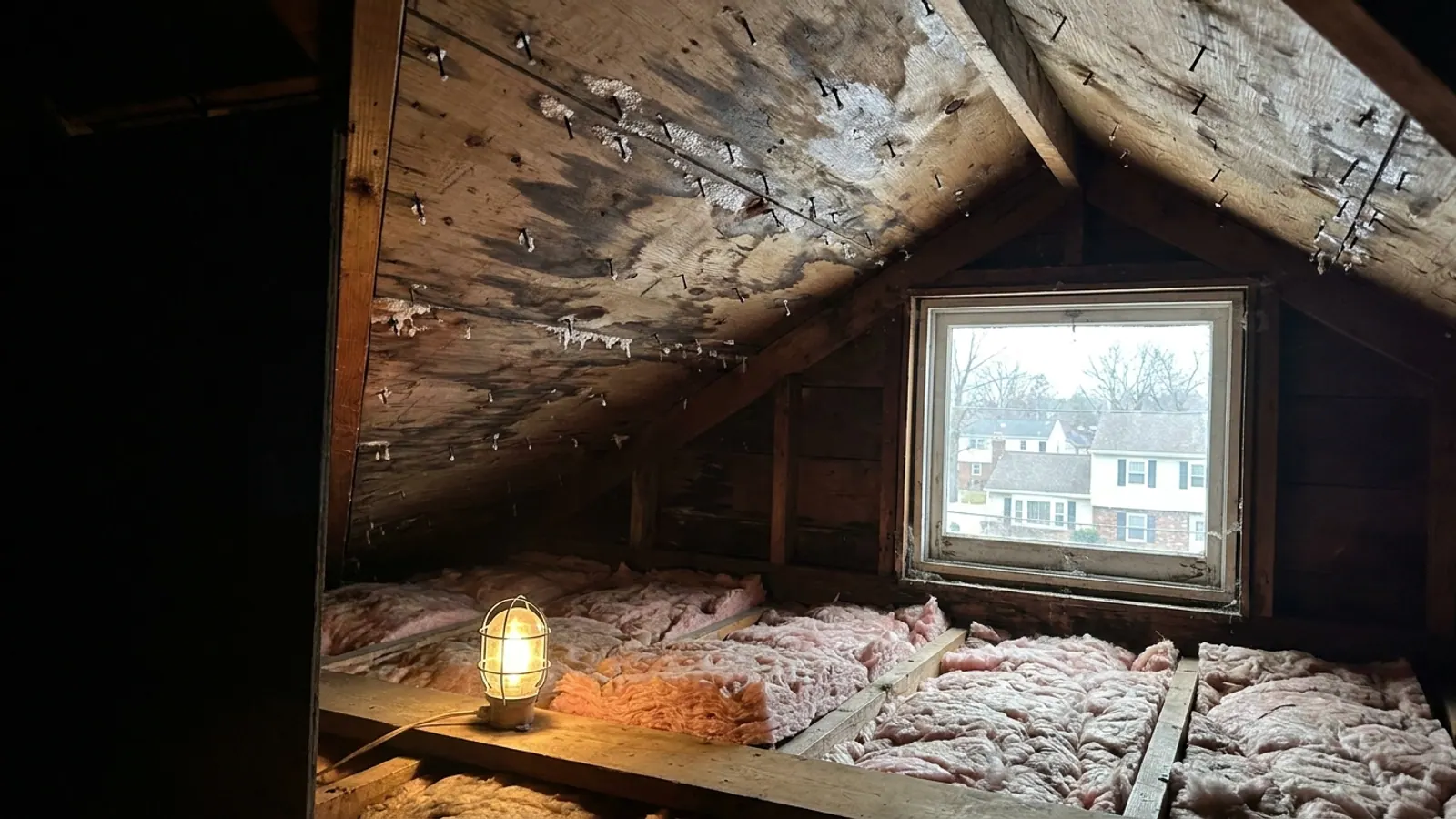
Frost on the nail points and dark damp patches on the underside of your roof sheathing mean one thing: warm, humid air from inside your house is getting into a cold attic and condensing on the first cold surface it touches. That surface is the roof deck. It is not a roof leak, and no amount of caulking on the outside will stop it.
This is one of the most common things a roofer finds in a New Jersey attic in January, and one of the most commonly ignored. Here is what causes it, what it is doing to your roof, and what actually fixes it.
Why frost forms on the underside of a roof deck
Heated indoor air holds moisture. Showers, cooking, laundry, dishwashers, a finished basement, a humidifier on the furnace, even the people in the house all add water vapor to the air. That air is buoyant, so it rises. Wherever there is a gap between the living space and the attic, it goes up through the gap.
Once it is in an unheated attic in winter, the air cools, and it can no longer hold that water. It condenses on the coldest surfaces available, which are the underside of the sheathing and the shanks of the roofing nails poking through it. Below freezing it condenses as frost rather than water, which is why you can see it as white crystals on hundreds of nail tips.
The frost is only the visible half. It melts on the first mild day and runs down the sheathing, drips onto the insulation, and in bad cases stains the ceiling below. Homeowners call that in as a roof leak, and it looks like one from the living room.
Condensation or an actual leak: how to tell them apart
They leave different patterns.
| Condensation | Roof leak | |
|---|---|---|
| Where the staining is | CondensationSpread over large areas of sheathing, often worst on the north slope and near the ridge | Roof leakConcentrated in one path, traced back to one spot |
| What is near it | CondensationNothing in particular; it follows temperature | Roof leakA chimney, a vent pipe, a valley, a skylight, a wall junction |
| When it shows | CondensationCold weather, worst after a cold snap or a thaw | Roof leakDuring and right after rain or snowmelt |
| Insulation below | CondensationDamp over a wide area, matted down | Roof leakWet in one localized area |
| Nail points | CondensationFrosted or rusting across the whole slope | Roof leakNormal except near the leak |
If what you see is one wet path around a penetration, that is flashing, and flashing failures are a separate problem with a separate fix. If it is everywhere and it tracks the weather rather than the rain, it is condensation.
Where the warm air is getting in
Air leaks, not the roof, are the source. In New Jersey houses these are the usual ones:
- The attic hatch or pull-down stair, almost never weatherstripped and almost never insulated
- Recessed light cans in the top-floor ceiling, especially older non-airtight housings
- Bath fans and kitchen fans that terminate in the attic instead of through the roof or a gable wall
- The chase around a chimney or a flue
- Open stud bays over interior partition walls
- Plumbing vent, wiring and duct penetrations through the top plate
- Gaps around ductwork running through the attic
A bath fan blowing into the attic is the single worst offender. It moves warm, saturated air straight to the deck every time somebody showers. New Jersey's code has required exhaust fans to terminate outdoors for a long time, but plenty of fans installed decades ago still dump into insulation. Look for a flex duct that just ends.
Ventilation is the second half of the fix, not the first
Attic ventilation works by moving cold outside air through the attic to carry moisture and heat out. Intake comes in low at the soffits, exhaust leaves high at the ridge. The ventilation code most municipalities enforce calls for a minimum ratio of net free vent area to attic floor area, and it allows the smaller ratio only when intake and exhaust are balanced roughly half and half.
The two failures we find constantly:
- Exhaust with no intake. A ridge vent was cut in and the soffits were never opened, or they were later stuffed with blown-in insulation. With nowhere to pull air from, the ridge vent draws air out of the house through the same ceiling leaks that are causing the condensation.
- Mixed exhaust types. A ridge vent plus powered fans plus box vents on the same attic short-circuit each other, so air enters through one exhaust and leaves through another and never sweeps the far corners of the attic.
The attic ventilation guide walks through the intake and exhaust math in full. What matters here is the order of operations: seal the ceiling first, vent second. Ventilating a leaky ceiling just increases the flow of house air into the attic.
What condensation does to your roof over time
Plywood sheathing that gets repeatedly wet delaminates. The glue lines between plies fail, the panel swells and loses stiffness, and it stops holding a nail. Plank decking on older homes rots along the edges and around the fasteners. Either way, you end up with a deck that will not hold shingles, and the shingles above a chronically damp deck can cup and lose their seal early.
It also destroys the insulation. Wet fiberglass compresses and loses most of its performance, so the heat loss gets worse, which makes the roof surface warmer, which is the same mechanism behind ice dams. Attic condensation and ice dams usually appear in the same house for the same reason.
By the time the frost is heavy enough to notice, the deck is often already stained. Whether it needs replacing depends on whether it is still hard and structurally sound. A soft spot underfoot is not.
How to check your attic in winter without wrecking anything
- Pick a cold morning, ideally after several days below freezing.
- Bring a bright light and step only on the joists or on planks laid across them.
- Look at the underside of the sheathing along the whole ridge and both slopes, and check the nail points for frost or rust.
- Look at the insulation for matted, darkened or damp areas.
- Follow every bath fan duct and confirm it exits the building, not the attic.
- Go outside and look at the soffits for continuous vents, then check from inside whether insulation is blocking them at the eaves.
- Photograph everything you find, including dates.
If climbing into a cold attic is not something you want to do, that inspection is part of what a roofer should be doing anyway. At Lightning Construction the inspection and written estimate are free with no obligation, and a salesperson does come to the house.
Fixing it with a roof replacement, and what to get in writing
If the roof is near the end of its life, do the ventilation work as part of the replacement. That is when the ridge is open, the soffits are accessible and the deck is exposed, so intake baffles, a proper continuous ridge vent and any sheathing replacement all happen while the crew is already up there. Most asphalt roof replacements are done in a single day.
If the roof still has years left, seal the ceiling and correct the venting on their own. That is the honest answer and it is a fraction of the cost of a roof.
Whatever the case, get these written on the estimate before you sign:
- The intake and exhaust plan in specifics, including linear feet of ridge vent and what happens at the soffits
- Whether soffit baffles are being installed at the eaves
- Where bath and kitchen fans will terminate
- The price for decking replacement, per sheet, agreed up front
That last item is where most homeowners get hit. Lightning finds bad decking, extra shingle layers and failed flashing at the free inspection and prices them into the quote, so there are no change orders on the day. There is no deposit either, and nothing is due until the work is finished and you have inspected it. Lightning pulls the permit from your municipality's construction office and attends the inspection under the New Jersey Uniform Construction Code.
What to do next
Get the attic looked at before the next cold stretch, not after the ceiling stains. If the frost is heavy, the insulation is matted or the deck is soft anywhere, have a roofer assess ventilation and sheathing together. See what is included in a roof replacement and attic ventilation job, then book a free inspection and written estimate and get the venting plan in writing.