Short answer
On almost every New Jersey house, architectural shingles are the right choice. They are thicker, carry a much higher wind rating and hold up better on the roof, and because the shingle itself is a small share of an installed roof price, the upgrade moves the total less than most homeowners expect. 3-tab still has a place on a detached garage, a shed, or a repair that has to match an existing 3-tab roof.
On this page
- What separates a 3-tab shingle from an architectural shingle
- Wind ratings, and why they matter on a New Jersey roof
- Side by side
- What each one looks like on the kinds of houses New Jersey has
- What the upgrade does to the price
- Warranty coverage is not the same on both
- When 3-tab is still the right call
- What to confirm before you sign
- What to do next
Put architectural shingles on the house. On a New Jersey roof replacement, the shingle is a modest share of what you are actually paying for. Tear-off, disposal, underlayment, ice and water shield, flashing, drip edge, ventilation, labor and the permit make up the rest, and none of those change when you move from 3-tab to architectural. What changes is a thicker shingle with a much higher wind rating and a longer service life on your roof.
That is the short answer. Here is what is actually different between the two, and the narrow set of cases where 3-tab is still the honest recommendation.
What separates a 3-tab shingle from an architectural shingle
The difference is the number of layers.
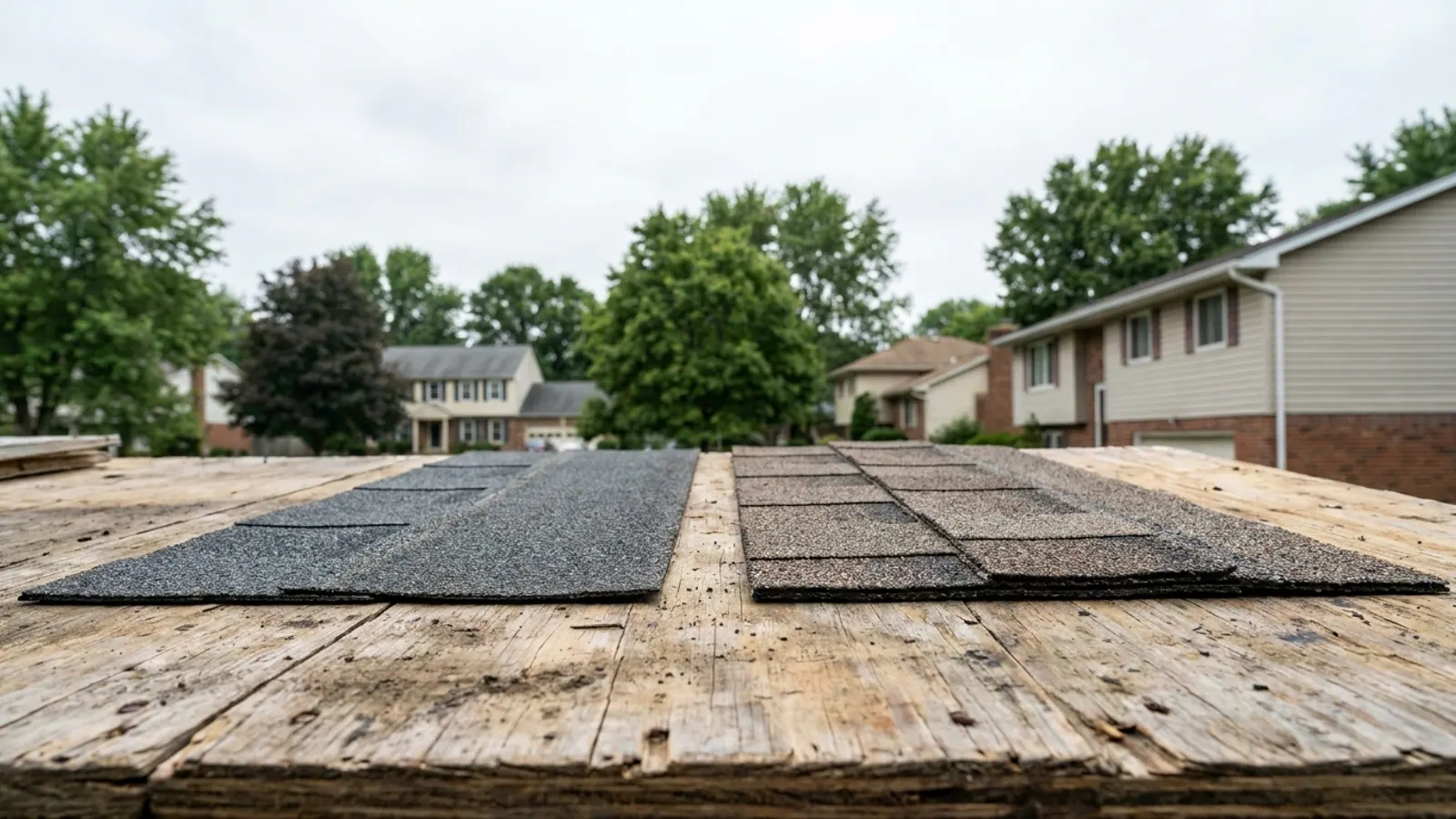
A 3-tab shingle is one layer of asphalt-saturated fiberglass mat, coated and surfaced with granules, then cut with two notches so each strip reads as three tabs on the roof. Every strip is identical. Every cutout lines up with the ones above and below it.
An architectural shingle, also sold as laminated or dimensional, is two or more layers of that same mat bonded together. The bottom layer is solid. The top layer is cut in a random pattern and laminated on, which is what creates the shadow lines you see from the street. There are no cutouts running the full width of the shingle.
That extra layer changes three things at once: weight, thickness, and how much asphalt is sitting between weather and your deck. It also removes the notches, and the notches are where a 3-tab roof gets into trouble.
Wind ratings, and why they matter on a New Jersey roof
Wind gets under a shingle at its edges. A 3-tab strip has cutouts stacked in vertical lines all the way up the slope, and each cutout is a free edge. Architectural shingles have far fewer exposed edges per square, more surface for the sealant strip to grab, and more weight holding the course down.
The published numbers follow from that. 3-tab products are commonly rated to 60 mph. Architectural products are commonly rated to 110 mph, and many go to 130 mph when they are installed with the manufacturer's enhanced nailing pattern and matched starter strip at the eaves and the rakes. Read the data sheet for the exact product on your estimate rather than trusting a category. The rating is conditional on installation, and a 130 mph shingle nailed high and started with cut-up field shingles is not a 130 mph roof.
New Jersey gets nor'easters every winter and the tail end of tropical systems most summers. Coastal counties take the worst of it, but a gusty spring line of storms strips tabs in Morris and Somerset counties too. The wind rating is the single most practical reason to choose architectural.
Side by side
| 3-tab | Architectural | |
|---|---|---|
| Construction | 3-tabSingle layer, cut into three tabs | ArchitecturalTwo or more layers laminated together |
| Typical wind rating | 3-tabAround 60 mph | Architectural110 mph, up to 130 mph with enhanced nailing |
| Appearance | 3-tabFlat, uniform, repeating lines | ArchitecturalShadow lines, varied texture, reads like shake or slate from the street |
| Weight per square | 3-tabLighter | ArchitecturalNoticeably heavier |
| Hides a slightly uneven deck | 3-tabNo, the lines telegraph every dip | ArchitecturalYes, the random pattern breaks up the plane |
| Manufacturer warranty tier | 3-tabLower | ArchitecturalHigher, and eligible for enhanced coverage with matched accessories |
| Where it belongs | 3-tabGarages, sheds, matching an existing 3-tab roof | ArchitecturalAlmost every house |
What each one looks like on the kinds of houses New Jersey has
A 3-tab roof is flat and repetitive. On a simple ranch with one long plane, that reads as tidy. On a colonial or a split level with dormers, a garage return and a couple of valleys, it reads as cheap, and the aligned cutouts draw the eye straight to any waviness in the deck underneath. Older sheathing that has taken on a little sag between rafters shows through a 3-tab roof and largely disappears under an architectural one.
Much of New Jersey's housing stock was built between the 1950s and the 1970s. Those roofs have been through at least one replacement already, sometimes two, and the decking is rarely perfectly flat. That is a real, practical argument for the thicker shingle beyond the warranty paperwork.
Color and line selection is a separate decision from this one, and the GAF shingles guide walks through the product lines, the color families and how the warranty tiers stack up. Read it before you pick, not after.
What the upgrade does to the price
It moves you within a range rather than into a new one. Most New Jersey asphalt roof replacements run $9,000 to $22,000 in standard-value towns, $14,000 to $35,000 in higher-value towns, and $25,000 to $60,000 for large or luxury homes. The band is set by the municipality's median home value from ACS 2024 five-year estimates, not by your shingle. Roof size, pitch, the number of valleys and penetrations, how many layers are already up there and the condition of the decking move the number far more than the choice between 3-tab and architectural.
Ask for both on the same estimate if you want to see the gap in your own numbers. Do not accept a per-square figure quoted over the phone as a price; the New Jersey roof cost guide explains what drives the total on a real house.
Warranty coverage is not the same on both
Manufacturer coverage on architectural lines is higher than on 3-tab, and the top tiers require the whole system from one manufacturer: starter strip, underlayment, ridge cap, ventilation. Skip one component to save a few hundred dollars and the roof drops to a lower tier of coverage without anyone telling you.
The manufacturer warranty covers the shingle. It does not cover the installation. Workmanship coverage comes from the contractor, and it is the one that actually matters in the first ten years, because most failures in that window are installation failures rather than product failures. The roof warranty guide covers the difference and what has to be in writing.
When 3-tab is still the right call
There are cases, and a contractor who will not name them is selling rather than advising.
- A detached garage, shed or outbuilding where the roof needs to be sound and inexpensive and nobody is looking at it.
- A repair or a partial slope on a house that already has a 3-tab roof with life left in it, where matching the existing pattern is the point.
- A low-slope porch or addition tied into a 3-tab main roof that you are not ready to replace yet.
That is the list. If the answer is "3-tab because it is cheaper," push back and ask for the two numbers side by side before you decide.
What to confirm before you sign
- The exact shingle line and color, written on the estimate. Not "architectural shingle," the actual product name.
- The starter strip and hip and ridge cap products, named separately. Field shingles cut down for either one costs you wind coverage.
- The nailing pattern, and whether the enhanced pattern needed for the higher wind rating is included.
- Ice and water shield at the eaves and in the valleys, and new drip edge at the eaves and rakes.
- Attic ventilation, intake and exhaust, and what is being added or replaced.
- A price for decking replacement per sheet, or a statement that it is already included.
- Who pulls the permit and who attends the municipal inspection.
On a Lightning Construction estimate, items six and seven are already settled. Extra shingle layers, damaged decking and bad flashing get found at the free inspection and priced into the quote, so there are no change orders on the day. Lightning pulls the permit from your municipality's construction office under the New Jersey Uniform Construction Code and attends the inspection, and you file nothing. There is no deposit, and nothing is due until the work is finished and you have looked at it.
What to do next
Get the roof looked at and get both options priced on one sheet of paper. Lightning Construction is GAF Certified, licensed and insured under New Jersey Home Improvement Contractor registration 13VH12437000, and most asphalt replacements are torn off and finished in a single day. See the roofing service page for what is included in a replacement, then book a free inspection and written estimate. It is genuinely no-obligation, and a salesperson does come to the house.