Short answer
Roofs get replaced in New Jersey all winter, and a cold-weather job is sound work as long as the crew adjusts for the temperature. What changes is shingle handling, nail gun settings, hand-sealing of the shingles that will not self-seal until spring, and clearing frost or snow off the deck before anything goes down. What does not change is the price you were quoted or the time the job takes.
On this page
Roofs get replaced in New Jersey in December, January and February, and a properly run cold-weather job lasts as long as one done in June. What changes is the technique. Shingles behave differently below freezing, the deck has to be dry and clear before anything is fastened to it, and the sealant strip that bonds one course to the next will not activate until the weather warms up. A crew that accounts for all three produces a roof you will not think about again. A crew that installs in January exactly the way it installs in July produces cracked shingles, blown-off courses and nails driven through the mat.
This post is about what actually changes on the roof and on the schedule. If you are still deciding whether to wait, the best time of year to replace a roof in New Jersey guide covers that decision in depth.
Can asphalt shingles be installed in freezing weather?
Yes. There is no temperature in the New Jersey climate at which shingle installation becomes impossible, and the Uniform Construction Code does not set one. Manufacturers publish cold-weather instructions rather than a cutoff, which tells you the answer is procedure, not prohibition.
The real limits are physical and they are all workable:
- Asphalt gets stiff and brittle when it is cold. A shingle that flexes easily at 70 degrees can crack when it is bent at 25.
- The self-sealing adhesive strip on the back of each shingle needs sun and warmth to activate. In winter it usually does not bond until the first stretch of warm days.
- Ice, frost and snow on the decking have to come off completely before underlayment goes down. Fastening over frost traps water under the new roof.
- Daylight is short. A December workday is several hours shorter than a June one, so the start time moves earlier.
What the crew does differently on a cold day
Shingle handling and storage
Bundles are kept warm and brought up in smaller batches so they are still workable when they are opened. Cold shingles are not dropped, dragged or bent sharply over a ridge or a hip. Where a shingle has to be cut, it is scored and snapped with a sharp blade rather than forced, because a cold mat tears where a warm one cuts clean.
Nail gun pressure
This is the detail that separates a good winter roof from a bad one. Cold asphalt resists the nail differently than warm asphalt, and a gun set for summer work will drive heads straight through the shingle mat. Every over-driven nail is a hole with no holding power, and it will not show from the ground. Compressor pressure gets checked against a test shingle and rechecked as the temperature moves through the day, and fastening is done at the nail line where the shingle is doubled.
Hand-sealing
Because the factory sealant will not activate in the cold, the courses that need immediate wind resistance get a hand-applied dab of asphalt roof cement under the tab. The eaves, the rakes, the ridge, the hips and anything around a penetration are the priority. Done right, the roof is wind-resistant the day it goes on and becomes fully self-sealed when spring heat hits it. Skipping this step is the most common winter shortcut and the reason people find shingles in the yard after a February wind event. The GAF shingles guide explains how the sealant strip works in the first place.
Ice and water membrane
Self-adhered membrane at the eaves and in the valleys needs a clean, dry, cold-rated surface to stick. On a freezing morning the deck gets swept and dried first, and the membrane is rolled and pressed rather than laid loose. This is also the layer that does the most for you in a New Jersey winter, since eave protection is part of managing ice dams on the next roof rather than the last one.
Snow and frost on the roof
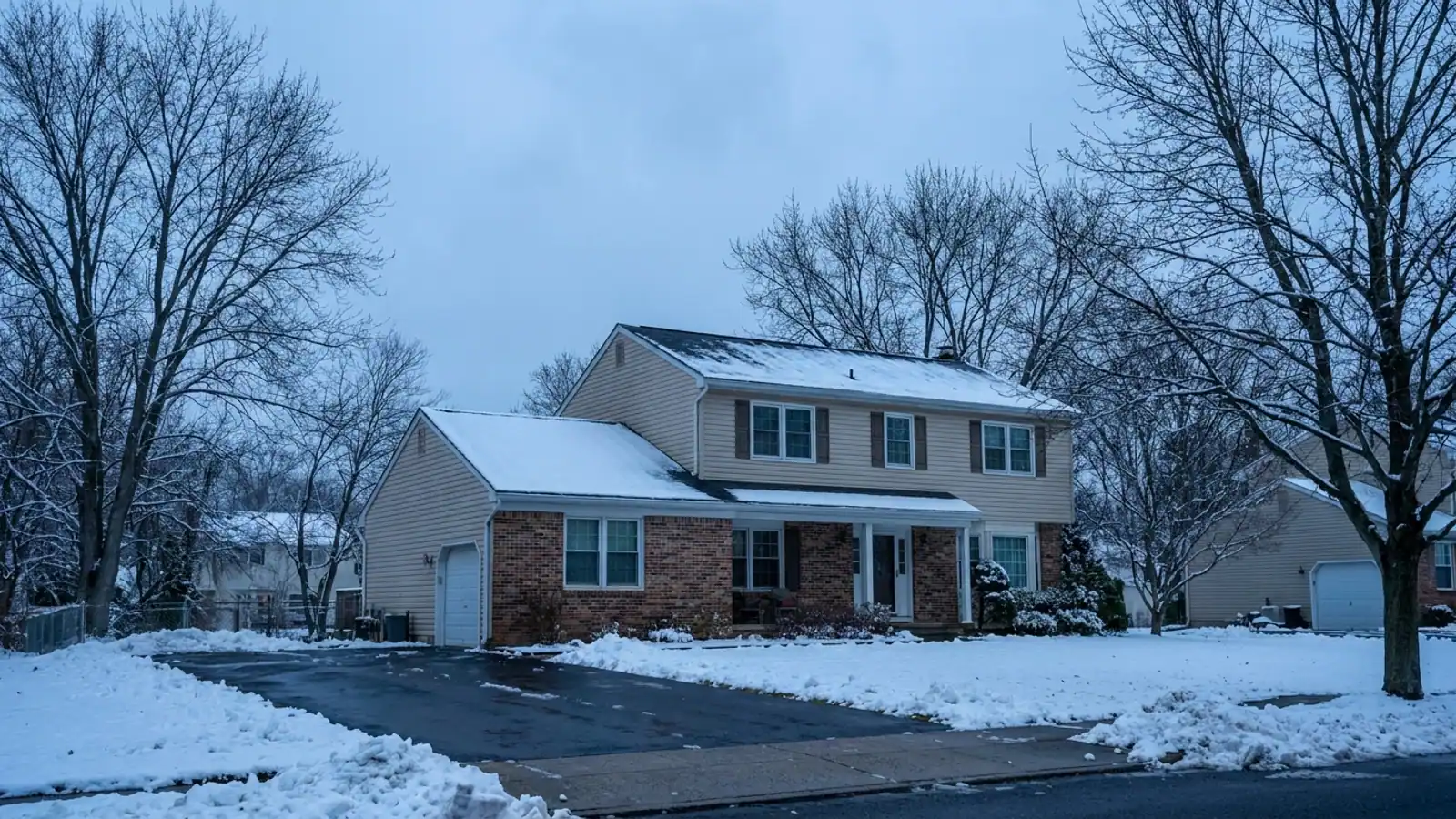
Snow gets removed before the tear-off starts, not worked around. That adds time to the front of the day, and it is the single biggest reason a winter date gets moved. Frost is more deceptive than snow: a north slope can look dry at 7 a.m. and still have a thin frost layer that turns to water under the first course of underlayment.
The honest version of winter scheduling is that the crew watches the forecast and the job moves when the weather says it should. A dry, cold day is a good roofing day. A day with snow falling or ice on the deck is not, and the work gets pushed rather than rushed.
Winter compared with spring and fall
| What changes | Winter | Spring and fall |
|---|---|---|
| What changesShingle flexibility | WinterStiff, handled and cut with more care | Spring and fallFlexes without cracking |
| What changesSealant strip | WinterBonds when warm weather returns; hand-sealed in the meantime | Spring and fallBonds within days |
| What changesDeck prep | WinterSnow and frost cleared before work starts | Spring and fallSweep and inspect only |
| What changesNail settings | WinterAdjusted for cold asphalt and rechecked during the day | Spring and fallSet once |
| What changesWorking daylight | WinterShorter, earlier start and finish | Spring and fallLong |
| What changesWeather delays | WinterMore frequent, driven by snow and ice | Spring and fallDriven by rain |
| What changesTime on site | WinterMost asphalt roofs still one day | Spring and fallMost asphalt roofs one day |
What a winter job day looks like
- The crew arrives early to use the daylight, and the ground, shrubs and driveway get protected before anything comes off the roof.
- Snow and frost are cleared from the slopes that will be worked that day.
- The old roof is stripped to the decking, and any soft or delaminated sheathing is replaced.
- Ice and water membrane goes on at the eaves and valleys, then underlayment over the field.
- Shingles are installed with adjusted nail pressure, and the perimeter and penetrations are hand-sealed.
- Ridge vent and ridge cap go on, the property is cleaned and swept for nails, and the site is walked with you.
Lightning Construction pulls the permit from your municipality's construction office and attends the inspection, in every town, in every season. You file nothing.
When waiting until spring is the right call
If your roof is aging but not leaking, and nothing is blowing off, waiting costs you nothing and you get a longer working day. That is a fair answer and worth hearing from a contractor.
Waiting is the wrong call when water is already getting in. A leak that runs from December to April soaks decking, insulation and ceilings, and you end up paying for interior repairs on top of the roof replacement you were going to buy anyway. Lightning runs 24/7 emergency response for that situation.
What to do next
Get the roof looked at before you decide the season. The inspection and the written estimate are free with no obligation, and a salesperson does come to the house. The estimate that comes out of it is the final price, with no deposit and no change orders, because extra shingle layers, bad decking and failed flashing are found at the inspection and priced in rather than discovered on the day. Financing is available through GreenSky and FTL, including 24 months at 0 percent interest and 120-month terms with no prepayment penalty.
Book a free inspection and written estimate on the get an estimate page and find out whether your roof needs to be done this month or can wait for the warm weather.