Short answer
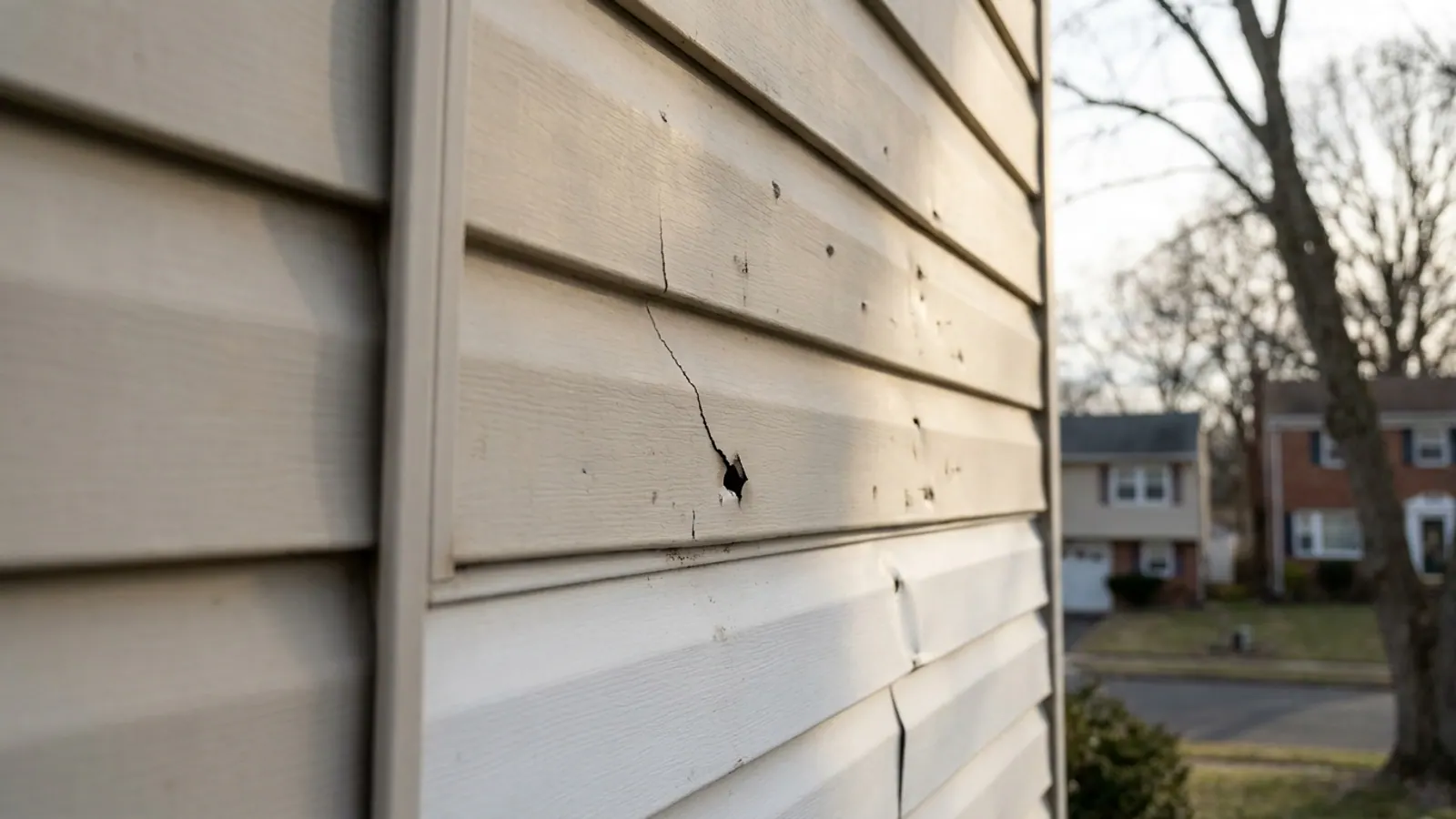
Hail and wind damage on vinyl siding usually shows up as hairline cracks, small punched holes and panels unlocked from the course below, and almost none of it is visible from the ground. You find it by walking each wall at arm's length in low side light, starting with the elevations the storm hit. What matters is not how the vinyl looks but whether water is now getting behind it, because the house wrap and sheathing fail long before the panel does.
On this page
Hail and wind damage on vinyl siding is mostly invisible from the driveway. The failures that matter are hairline cracks, small punched holes, chipped butt edges and panels that have unlocked from the course below, and all four of those disappear at a distance of twenty feet. A wall can look perfect from the street and still be letting water behind it after every rain.
That is the whole problem with storm damage on vinyl. The panel is a rain screen, not a waterproof layer, and it was never meant to be airtight. What keeps the wall dry is the house wrap and the flashing behind the siding. Once an impact opens a path that lets wind-driven rain past the panel at an angle the system was not designed for, the damage moves into the sheathing where nobody is looking.
What hail actually does to a vinyl panel
Vinyl is a thermoplastic. Its impact resistance is temperature dependent, and in New Jersey that matters because hail here is not only a summer event. A late-season storm in March or November comes down on siding that is cold and brittle, and a stone that would leave a shallow dent in August will crack straight through in cold weather.
The four things hail leaves behind:
- Punctures. A clean round or oval hole, usually smaller than a dime, most often in the lower third of a panel where the vinyl is unsupported.
- Cracks. Short vertical splits, often running up from the butt edge, sometimes only a hairline wide. These are the ones homeowners miss.
- Chipped butt edges. The lower lip of the panel breaks away in small pieces, which weakens the lock on the course below.
- Dents and bruising. Less common than on aluminum, but a heavy stone can leave a dished area that shows only in raking light.
Thickness matters here. Builder-grade vinyl cracks at impact levels that heavier panels shrug off. If your siding is the thin stock that went on a lot of New Jersey subdivisions in the 1980s and 1990s, expect more of it to be damaged after the same storm.
What wind does, and why it looks different
Wind damage is patterned and hail damage is random. That single difference is how you tell them apart standing at the wall.
Vinyl hangs from a nail hem and locks into the panel below. Wind gets under the butt edge, lifts the course, and either unlocks it, splits the nail hem, or pulls it off the wall completely. It concentrates where pressure is highest: the top course under the eave, the corners, the gable ends, the wall facing the storm, and anywhere the panels were nailed too tight to move.
An unlocked panel is the one to look for. It will still be hanging on the wall, still look more or less straight, and the lock at its bottom edge will have let go so the panel rattles when you push it. Rain runs behind it from that point on.
How to inspect your own walls after a storm
Do this within a week, while the evidence is fresh and before the next rain washes debris off the ground.
- Start with the elevation the storm came from. In most New Jersey storms that is the north or east wall, but check your yard for which side took the branches and leaf litter.
- Walk each wall at arm's length, not from the lawn. Go slowly, eye level first, then crouch and look up along the plane of the wall.
- Use low side light. Early morning or late afternoon sun raking across a wall shows dents and waviness that noon light hides completely.
- Push on every panel at the butt edge. A panel that is still locked gives a little and springs back. One that is unlocked moves loose and clicks.
- Check corner posts, J-channel at window openings and any utility penetration. Those are where wind-driven water gets in first.
- Look at the ground. Chips of vinyl, pieces of butt edge and torn nail hem in the mulch mean something above you let go.
- Photograph everything, with a tape measure or a coin in frame for scale, and note the date.
Anything above the first story needs a ladder or someone with one. Do not climb a wet ladder to look at siding.
Reading what you found
| What you see | What it usually means | Urgency |
|---|---|---|
| What you seeHairline crack above the nail hem | What it usually meansCosmetic for now, water path later | UrgencyMonitor, plan a repair |
| What you seeCrack or hole in the exposed face | What it usually meansRain reaches the house wrap behind it | UrgencyRepair this season |
| What you seeChipped butt edge | What it usually meansWeakened lock, panel may release in the next wind | UrgencyRepair soon |
| What you seePanel unlocked or rattling | What it usually meansAlready taking water behind the wall | UrgencyFix now |
| What you seeDents only, no cracks | What it usually meansAppearance issue, no water path | UrgencyDocument, no rush |
| What you seeStaining or soft spots on interior drywall | What it usually meansWater has been behind the wall a while | UrgencyOpen the wall and look |
The one row people underrate is the unlocked panel. There is no hole, nothing looks broken, and the wall is wetting out behind the siding every time it rains sideways.
Why the damage keeps going after the storm
Water behind vinyl does not run off the way it does on the face. It tracks down the house wrap, finds a lap or a staple hole, and soaks into the sheathing. On an older house where the wrap was never properly lapped over the flashing at window and door openings, it gets into the framing. The siding looks the same for years while the wall behind it softens.
That is why a storm inspection on siding should include someone pulling a panel in the suspect area. You cannot assess a rain screen without looking behind it once. If the sheathing is dry and the wrap is intact, you replace panels and move on. If it is not, the scope changes, and you want to know that before you sign anything rather than halfway through the job.
While you are at it, look up. The same storm that cracked siding often lifted shingles or bent gutter hangers, and the storm damage guide for New Jersey roofs covers what to check on the roof and in what order.
Repair, partial replacement or whole-house residing
Three honest outcomes, and which one applies depends on three questions: how widespread the damage is, whether matching material exists, and what the wall behind it looks like.
A few panels, matching stock available
Swap them. An installer unlocks the course with a zip tool, removes the damaged panel, and locks a new one in. The catch is color. Vinyl fades under New Jersey sun, so a panel in the original factory color rarely matches siding that has been up for fifteen years. On a side wall nobody sees, that is acceptable. On the front, it is not.
One elevation hit hard
Residing a single wall gives you a clean color break at the corner post, which looks far better than a patchwork of mismatched panels across one face. It is a real option when the storm came from one direction and the other three walls are untouched.
Damage across most of the house, or the profile is discontinued
At that point you are residing. Siding runs $10,000 to $22,000 in standard-value towns, $16,000 to $38,000 in higher-value towns, and $30,000 to $70,000 on large or luxury homes, with the band set by the municipality's median home value from ACS 2024 five-year estimates. Wall size, the number of corners and openings, trim, soffit and fascia work, and what is found behind the old siding all move the number within that band. If the walls are coming off anyway, this is the moment to decide between heavier vinyl and fiber cement, and the siding options guide lays out how the two compare on impact resistance and maintenance.
Documenting it properly
Whether or not you file a claim, document the damage the same way: dated photos of each elevation from a distance, close-ups of every crack and hole with something in frame for scale, and photos of debris on the ground. Note the date of the storm. Keep the written estimate with the photos.
If you do go to your insurer, understand that the policy language, the deductible and the age of the siding all drive the outcome, and a contractor cannot tell you what your carrier will approve. What a contractor can do is document what is actually wrong and price the repair in writing.
What to do next
Walk the walls, photograph what you find, and get a written opinion before the damage turns into rot behind the sheathing. Lightning Construction inspects siding and writes estimates free with no obligation, a salesperson comes to the house, and there is no deposit on any job. The written estimate is the final price, with no change orders, because the conditions that normally trigger one are found at the inspection and priced in. Permits, where the municipality requires them, are pulled by Lightning under the New Jersey Uniform Construction Code, and Lightning attends the inspection.
Start with the siding page to see what the work covers, or book the free estimate and have someone look at the wall before the next storm.