Short answer
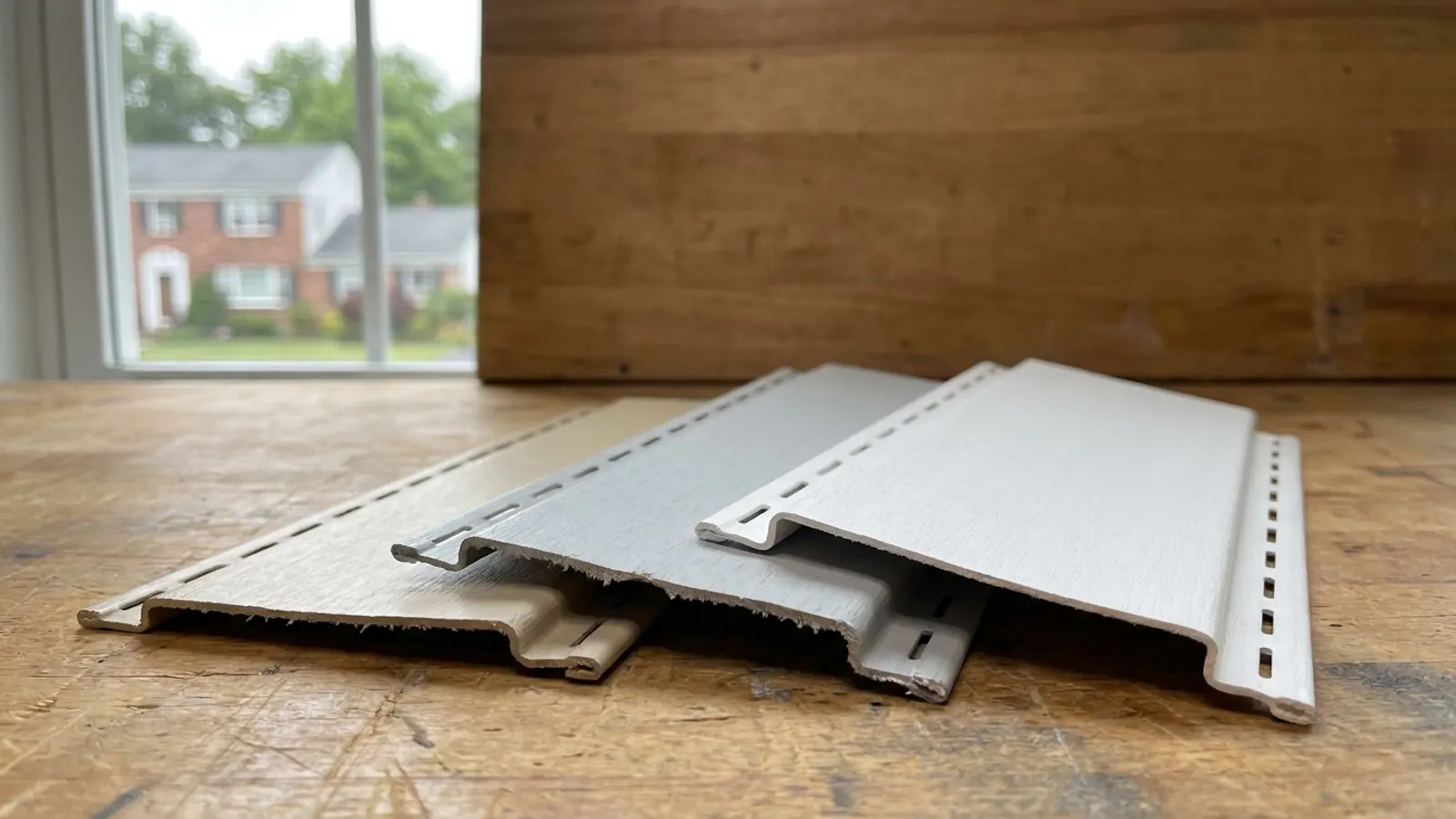
Vinyl siding thickness is measured in thousandths of an inch and typically runs from about 0.040 on builder-grade panels to 0.046 and above on premium lines. The extra thickness buys rigidity, which shows up as a flatter wall, deeper shadow lines, better impact resistance and a higher tested wind load. It does not buy color retention, insulation value or a better installation, and those decide more about how the wall looks in ten years than the panel number does.
On this page
- What the gauge number on vinyl siding actually measures
- Common vinyl siding thicknesses, side by side
- What the extra thickness buys you
- What thickness does not buy
- Where thickness stops mattering: the installation
- When the heavier panel is worth it on a New Jersey house
- What to get in writing before you sign
Vinyl siding thickness is measured in thousandths of an inch, not in a wire gauge, and residential panels run from about 0.040 on builder-grade lines to 0.046 and above on premium ones. The extra thickness buys rigidity. A stiffer panel hangs flatter, holds a deeper profile, resists a thrown baseball or a hail strike better, and carries a higher tested wind load. That is the whole of it. Thickness does not buy color retention, it does not buy insulation, and it does not fix a bad wall underneath.
Here is what each part of that means when you are standing in the driveway comparing two estimates that both say "vinyl siding."
What the gauge number on vinyl siding actually measures
It is the thickness of the vinyl itself, taken at the face of the panel, written as a decimal fraction of an inch. A 0.044 panel is forty-four thousandths of an inch thick. Salespeople say "forty-four gauge" out of habit, but there is no gauge scale involved.
ASTM D3679 is the product standard for rigid vinyl siding, and it sets 0.035 inch as the floor. Anything sold as certified siding meets that. Almost nothing sold for a full residential re-side in New Jersey is that thin, because a 0.035 panel telegraphs every irregularity in the wall behind it.
One thing to watch: the number is measured on the vinyl, not on the assembly. Insulated siding has rigid foam bonded to the back of the panel, and the vinyl skin on it usually sits in the same 0.042 to 0.046 range as standard siding. The foam changes how the wall behaves, but it does not change the vinyl measurement, so do not let a quote present total panel depth as thickness.
Common vinyl siding thicknesses, side by side
| Thickness | Where it shows up | What you notice on the wall |
|---|---|---|
| Thickness0.035 in | Where it shows upASTM minimum, rarely specified for a full re-side | What you notice on the wallFlexible, follows every dip in the sheathing |
| Thickness0.040 in | Where it shows upBuilder grade, tract work, budget quotes | What you notice on the wallReads thin at the butt edge, more visible seams |
| Thickness0.042 in | Where it shows upMid-range residential | What you notice on the wallAcceptable on flat, sound walls with tight stud spacing |
| Thickness0.044 in | Where it shows upStandard residential upgrade | What you notice on the wallNoticeably stiffer, holds line better on long runs |
| Thickness0.046 in and up | Where it shows upPremium and architectural lines | What you notice on the wallDeep profile, strong shadow line, highest tested wind loads |
The jump most homeowners actually feel is between 0.040 and 0.044. Above 0.046 the returns get smaller and the panel starts costing real money.
What the extra thickness buys you
A flatter wall. Thicker vinyl resists bowing between fasteners. On a wall with studs 16 inches on center and older sheathing that has moved, a 0.040 panel picks up the waves. A 0.044 or 0.046 panel spans them better.
Deeper shadow lines. Thicker stock holds a sharper butt edge, so a double-4 or dutchlap profile reads more like wood from the street instead of flattening out in direct sun.
Higher wind load. Vinyl siding is tested for transverse load under ASTM D5206, and thicker panels with a deeper nail hem generally carry higher ratings. That rating only holds if the panel is fastened on the manufacturer's schedule, which is usually every 16 inches for horizontal siding.
Impact resistance. Thicker vinyl takes a hit better in cold weather, when all vinyl gets more brittle. A January stone from a mower is the usual test.
A better nail hem. This matters more than the face thickness and nobody talks about it. The nail hem is the folded top edge that the fasteners go through, and premium lines fold it thicker and roll it more securely. A blown-off panel almost always tears at the hem, not in the field.
What thickness does not buy
Color retention. Fade resistance comes from the pigments and the UV-stable capstock on the outer layer, not from the thickness. A well-pigmented 0.042 panel will hold its color longer than a poorly pigmented 0.048 one. Ask which line, not just which number.
Energy savings. Standard vinyl of any thickness has essentially no R-value. If you want a thermal difference, that is a separate product conversation, and the siding options guide lays out where vinyl sits against fiber cement.
A dry wall. Vinyl siding is a rain screen, not a waterproof layer. Water gets behind it by design and is meant to drain out. What keeps the wall dry is the house wrap, the flashing at every penetration and the way the panels are lapped. Thicker vinyl over a failed wrap is still a wet wall.
Straight lines. A thick panel installed too tight, nailed through the face, or started off level will still look wrong.
Where thickness stops mattering: the installation
Vinyl moves. A 12-foot panel can grow and shrink as much as half an inch across a New Jersey year, from a January morning to an August afternoon on a south wall. Every install rule for vinyl exists because of that movement, and violating them ruins expensive siding faster than a thin gauge ever will.
- Nails go in the center of the slot, straight, never at an angle.
- Nails are driven to leave roughly 1/32 inch of shank showing, so the panel hangs and slides rather than being pinned.
- Panels are never nailed through the face. A face nail is a permanent buckle waiting for the first hot week.
- Panels get a gap where they meet trim and channels, wider in cold weather, per the manufacturer's instructions.
- Vertical laps are staggered so seams do not stack in one line down the wall.
If you want to judge a siding job, look down the wall at a low angle in the afternoon. A well-hung wall is straight. A pinned wall waves.
When the heavier panel is worth it on a New Jersey house
Go thicker when the wall is long and uninterrupted, when the house sits on an open lot or near the water and takes real wind, when you are choosing a deep profile like dutchlap or board and batten, or when the sheathing underneath is old and no longer perfectly flat. A lot of New Jersey housing stock was built between the 1950s and the 1970s and has moved since.
Stay in the mid range when the walls are short and broken up by openings, the house is sheltered, and the budget is better spent on trim, soffit and fascia detail that you will actually look at.
New Jersey siding jobs run $10,000 to $22,000 in standard-value towns, $16,000 to $38,000 in higher-value towns, and $30,000 to $70,000 for large or luxury homes. The band is set by the municipality's median home value from ACS 2024 five-year estimates, not by your panel thickness. Moving from 0.040 to 0.044 moves you within a range; it does not move you into a new one. Lightning Construction works in all 21 New Jersey counties, and you can find your town on the service areas page.
What to get in writing before you sign
Ask for four things on the estimate: the manufacturer, the product line, the panel thickness in inches, and the profile. "Premium vinyl" is not a specification. If the number is not written down, you cannot check what came off the truck.
Also confirm who pulls the permit and what happens if the crew finds rot behind the old siding. Lightning Construction pulls the permit and attends the municipal inspection under the New Jersey Uniform Construction Code, takes no deposit, and writes no change orders. The conditions that normally trigger one are found at the free inspection and priced into the quote, so the written estimate is the final price.
Book a free siding estimate and a salesperson comes to the house, measures the walls, looks at the condition of what is behind the existing siding, and leaves a written number with the product line and thickness on it. There is no obligation. You can compare the details of what is included on the siding page before the appointment so you know what to ask about.