Short answer
Vinyl siding buckles because it expands and contracts with temperature, and nails driven tight through the nailing hem stop it from moving. With nowhere to go, the panel pushes against its fasteners and bows outward between them. The fix is to unlock the affected courses and re-hang them with the nails centered in the slots and left slightly loose, which usually means removing and reinstalling siding rather than pushing it flat.
On this page
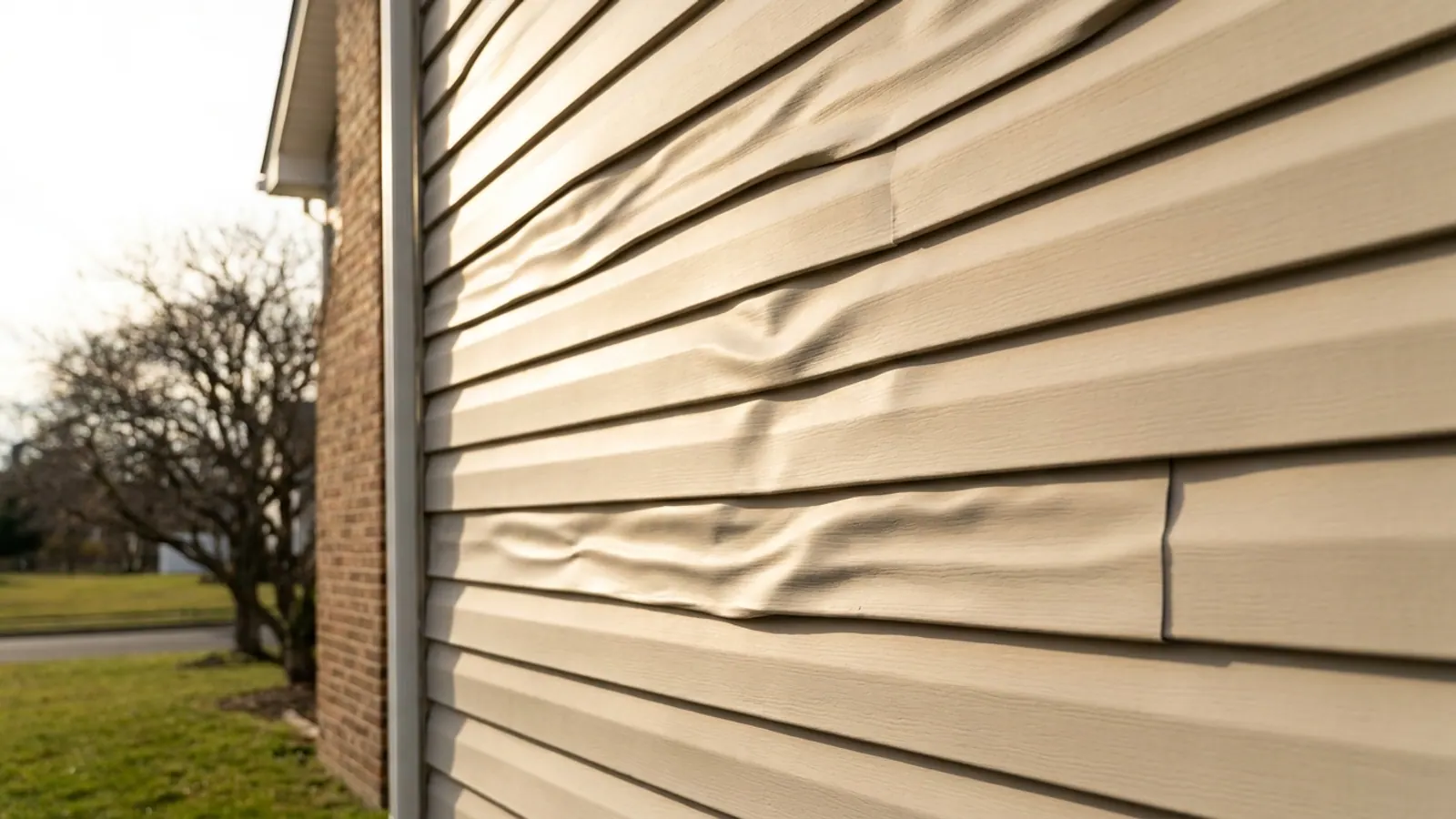
Vinyl siding buckles because it moves and the fasteners will not let it. Vinyl expands when it heats up and contracts when it cools, and every panel on your house is designed to slide side to side as that happens. When a nail is driven tight against the nailing hem, or driven through the face of the panel, that course is pinned. The next hot afternoon the vinyl grows, has nowhere to go, and bows outward between the fasteners. That is the wave you see from the driveway.
This is one of the most common installation defects in New Jersey, and it is almost always visible within the first full summer after the job.
Why vinyl siding buckles in the first place
A 12-foot vinyl panel changes length noticeably between a January morning and a July afternoon. That is not a defect. It is why the panel has horizontal slots in the nailing hem instead of round holes, and why manufacturer instructions tell the installer to hang the siding rather than fasten it.
Hung correctly, a panel locks into the course below it, rests on the nails, and slides freely behind the nail heads as the temperature changes. Pin it in any one spot and the movement has to show up somewhere else. On a south- or west-facing wall in full sun, the force is enough to visibly deform the panel.
The usual causes, in the order we find them:
- Nails driven all the way home against the hem instead of left slightly loose.
- Nails placed at the end of a slot instead of centered in it.
- Panels cut too long and jammed into the J-channel or corner post with no clearance.
- Face-nailing, where the installer drives a nail straight through the panel to hold a stubborn spot.
- Panels stretched upward while nailing instead of being pushed up until they lock and then released.
All five look fine on installation day. All five show up when the wall heats up.
How to tell nailing is the cause and not something else
Wavy vinyl has three common explanations, and they look different up close.
| What you see | Likely cause | What it means |
|---|---|---|
| What you seeLong, even ripples between fastener points, worse in afternoon sun | Likely causeNails too tight or panels locked at the trim | What it meansInstallation error, fixable by re-hanging |
| What you seeMelted, rippled or glossy distortion in one concentrated spot | Likely causeReflected heat from glass or a grill | What it meansA heat source, not the nailing |
| What you seeBulges that follow the wall plane, with soft spots behind | Likely causeFailed sheathing or a wet wall underneath | What it meansOpen the wall before touching the siding |
There is a fast field check. Push up on the bottom edge of a buckled panel with your palm. A correctly hung panel has a little play and slides. A pinned panel is rigid. Then look along the butt line at the corner post. Vinyl that was cut tight into the channel with no gap will show a hard, bowed line right at the trim.
What the instructions actually require
The standard manufacturer requirements are specific, and they are the same ones a municipal inspector and a good crew work from. Nails go in the center of the slot. The nail head is left roughly a thirty-second of an inch off the hem, so the panel can slide. Fasteners penetrate the nailable substrate, not just the foam board. Panels get clearance at every corner post, J-channel and stop — more in cold weather than in warm, because a panel installed on a 35-degree day is going to grow.
What goes behind the siding matters just as much as how it is fastened. Our guide to siding options for New Jersey homes covers how vinyl and fiber cement differ in how they handle movement, weather and impact.
How buckled vinyl siding gets fixed
The honest answer is that you cannot press it flat. The panel is deformed because it is being held, and the wave comes back with the next temperature swing. The repair is mechanical.
- The crew unlocks the course above with a zip tool, which releases the lock on the buckled panel.
- The buckled panel comes off, along with any panel above or below that is also pinned.
- The old fasteners are pulled and the house wrap behind them is checked and patched where nails punched through it.
- Panel ends are re-cut for proper clearance at the corner posts and J-channels.
- The panels are re-hung with nails centered in the slots, left loose, and the courses are re-locked.
When the buckling is limited to one elevation and the color still matches, this is a repair. When the whole house was hung this way, re-hanging every panel costs nearly what new siding costs, and the panels have already been stressed and handled twice. At that point replacing the siding is the better spend.
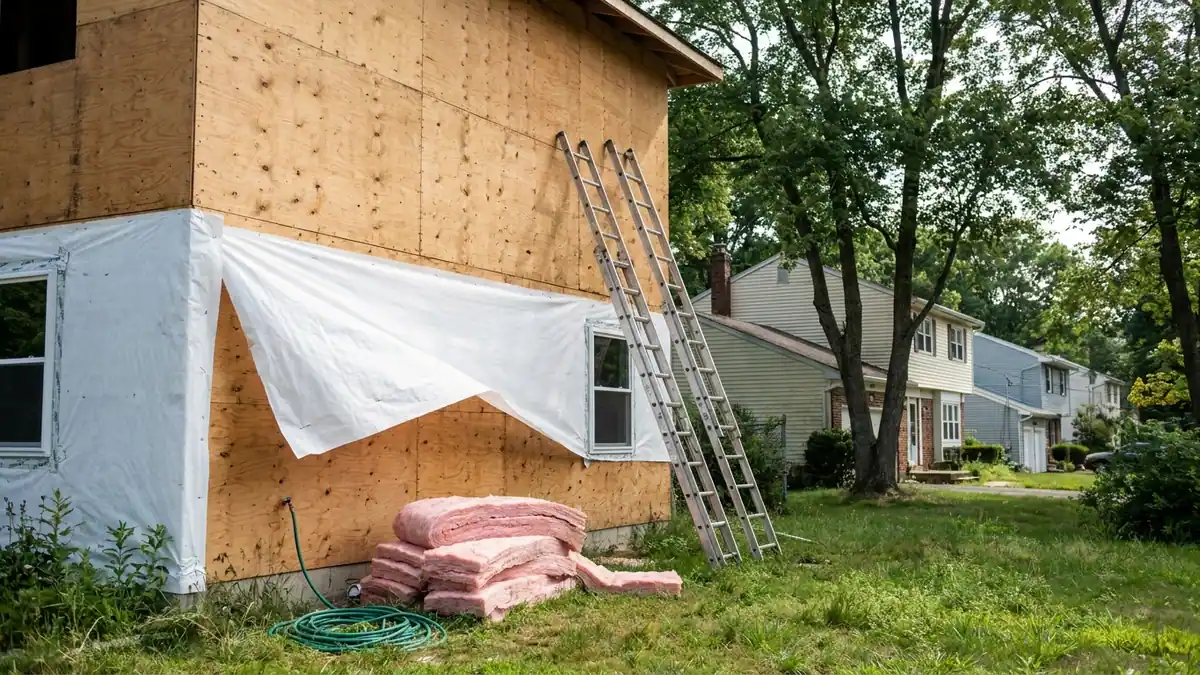
The other thing that decides it is what is behind the wall. Face-nailed panels mean holes through the house wrap. If the wall has been taking water at those points for a few seasons, the sheathing needs to be looked at before anything new goes back up.
Matching panels on a repair
Vinyl fades. Not badly, and not evenly, but enough that a panel pulled from a stock of the same color and profile rarely matches a wall that has been in the sun for a decade. Darker colors show it more than beige and clay.
This is why a repair on a low-visibility elevation often works and a patch in the middle of the front of the house often does not. Where the profile has been discontinued, which happens with older houses, a full elevation is the practical option.
What siding work costs in New Jersey
Siding in New Jersey runs $10,000 to $22,000 in standard-value towns, $16,000 to $38,000 in higher-value towns, and $30,000 to $70,000 on large or luxury homes. The band is set by the municipality's median home value from ACS 2024 five-year estimates, not by the profile or color you pick. Wall area, the number of corners, window and door openings to trim around, soffit and fascia, and the condition of what is behind the old siding move the number inside the band.
A targeted repair on one wall is a much smaller job than any of those ranges, and a free inspection is how you find out which conversation you are having.
How Lightning Construction handles it
We come out, look at the wall, and tell you whether it is a re-hang or a replacement. The inspection and the written estimate are free with no obligation, and a salesperson does come to the house.
If it is a replacement, three things are settled before anyone starts. There is no deposit — nothing is due until the work is finished and you have inspected it. There are no change orders, because rot, failed house wrap and bad substrate are found at the inspection and priced into the written estimate. And Lightning pulls the permit and attends the municipal inspection under the New Jersey Uniform Construction Code, in every one of the 544 municipalities we serve. You file nothing.
We are veteran-owned and family-operated, GAF Certified, licensed and insured under New Jersey Home Improvement Contractor registration 13VH12437000, and rated 4.9 out of 5 from 264 Google reviews. More on who runs the company is on our about page.
What to do next
Go out on a hot afternoon and look down the length of each wall from the corner, not straight on. Buckling shows in raking light and hides in flat light. Check whether the bottom edge of a wavy panel slides when you push it, and look for nail heads visible on the face of any panel.
If you find either, get it looked at before another summer stresses the panels further. Schedule a free inspection and written estimate and we will tell you plainly whether you are looking at a repair or a wall.