Short answer
Light and mid-tone colors hold their look longest, because there is less pigment to break down and any shift is harder to see. Dark colors can hold up well in New Jersey, but only from a product line built for them, with engineered inorganic pigments in a thick capstock rather than a dark color sprayed into a standard panel. The exposure matters as much as the color, since south and west walls take years more sun than the north side of the same house.
On this page
- Why vinyl siding fades in the first place
- Which colors hold up, and which ones move
- Exposure matters as much as the color
- What the fade warranty actually says
- How to choose a color so it still looks right in ten years
- Fading and repairs: the part nobody mentions
- What this costs in New Jersey
- What to do next
Light and mid-tone colors hold up best in New Jersey sun, and the darker you go, the more the product line matters. A white, almond, clay or light gray panel from almost any decent manufacturer will still look right in fifteen years. A deep charcoal, navy or forest green will too, but only if it comes from a line engineered for dark colors, with the right pigments in a thick capstock. The same shade pulled from a cheap line will be noticeably lighter on the south wall long before the rest of the house catches up.
Here is what actually causes the fade, which colors tolerate it, and what to put in writing before you pick a color off a chip card in a showroom.
Why vinyl siding fades in the first place
Ultraviolet light breaks down the pigment molecules at the surface of the panel. Heat speeds that up, and so does rain, airborne salt and the grit that collects on a wall nobody ever washes.
Good vinyl siding is co-extruded, which means it is made in two layers at once. The substrate underneath is the bulk of the panel and carries the strength. The capstock on top is a thinner outer layer that carries the color, the UV inhibitors and the weathering package. The capstock is the only part of the panel the sun ever touches, so the quality and thickness of that layer decides how long the color lasts.
Two panels can look identical on a sample board and be completely different here. One has a generous capstock loaded with titanium dioxide and inorganic pigments. The other has a thin cap with organic pigments that give a rich color on day one and give it up by year six on a west-facing gable.
Which colors hold up, and which ones move
Color families behave differently, and the pattern is consistent.
| Color family | How it holds up | What to know |
|---|---|---|
| Color familyWhite, almond, cream | How it holds upBest | What to knowVery little pigment to break down, and a small shift is nearly invisible |
| Color familyLight gray, sandstone, clay | How it holds upVery good | What to knowThe current default on most New Jersey re-sides for good reason |
| Color familyMid-tone gray, sage, pewter | How it holds upGood | What to knowSafe in any reputable line; shows dirt less than white |
| Color familyDeep charcoal, navy, hunter green | How it holds upGood in the right line only | What to knowNeeds engineered inorganic pigments and a thick capstock |
| Color familyRed, burgundy, bright blue | How it holds upHardest | What to knowHistorically the quickest to shift; demand written fade coverage |
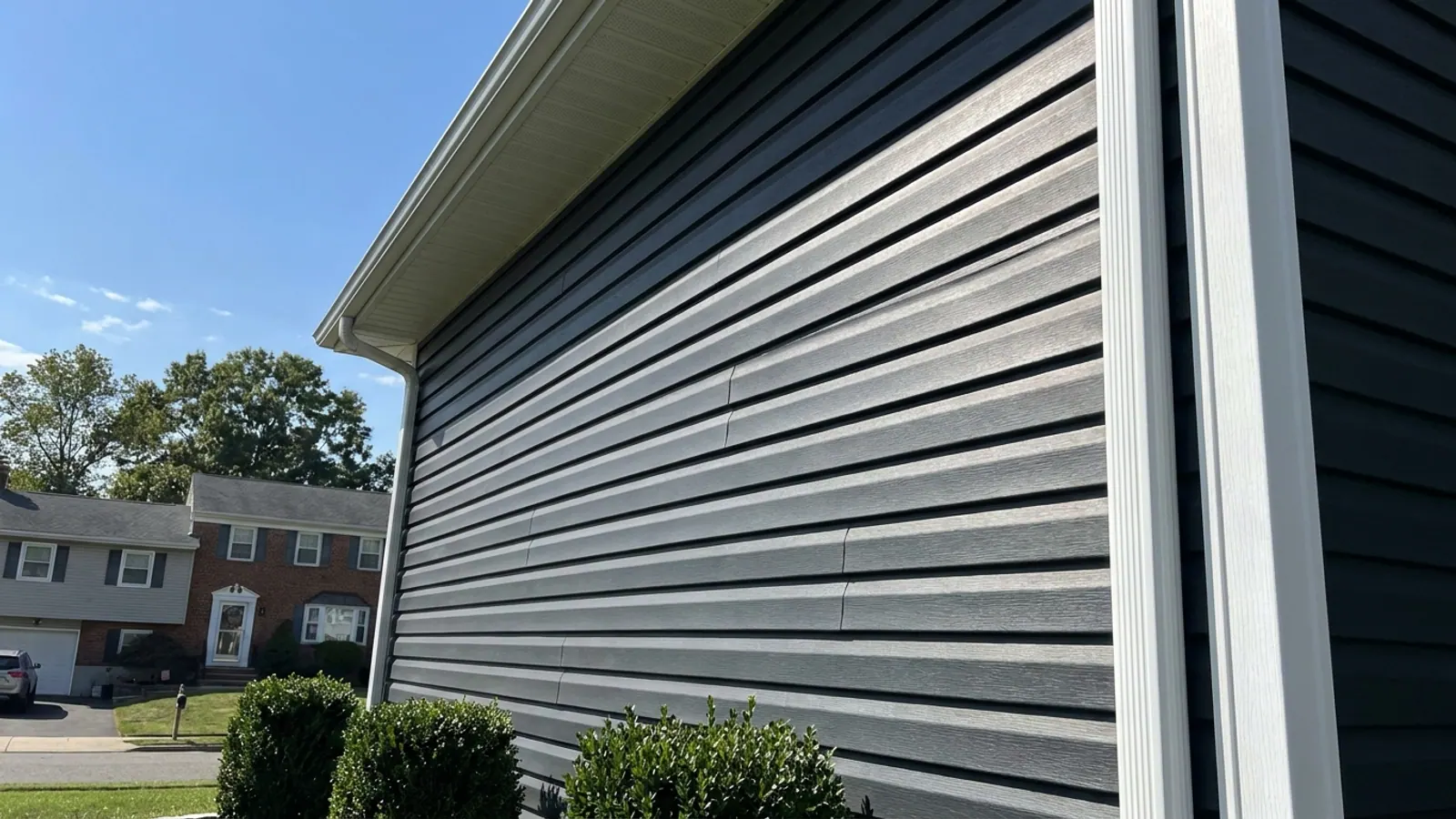
The honest version is that dark siding is a legitimate choice in New Jersey now in a way it was not twenty-five years ago. Manufacturers build dedicated dark-color lines with heat-reflective pigment technology and stiffer formulations. You pay more for those lines. If a contractor quotes you a deep charcoal at the price of a builder-grade white, something in the specification is not what you think it is.
Exposure matters as much as the color
Fading is not uniform across a house, and that is what homeowners actually notice.
South and west walls take the most direct sun and the most hours of it. A second-story gable with no tree cover gets more than the first floor behind a maple. North walls barely change at all. Ten years in, the complaint is rarely "my siding faded" and almost always "the front looks different from the back."
There are two other sources of local damage worth naming. Reflected light and heat off a neighbor's window or a glass storm door can concentrate on one spot. So can heat bouncing off a dark driveway or a grill left too close to the wall. Those produce a bleached or distorted patch, not even fading, and no color choice prevents them.
What the fade warranty actually says
Read the fade clause, not the cover of the brochure. Most vinyl siding warranties handle color separately from the panel itself, and the terms are specific:
- A stated limit on color change, usually expressed in Hunter units and measured to an industry test method. Change inside that limit is normal weathering and is not a claim.
- An exclusion for anything not caused by the product, including reflected heat, chemical exposure, pressure washing with the wrong detergent, and painting the panels.
- Proration. Full coverage for an initial period, then a declining percentage.
- Transfer rules if you sell the house, often limited to one transfer and a set window after installation.
Ask for the actual warranty document for the exact line and color on your estimate before you sign. Dark colors sometimes carry different terms than the light colors in the same family. If nobody can produce the document, that tells you what the coverage is worth.
How to choose a color so it still looks right in ten years
Small chips lie. Get full panel samples, take them outside, and hold them against the things on your house you are not replacing.
- Look at the samples on a bright day and again on an overcast one. Vinyl reads several shades different between the two.
- Hold the panel against the brick, stone or roof shingle you are keeping. Those are fixed; the siding is the variable.
- Check the trim, soffit and fascia at the same time. A charcoal wall with a white corner post is a hard line, and the contrast is the whole look.
- Pick a color the manufacturer sells across its full accessory range, including corner posts, J-channel, utility trim and the soffit profile you need.
- Order a few extra panels and store them flat in a garage or basement. Years later, they will match the original stock far better than a current-production run of the same color name.
The guide to siding options for New Jersey homes covers the material decision between vinyl and fiber cement, which is the choice to settle before you worry about shade.
Fading and repairs: the part nobody mentions
If a tree limb takes out four panels on your sunniest wall in year twelve, a new panel in the same color will not blend. Weathered vinyl never goes back to its original shade, and the new piece sits there brighter than everything around it. This is why light colors are the practical choice on a house you plan to keep a long time. There is simply less distance between weathered and new.
When the damage is large or the wall is badly faded, replacing the full elevation corner to corner is usually the result that looks right. On a two-story with a sun-beaten west side, that is a real conversation to have before the crew starts, not after.
What this costs in New Jersey
Siding runs $10,000 to $22,000 in standard-value towns, $16,000 to $38,000 in higher-value towns, and $30,000 to $70,000 for large or luxury homes. The band is set by the municipality's median home value from ACS 2024 five-year estimates, not by your color choice. Within a band, the panel line, the thickness, the trim package and the amount of wall move the number. A premium dark-color line costs more than a standard white, and the estimate should show you which one you are buying by name.
Lightning Construction works in all 21 New Jersey counties and 544 municipalities, takes no deposit, writes no change orders, and pulls the permit and attends the municipal inspection itself. The written estimate is the final price, and nothing is due until the work is finished and you have walked the house.
What to do next
Narrow it to two colors, get full panels of both, and look at them on your own wall at noon and at five o'clock. Then ask for the product line in writing, with the fade warranty attached.
Lightning's inspection and written estimate are free with no obligation, and a salesperson does come to the house. See the siding service page for what the work covers, or book a free estimate and bring your color questions to the appointment.