Short answer
Switching from stucco to siding is a tear-off job, not an overlay. The stucco, the metal lath and the old building paper all come off down to the sheathing, and what the crew finds behind it sets the real scope, because stucco that cracked and leaked for years often leaves wet sheathing and soft framing under the openings. Once the walls are dry and sound, new house wrap, new flashing and either vinyl or fiber cement go on.
On this page
Stucco does not get sided over. On a New Jersey house where the stucco is cracked, stained or hollow, the switch to siding is a full removal down to the sheathing, followed by whatever repair the sheathing and framing need, then a new water-resistive barrier, new flashing and new siding. That is the honest scope, and any quote that skips the removal is quoting a different job than the one your house needs.
Here is what the work actually involves, what usually turns up behind the stucco, and what to settle in writing before a crew shows up.
Why New Jersey stucco walls fail
There are two different stucco systems on houses here, and they fail differently.
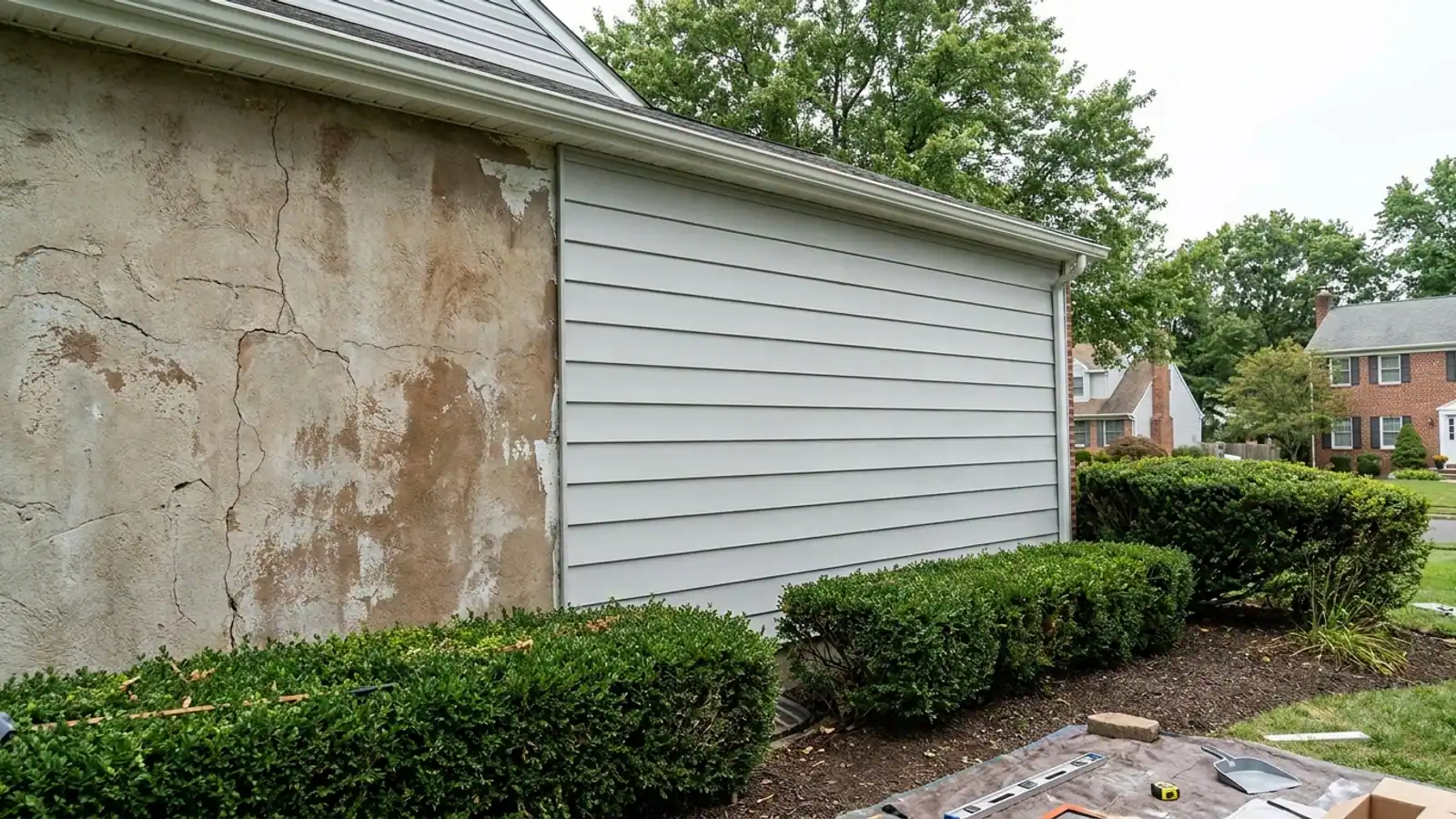
Traditional stucco is three coats of portland cement plaster over metal lath and building paper, fastened to the sheathing. Cement plaster cracks. That is expected, and a hairline crack on a wall with an intact drainage layer behind it is not an emergency. The trouble starts when New Jersey's freeze-thaw winters widen those cracks year after year and the paper behind the lath is torn, lapped backward or missing at the openings. Then every crack is a path to the sheathing and nothing drains back out.
Synthetic stucco, or EIFS, is foam board with a thin acrylic finish coat. Older barrier-style installations were built with no drainage plane at all, so any water that got past the finish had nowhere to go. Those walls hide damage well, which is the problem.
Signs the stucco is past patching
- Cracks wider than about an eighth of an inch, especially running diagonally from the corners of openings
- Areas that sound hollow when tapped, which means the plaster has separated from the lath
- Dark staining or streaking below window corners, band joists and roof-to-wall junctions
- Soft, spongy spots you can push in with a screwdriver
- Bulges, rust stains bleeding through the finish, or crumbling at the base of the wall
- Peeling interior paint, musty smell or stained baseboards on an exterior wall
One or two tight cracks on an otherwise sound wall can be patched. A wall with hollow sections, staining under the openings and soft sheathing is telling you the drainage layer is gone, and patching the surface changes nothing.
What happens when the stucco comes off
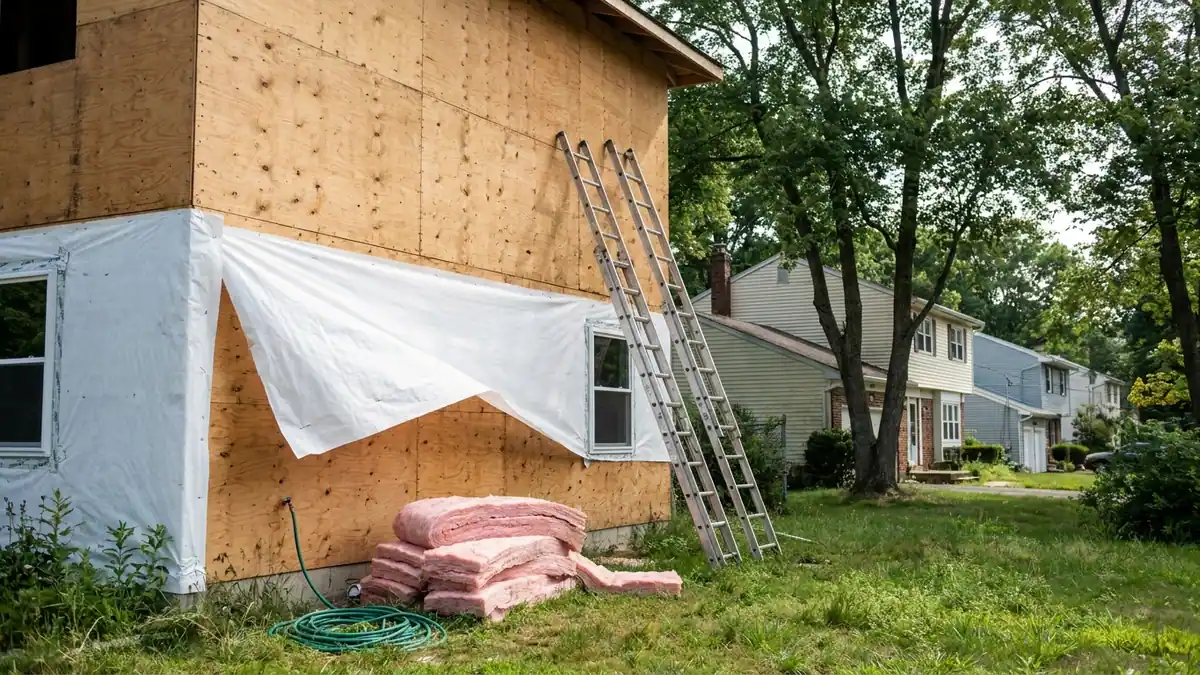
Removal is the loud, heavy part of the job. Cement stucco and lath are dense debris, so the dumpster fills faster than it does on a vinyl tear-off. The crew stages the walls, protects the ground and the plantings, then strips the plaster, the lath and every lath fastener, and scrapes the old building paper off the sheathing.
What shows up underneath, in rough order of how often it shows up:
- Delaminated or blackened plywood and OSB sheathing, usually under and around openings
- Soft bottom plates and rim joists where water ran down the inside face of the wall
- Building paper installed with reverse laps, or no paper at all behind an EIFS wall
- No pan flashing at window sills and no kickout flashing where a roof edge meets a wall
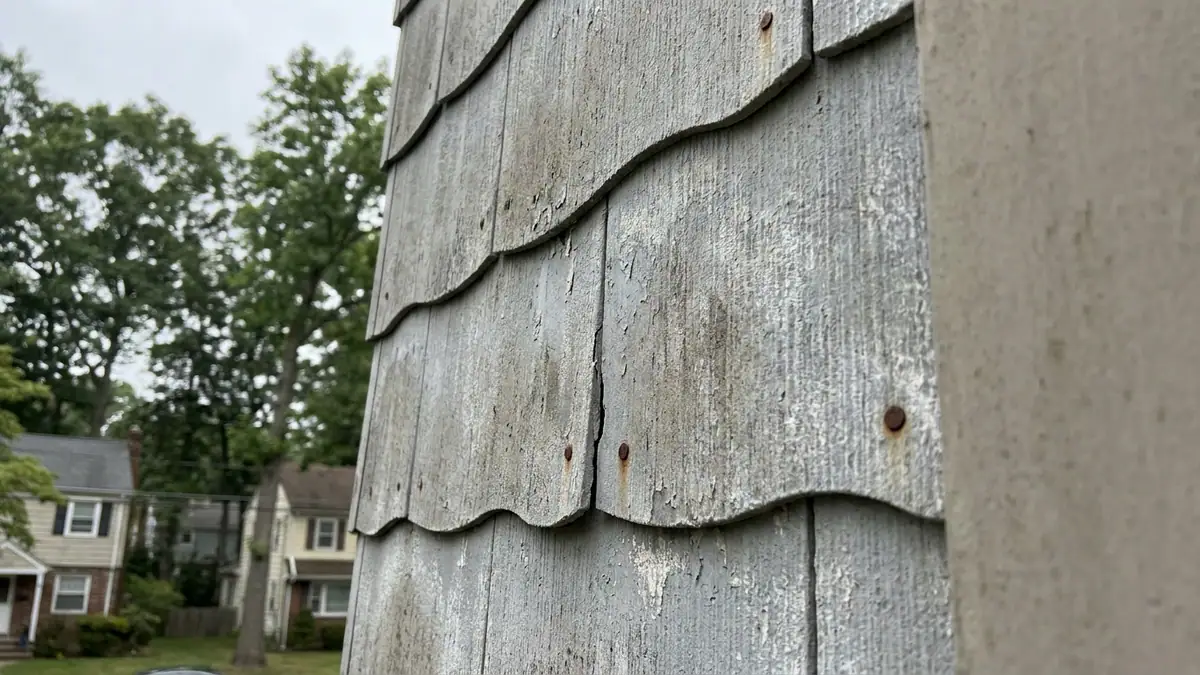
- Rusted or missing lath fasteners that never hit framing
Those conditions are the reason stucco removal gets quoted badly. A contractor who prices only what he can see from the driveway has to come back and ask for more money once the wall is open. Lightning Construction writes no change orders, which means the sheathing, framing and flashing work is found at the free inspection and priced into the written estimate. There is also no deposit on the job, so nothing is due until the work is finished and you have walked the house and inspected it.
The stucco-to-siding job, step by step
- Free inspection and written estimate. A salesperson comes to the house, walks every wall, probes the soft areas and opens a test section where the readings call for it. The estimate is the final price.
- Lightning pulls the permit from your municipality's construction office under the New Jersey Uniform Construction Code and attends the inspection.
- Staging goes up, ground and landscaping get covered, the dumpster is set.
- Stucco, lath, fasteners and old paper come off down to bare sheathing.
- Damaged sheathing is cut out and replaced, soft framing is sistered or replaced, and the wall is re-nailed to the schedule.
- New house wrap goes on with correct laps and taped seams, plus flashing at every opening and penetration and kickout flashing at roof-to-wall junctions.
- Corner posts, trim, starter strip and J-channel, then the siding itself.
- Soffit and fascia are addressed, and gutters and downspouts go back up or get replaced.
- Final cleanup, nail sweep, and the municipal inspection.
One thing to plan around: Lightning does roofing, metal roofing, siding and gutters, not windows or doors. If your windows are at the end of their life, replace them before the siding goes on, because the new trim and flashing are built around them.
Vinyl or fiber cement on a former stucco wall
| Standard vinyl | Insulated vinyl | Fiber cement | |
|---|---|---|---|
| Wall appearance | Standard vinylLight, slight flex between studs | Insulated vinylFlatter, more solid-looking | Fiber cementHeaviest, flattest, closest to masonry-era detailing |
| Weight on framing | Standard vinylLowest | Insulated vinylLow | Fiber cementHighest, framing condition matters more |
| Finish upkeep | Standard vinylNone, color is through the panel | Insulated vinylNone | Fiber cementFactory finish, repaint eventually |
| Impact resistance | Standard vinylLowest | Insulated vinylBetter | Fiber cementBest |
| Relative cost | Standard vinylLowest | Insulated vinylMiddle | Fiber cementHighest |
Houses that were stuccoed often have tight, plain trim details and shallow overhangs, and fiber cement handles that look better. Vinyl is the value choice and performs fine on a properly wrapped wall. The siding options guide compares the two materials in depth, including trim, color and maintenance.
What a stucco-to-siding job costs in New Jersey
Lightning's siding range is $10,000 to $22,000 in standard-value towns, $16,000 to $38,000 in higher-value towns, and $30,000 to $70,000 for large or luxury homes. The band is set by your municipality's median home value from ACS 2024 five-year estimates, not by your material choice.
Inside your band, a stucco removal sits toward the higher end of comparable work, because the tear-off labor is heavier, the disposal weight is greater, and sheathing repair is more common than it is behind vinyl. Wall area, the number of stories, the number of openings and how much framing needs replacing move the number more than anything else. Take the range as a range and get your own number in writing.
The details that keep the new wall dry
The siding is the last layer, not the waterproofing. What keeps water out of a former stucco wall is underneath it:
- A continuous water-resistive barrier, lapped shingle-style and taped at the seams
- Flashing at every opening head and sill, and at hose bibs, vents and electrical penetrations
- Kickout flashing where a lower roof dies into a wall, which is one of the most common sources of the stains you see on stucco
- A drainage gap where the material calls for one, so anything that gets behind the panel can exit at the bottom
- Gutters and downspouts that actually carry water away from the wall instead of overflowing down it, which is worth handling with the siding while the staging is already up. Our gutters page covers seamless aluminum, guards and downspout sizing.
Ask for those items by name on the estimate. A line that says only "install siding" tells you nothing about the wall behind it.
What to do next
If your stucco is cracked, stained or hollow, get the walls looked at before another winter opens the cracks further. The inspection and written estimate are free with no obligation, a salesperson comes to the house, and the price you sign is the price you pay. See the siding services page for what the work includes, or request a free estimate and we will pull the permit and attend the inspection in your municipality.