Short answer
They leak because the hood or block was sealed to the face of the siding with caulk instead of being flashed into the water-resistive barrier behind it. Caulk is a wear item and fails in a few seasons, and once it opens at the top edge, wind-driven rain runs straight into the wall cavity. A penetration done right is lapped into the house wrap with the barrier shingled over the top flange, so water is directed back out even when the sealant is gone.
On this page
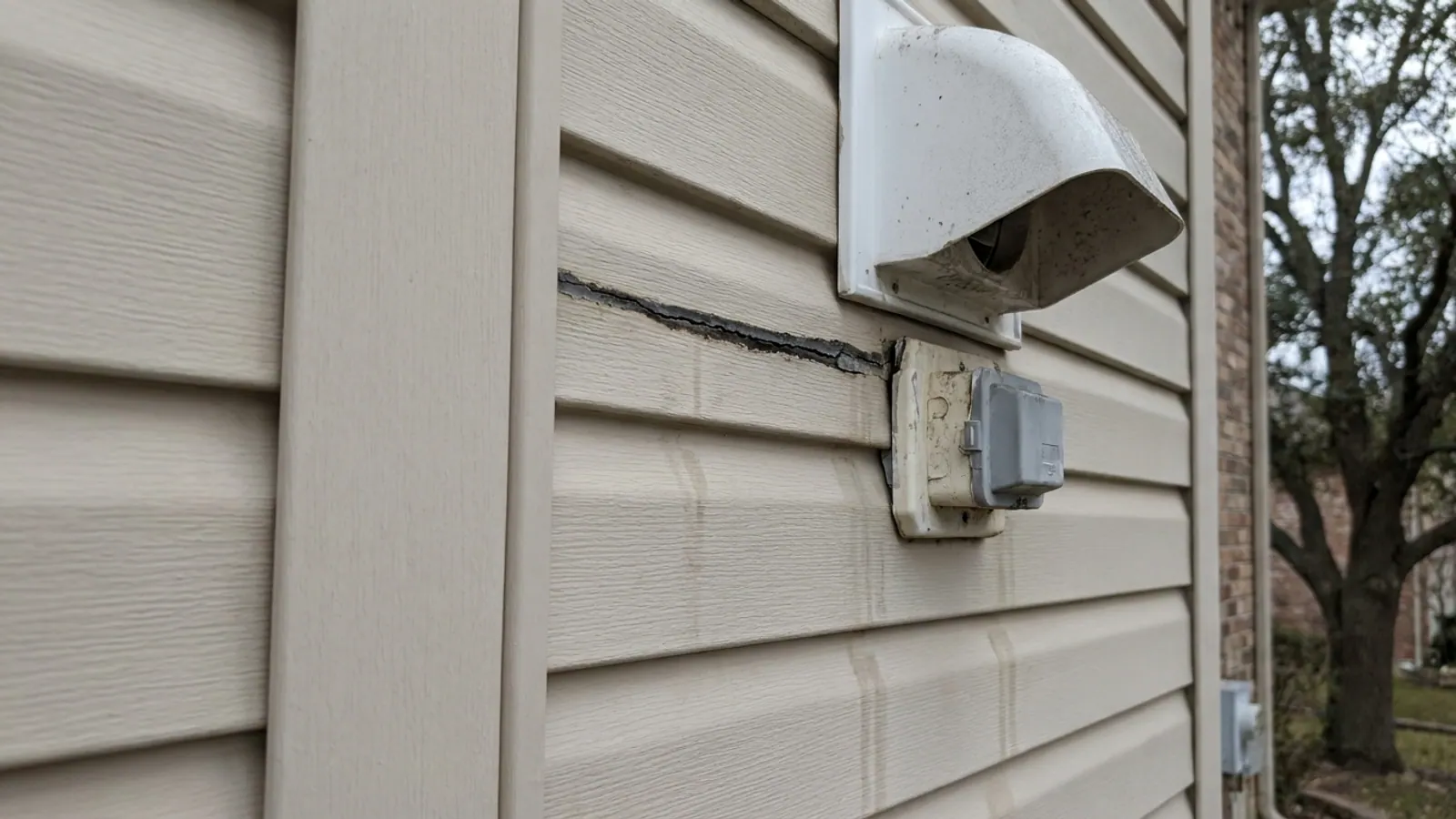
A dryer vent leaks because somebody caulked the hood to the face of the siding and called it sealed. Caulk is a wear item. It shrinks, it pulls away at the top edge first, and once that joint opens, wind-driven rain follows the duct straight into the wall cavity where nothing dries out.
The same thing happens at bath and range exhaust hoods, at outlet and light mounting blocks, at hose bibs, and at every cable, camera and mini split line set that got drilled through the wall after the siding went up. These are small holes. They cause a disproportionate share of the rot we find when we strip a wall.
Why the hole is the problem, not the siding
Vinyl siding is not a watertight skin and was never designed to be. It is a rain screen. Water gets behind it in every storm, runs down the back of the panels, and is supposed to drain out at the bottom. The layer that actually keeps the house dry is the water-resistive barrier behind the siding, usually house wrap or felt, lapped from the bottom up so every upper course sheds over the one below it.
A penetration cuts through both layers. If the barrier is simply slit open and the vent duct shoved through, the cut edge at the top of the hole faces up and collects everything running down the wall. Sealant on the outside of the siding is the only thing stopping it, and sealant on the outside of the siding does not last as long as the siding does.
This is true of fiber cement and standard vinyl alike. The siding material changes the look, the impact resistance and the price, not the physics of a hole in a drainage plane. The siding options guide covers what separates the materials themselves.
The penetrations that cause the most trouble
Dryer vent hoods
The worst offender, for three reasons. The duct is large, often four inches, so the hole is large. The hood has a hinged damper that gets propped open by lint, which lets rain and snow blow in. And the air leaving it is warm and humid, so any moisture that does get into the cavity sits in a warm, damp pocket and feeds mold instead of drying.
Dryer exhaust also has to terminate outdoors. Not into a soffit, not into the attic, not into a crawl space. We still find ducts dumping into soffit cavities on older New Jersey houses, and the wet sheathing above it tells the story before anyone opens the wall.
Kitchen and bath exhaust hoods
Same geometry, different grease load. A range hood termination collects a greasy film that holds dirt, breaks down sealant faster, and keeps the damper from closing. Bath fan terminations are often the ones installed last and flashed least, especially when the fan was added during a bathroom remodel years after the siding.
Outlet blocks, light blocks and hose bibs
A mounting block is a molded plastic pad that gives a flat surface on a profiled wall. Installed correctly it has a nailing flange that goes under the course above and over the course below, with flashing tape at the top. Installed badly it is screwed over finished siding and ringed with caulk, which seals the bottom edge too and traps whatever gets in.
Hose bibs add a second problem. They vibrate, they get yanked on by a hose, and the pipe behind them is a condensation source in summer.
Anything added after the siding went on
Satellite brackets, cameras, low-voltage lighting, generator interlocks, mini split line sets. These are drilled by a trade that is not a siding trade, and the hole is almost never flashed. A line set sleeve angled uphill through a wall is a funnel.
Caulk versus a flashed penetration
| Caulk-only install | Flashed install | |
|---|---|---|
| What stops water | Caulk-only installA bead of sealant on the siding face | Flashed installHouse wrap lapped over the top flange |
| Service life | Caulk-only installA few seasons before the top edge opens | Flashed installAs long as the wall assembly |
| What happens when sealant fails | Caulk-only installWater enters the cavity with no exit | Flashed installWater drains back out behind the siding |
| Drainage at the bottom | Caulk-only installSealed shut, so water is trapped | Flashed installLeft open on purpose |
| Visible from outside | Caulk-only installLooks identical | Flashed installLooks identical |
That last row is why this keeps happening. You cannot tell the two apart from the driveway. The only moment anyone can verify it is when the siding is off.
How to tell water is already getting behind the wall
- A dirty vertical streak on the siding below a hood or block, which means water is running where it should not be.
- Caulk that has shrunk, cracked or pulled away at the top edge of the hood.
- Siding panels that feel loose or sound hollow and dull when tapped near the penetration.
- Soft drywall, blistered paint or a baseboard pulling away on the inside of that same wall.
- A musty smell in the laundry room or the bathroom served by that fan.
- Carpenter ants or a small wasp nest at the penetration, which usually means soft wood.
Rule out the easy cause first. If the gutter above that wall overflows in heavy rain, the water sheeting down the siding is a drainage problem before it is a penetration problem, and the gutter maintenance guide covers how to confirm that.
What a correct penetration looks like when siding is replaced
- The old hood or block comes off with the siding and the hole is opened up so the sheathing around it can be seen and pressed on.
- Soft or rotted sheathing gets cut back to sound framing and replaced. Patching over wet wood is how the next siding job finds the same hole.
- The water-resistive barrier is repaired or replaced across the whole wall, not patched in a square around the opening.
- Flashing tape goes on in order: sides, then a head flap, with the house wrap above cut and lapped over the top flange of the hood or block.
- The unit is fastened through its flange, not face-screwed through finished siding.
- Sealant goes on the sides and top as a secondary line, and the bottom edge is deliberately left open so anything that gets in can get back out.
- The siding is cut to the unit with the correct clearance, not jammed tight against it, because vinyl moves with temperature.
Step three is the one homeowners never see quoted. Ask whether the estimate includes replacing the house wrap and how rotted sheathing is handled.
What this costs and what to get in writing
Penetration detailing is not a line item you shop separately. It is part of a siding replacement, which runs $10,000 to $22,000 in standard-value New Jersey towns, $16,000 to $38,000 in higher-value towns, and $30,000 to $70,000 on large or luxury homes. The band comes from the municipality's median home value in the ACS 2024 five-year estimates, not from how many vents are in the wall.
Get these in the written estimate before you sign anything:
- Every penetration listed by name, including ones the previous owner added.
- New mounting blocks and new vent hoods where the old ones are brittle or will not seal.
- Who replaces the house wrap, and over how much of the wall.
- How rotted sheathing is priced, and whether that price is already in the total.
Lightning Construction takes no deposit, writes no change orders, and finds the conditions that normally trigger one during the free inspection so they are already in the quote. We pull the permit and attend the municipal inspection under the New Jersey Uniform Construction Code in every municipality we work in, and we work in all 21 New Jersey counties.
What to do next
If you have a stain under a dryer vent, press on the siding around it and press on the drywall inside. Soft in either place means the wall is already wet and re-caulking the outside will not reverse it. Book a free inspection and written estimate. It is genuinely no-obligation, a salesperson does come to the house, and you will see photographs of what is behind the hood rather than a guess from the driveway.