Short answer
Trim is included only if the quote says so in writing, and that is exactly where two siding bids on the same house separate by thousands of dollars. A complete siding quote names the field siding, the corner posts, the J-channel, how existing trim is handled, the soffit and fascia, the shutters, the mounting blocks and the disposal. If a line is not written down, assume it is not in the price.
On this page
- What a complete siding quote should list
- Trim: wrapped, replaced, or left as it is
- J-channel, corner posts and the details that carry the labor
- Shutters: reinstall, replace, or leave them off
- Soffit, fascia and where the siding job meets the roof
- Two things Lightning does not put in a siding quote
- What siding costs, and why the trim moves the number
- What to do next
Trim is included only when the quote says it is. That single line is why two siding bids on the same New Jersey house can land thousands of dollars apart while both claim to be for "siding." The field panels on the flat walls are the easy part and the cheapest part. The money and the labor are in the edges: corner posts, J-channel, window and door trim, rake boards, soffit, fascia, shutters and every block a light fixture or a dryer vent sits on.
So read the estimate for what it lists at the edges, not what it charges per square. Below is what belongs on a complete siding quote, what each item actually is, and the questions that flush out a bid that left half the house off the page.
What a complete siding quote should list
A quote you can compare against another quote names materials and quantities, not just a total. At minimum, look for these lines:
- Tear-off and disposal of the existing siding, or a written statement that the new siding goes over the old.
- House wrap or building wrap, named by product, and whether it is new or existing.
- The siding itself, named by manufacturer, product line, profile and color.
- Outside and inside corner posts, and whether they are standard or a heavier decorative post.
- J-channel and starter strip at every opening and every termination.
- Window and door trim treatment, spelled out as wrapped, replaced or left alone.
- Soffit, priced by vented or solid, and fascia wrap by linear foot.
- Shutters, priced as reinstall, replace or remove.
- Mounting blocks for lights, hose bibs, dryer vents and electrical outlets.
- Gutter removal and reinstallation, if the gutters come off to get behind the fascia.
- Permit, pulled by the contractor, and final cleanup including magnetic sweep for fasteners.
If you hand a bid to a second contractor and he cannot tell from it what he would be matching, it is not a real estimate. The reading a contractor estimate questions apply just as much to siding as to a roof.
Trim: wrapped, replaced, or left as it is
There are three honest ways to handle the wood trim around openings and along rakes, and they cost three different amounts.
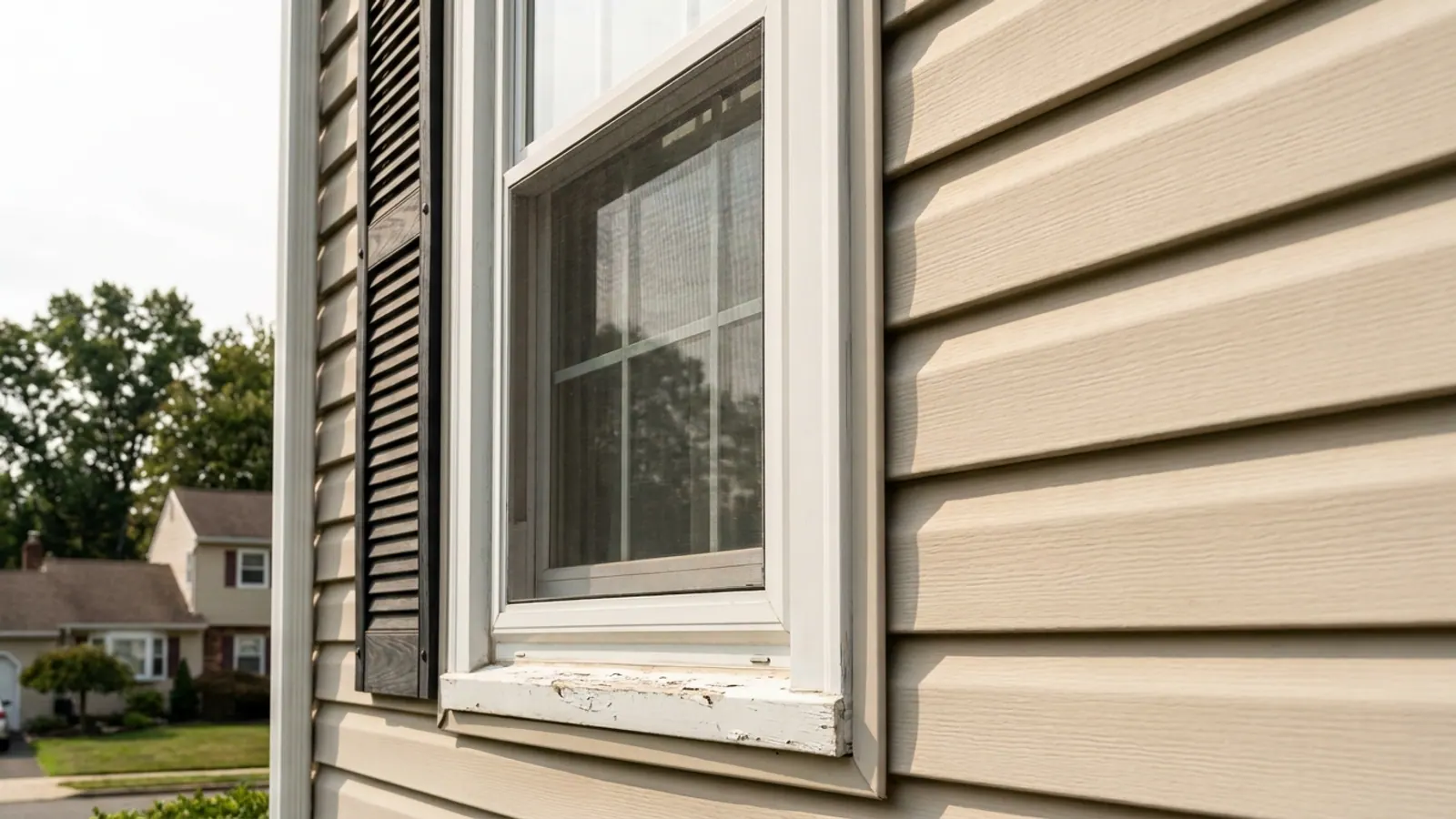
Wrapping means bending aluminum coil stock on a brake and fitting it over the existing wood. The wood stays. The aluminum takes the weather and the color matches the siding. It is the most common approach on New Jersey houses and it works well as long as the wood underneath is dry and solid.
Replacing means pulling the old trim off and installing new PVC or composite boards. It costs more, it takes longer, and it is the right call when the existing trim is rotted, badly cut up from previous work, or so thin that the wrap would look flat.
Leaving it means the old painted wood stays exposed next to brand new siding. Some homeowners choose that deliberately on a house with detailed original trim they want to keep painted. Most do not choose it at all; it just shows up as a surprise on install day because nobody wrote down which of the three was priced.
| Approach | What you get | Where it goes wrong |
|---|---|---|
| ApproachAluminum wrap over existing wood | What you getColor-matched, no painting, fastest | Where it goes wrongRot sealed under the metal if nobody checked the wood first |
| ApproachNew PVC or composite trim | What you getNo rot, crisp edges, full replacement | Where it goes wrongCosts more and adds a day or more to the schedule |
| ApproachLeave existing wood | What you getLowest price | Where it goes wrongOld paint against new siding, and you still own the maintenance |
Ask which one the number covers. Then ask what happens if the crew pulls a piece of trim and finds soft wood behind it. On a Lightning estimate that condition is found at the free inspection and priced into the quote, because there are no change orders and the written number is the final number.
J-channel, corner posts and the details that carry the labor
J-channel is the receiving trim that takes the cut edge of a panel where the siding runs into a window, a door, a roofline or a soffit. Corner posts do the same job at the corners of the house. The material is inexpensive. The labor is not, because each opening has to be cut, lapped in the correct order and left able to drain.
That order matters. Water that gets behind vinyl siding is normal and expected; the system is designed to shed it back out. When the head J-channel over an opening is lapped the wrong way, or the drainage holes at the bottom get sealed with caulk, water stops leaving. That is how a wall rots behind siding that looks perfect from the street.
Heavier corner posts, decorative window headers, wider trim profiles and bead-board porch ceilings all exist as upgrades. None of them are wrong. They just need to be on the page with the rest, so you are choosing them rather than discovering them.
Shutters: reinstall, replace, or leave them off
Decide before the crew arrives. Old vinyl shutters come off sun-faded and often brittle at the mounting holes, and the new panel layout rarely lines up with the old fastener locations. Reinstalling twenty-year-old shutters on a new wall usually looks exactly like what it is.
The three options, plainly:
Reinstall the existing shutters
Cheapest, and reasonable when the shutters are newer than the siding and still hold their color. Expect new fasteners and new holes, and expect a few to crack coming off.
New shutters
A per-pair material cost plus install labor. This is where a plain vinyl wall gets most of its character back, and it is the item homeowners most often forget to price until the siding is already up.
No shutters
A legitimate choice, especially on a house where the shutters never fit the window width to begin with. Say so early, because the old mounting holes need to be handled while the wall is open, not after.
Soffit, fascia and where the siding job meets the roof
Soffit and fascia are separate line items and should be priced separately. Vented vinyl soffit gets installed under the eaves and it feeds the attic intake air, which matters to the whole roof system, not just the look of the overhang. Aluminum fascia wrap covers the board the gutters hang on.
If the gutters have to come off to get at the fascia, that is a line on the quote too. Old aluminum gutters do not always survive removal and reinstallation, which is why fascia work and new seamless gutters are often quoted together. Confirm whether your existing gutters are being reused or replaced, in writing.
Two things Lightning does not put in a siding quote
Windows and doors. Lightning Construction does not sell or install them. The trim around them is siding work and gets wrapped or replaced as part of the job, but the units themselves are somebody else's trade, and any quote implying otherwise is not ours.
A deposit is the other one. Nothing is due until the work is finished and you have walked it. Lightning pulls the permit from your municipality's construction office under the New Jersey Uniform Construction Code and attends the inspection; you file nothing.
What siding costs, and why the trim moves the number
Siding in New Jersey runs $10,000 to $22,000 in standard-value towns, $16,000 to $38,000 in higher-value towns, and $30,000 to $70,000 for large or luxury homes. The band is set by the median home value of your municipality, using American Community Survey 2024 five-year estimates. Within a band, the swing is almost entirely openings, trim detail and how much soffit and fascia is in play. A center-hall colonial with eight simple windows and a rectangular footprint is a different job from a house with dormers, bays, a wraparound porch and forty corners, even at identical square footage.
For material choices behind those numbers, the siding options guide covers vinyl against fiber cement in depth. This post is about what shows up on the page next to whichever one you pick.
What to do next
Get the trim decisions made before you compare prices, because otherwise you are comparing different jobs. Walk your own house first and count the openings, note which trim looks soft or split, and decide now whether shutters stay. Then have someone price all of it at once.
Lightning Construction NJ is veteran-owned, family-operated, GAF Certified, licensed and insured under New Jersey Home Improvement Contractor registration 13VH12437000, and rated 4.9 out of 5 from 264 Google reviews. See what a full siding replacement covers, or book a free inspection and written estimate. It is free and there is no obligation, and a salesperson does come to the house.