Short answer
Most full siding replacements on a New Jersey house take three to seven working days. A straightforward one-story ranch in vinyl can finish in two or three; a two-story house with a lot of trim, or one going to fiber cement, runs a week or more. What stretches a siding job is almost never the siding itself, it is rot behind it, trim detail, and the number of walls the crew can reach at one time.
On this page
Most full siding replacements on a New Jersey house take three to seven working days. A one-story ranch in standard vinyl with simple trim can be done in two or three. A two-story colonial with dormers, a garage return, wrapped columns and a switch to fiber cement is a week or more, and occasionally two.
That is the honest range. What follows is what actually sets your number, what the crew is doing on each of those days, and the specific conditions that add time.
What sets the schedule on your house
Five things, in roughly this order of impact.
Wall area, not floor area. A 1,900 square foot two-story house has less roof than a 1,900 square foot ranch but far more wall, and the second story means scaffold or ladder staging for every course. Wall area is what gets sided, so that is what gets estimated.
Number of corners and openings. Every window, every door, every outside corner, every light fixture, dryer vent, hose bib and electrical penetration is a cut, a flashing detail and a piece of trim. A plain rectangular box goes fast. A house with bay windows, a bumped-out breakfast nook and three roof-to-wall intersections does not.
Material. Standard and insulated vinyl are the fastest. Fiber cement is slower on every step, because the planks are heavy, they are cut with a dust-controlled saw, they are nailed rather than hung on nails, and many details get primed and caulked. The siding options guide compares the two on cost and durability; on schedule alone, expect fiber cement to add days, not hours.
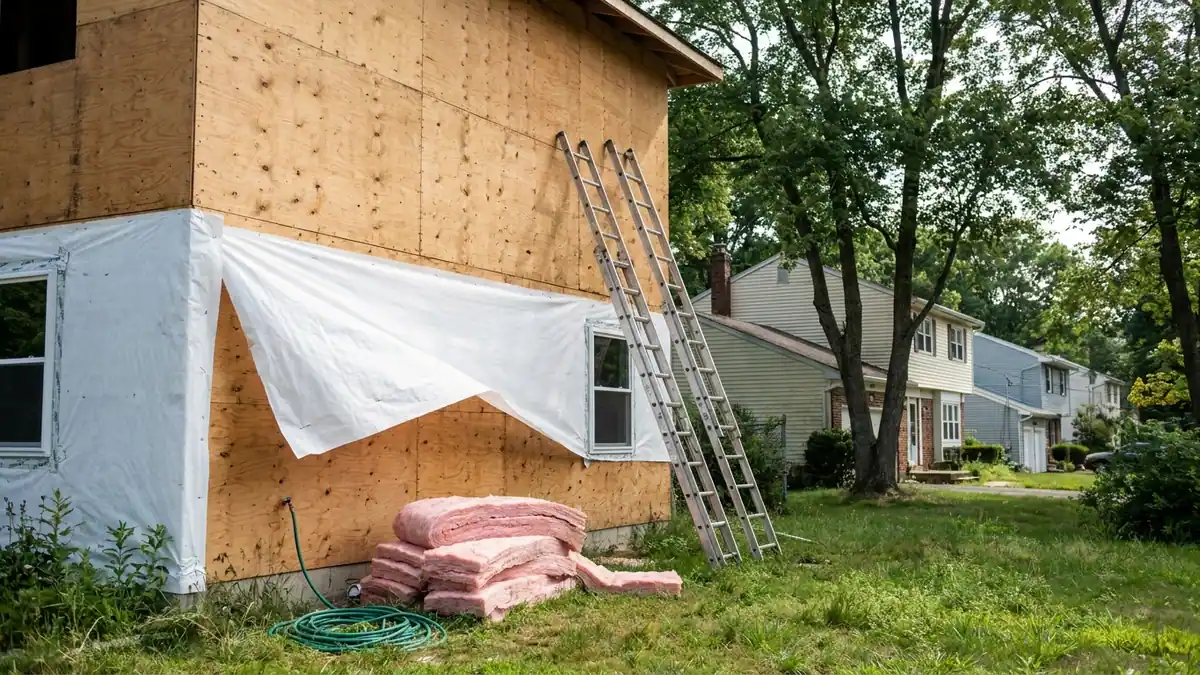
What is behind the old siding. Sheathing that is soft, missing house wrap, or framing that has taken water at a window head all get repaired before new siding goes on. That work is real carpentry and it takes real time.
Access. A house tight to a property line, a fenced yard, a deck against a wall, or a driveway too short for the dumpster and the brake table all slow staging. So does a wall the crew can only reach from one side.
Typical duration by house type
| House | Material | Typical working days |
|---|---|---|
| HouseOne-story ranch, simple trim | MaterialStandard or insulated vinyl | Typical working days2 to 3 |
| HouseSplit level or cape | MaterialVinyl | Typical working days3 to 4 |
| HouseTwo-story colonial, garage return | MaterialVinyl | Typical working days4 to 6 |
| HouseTwo-story with dormers and heavy trim | MaterialVinyl | Typical working days5 to 7 |
| HouseAny two-story | MaterialFiber cement | Typical working days6 to 10 |
| HouseSingle elevation or repair section | MaterialVinyl | Typical working daysHalf a day to 1 day |
Treat those as planning numbers. The written estimate you get should say how many days the crew expects, and it should say it before you sign anything.
Day by day on a vinyl siding replacement
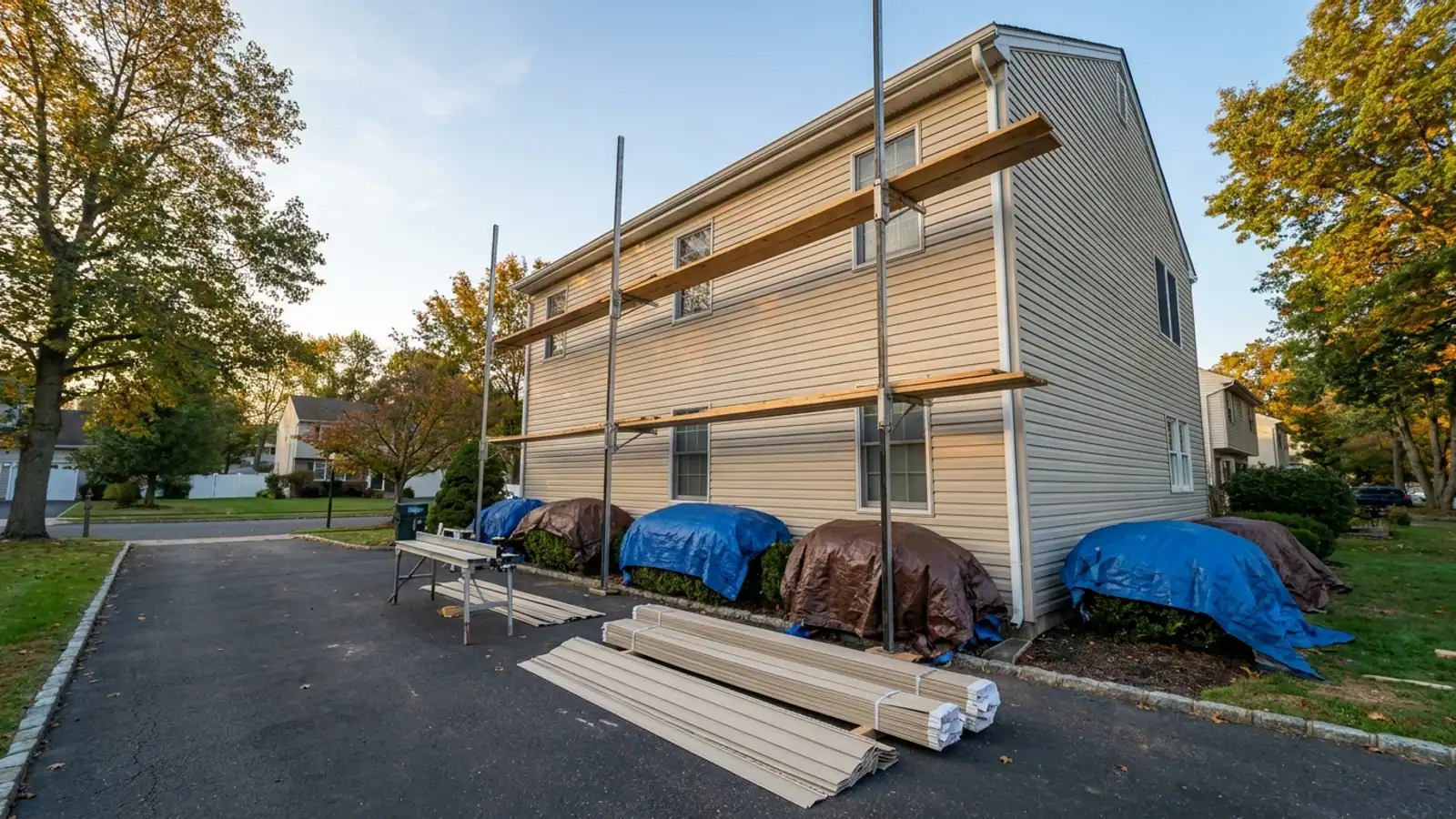
- Setup and tear-off, wall one. Tarps go over shrubs and beds, the dumpster is placed, the brake table goes up on the driveway. The crew strips the old siding off the first elevation down to the sheathing and inspects what is under it.
- Repairs and house wrap. Bad sheathing comes out and gets replaced, then weather-resistive barrier goes on with the laps in the right direction and window flashing integrated into it. This is the part nobody sees later and the part that decides whether the wall stays dry.
- Trim, then field panels. Starter strip, corner posts, J-channel around openings, then courses of siding working up the wall. Panels are cut on the brake table, locked into the course below and nailed loose enough to move with temperature.
- Repeat, elevation by elevation. The crew usually finishes one wall completely before opening the next, so the house is never fully exposed overnight.
- Soffit, fascia and details. Soffit and fascia work, light blocks, vent hoods and any wrapped columns come after the field siding on each side.
- Cleanup and walkthrough. Magnet sweep for nails, tarps up, dumpster gone, then you walk the house with the crew lead and look at every elevation from the ground before anything is paid.
On a small house steps one through three all happen on day one. On a big house they repeat four times.
What adds days
Rot behind the old siding
This is the single most common reason a siding job runs long. Water that got behind failed caulk at a window, or ran down a wall from an overflowing gutter for years, leaves soft sheathing and sometimes rotted studs or a bad sill. The crew replaces it. On a wall with a long history of gutter overflow, that repair can be most of a day by itself. If the gutters caused it, they get corrected as part of the work rather than left to do it again; the seamless gutters guide explains where overflow starts.
Fiber cement instead of vinyl
Heavier planks, slower cutting, more fasteners per board, joint flashing, caulking and touch-up paint at cut ends. Every one of those is a few extra minutes per board, and a house has a lot of boards.
Custom trim and wrapping
Wrapping a porch column, building out a window surround, or bending custom aluminum trim on site is skilled hand work. It looks the best when it is done right and it is not fast.
Color and material availability
Special-order profiles and colors can add lead time before the crew ever shows up. That is not install time, but it is time, and it belongs on the schedule conversation.
Does weather stop siding work in New Jersey?
Less than homeowners assume. Because only one section of wall is open at a time and house wrap follows immediately behind the tear-off, light rain does not usually shut a siding crew down. What does: steady rain, wind strong enough to make handling long panels unsafe, and ice or frost on the scaffold. Cold is workable, though vinyl gets more brittle in deep cold, so cuts are made carefully and expansion gaps are set for the temperature the panels are going on at.
A stopped day pushes the finish date. It does not change the price, because there are no change orders on the job.
Do permits and inspections add time?
The permit is handled before the crew arrives and does not sit in the middle of your schedule. Lightning pulls the siding permit from your municipality's own construction office under the New Jersey Uniform Construction Code, and attends the municipal inspection. You file nothing and you do not need to be home for it. The inspection happens on the town's schedule after the work is complete, and it does not hold up the crew leaving.
What you can do to keep it on schedule
- Clear the driveway. The brake table and the dumpster need it, and a crew walking cut panels from the street loses time all day.
- Unlock the gate and move anything against the walls: grills, planters, patio furniture, firewood stacked on siding.
- Take pictures and mirrors off exterior walls. Nailing shakes them.
- Point out every wall you have ever seen water on. It saves discovery time and it belongs in the estimate anyway.
- Plan for dogs. Gates get propped open and the noise carries.
What to do next
Get a written estimate that names the material, the trim details, the number of days and the price, and check that the wall repair is priced in rather than left open. Siding runs $10,000 to $22,000 in standard-value towns, $16,000 to $38,000 in higher-value towns and $30,000 to $70,000 for large or luxury homes, with the band set by the municipality's median home value from ACS 2024 five-year estimates. Lightning takes no deposit, so nothing is due until the job is finished and you have walked the house.
See what is included on the siding page, then book a free estimate. The inspection and the written estimate are free with no obligation, and a salesperson does come to the house.