Short answer
J-channel is a trim piece that hides the cut edge of siding panels at an opening, and it is not waterproof. Water gets in when the flashing and house wrap behind the J-channel are missing, lapped the wrong way, or replaced with a bead of caulk. A window opening that is drained correctly will stay dry even when the J-channel is full of water, which it will be after every hard rain.
On this page
J-channel is a trim piece. It receives the cut edge of a siding panel at a window, a door, a roof line or a corner, and it makes that edge look finished. It does not keep water out of the wall, and it was never designed to. The parts that keep water out are the house wrap, the flashing at the head and the sill, and the way those two are lapped so every drop that gets behind the siding runs down and out instead of sideways and in.
This matters because window and door openings are where most siding water problems start. Any wall has a few thousand square feet of nothing happening and then a handful of rectangular holes cut through it. The holes are the problem.
Why water gets behind siding in the first place
Assume it does. Vinyl siding is a drainage plane, not a seal. The panels have weep slots in the butt of each course, the laps are open, and the J-channel at every opening collects water and holds it until it drains out the bottom. Driven rain goes behind the panels on a windy day no matter how well the siding is hung.
So the question is never how to stop water from getting behind the siding. The question is what happens to it once it is back there. On a correctly built wall it lands on house wrap, runs down the wrap, crosses the flashing above the window, sheds out over the face of the trim, and ends up on the ground. On a badly built wall it lands on bare sheathing, finds the gap at the top corner of the window, and runs into the framing.
The guide on house wrap behind siding covers the material side of this choice. What follows is the detail at the opening itself.
The three places an opening leaks
The head
The top of the window is where almost all of it happens. There should be a head flashing — a metal or flexible flashing that turns out over the top of the window casing or nailing flange and tucks up under the house wrap above it. The wrap laps over the flashing, the flashing laps over the window. Water coming down the wall crosses it and keeps going.
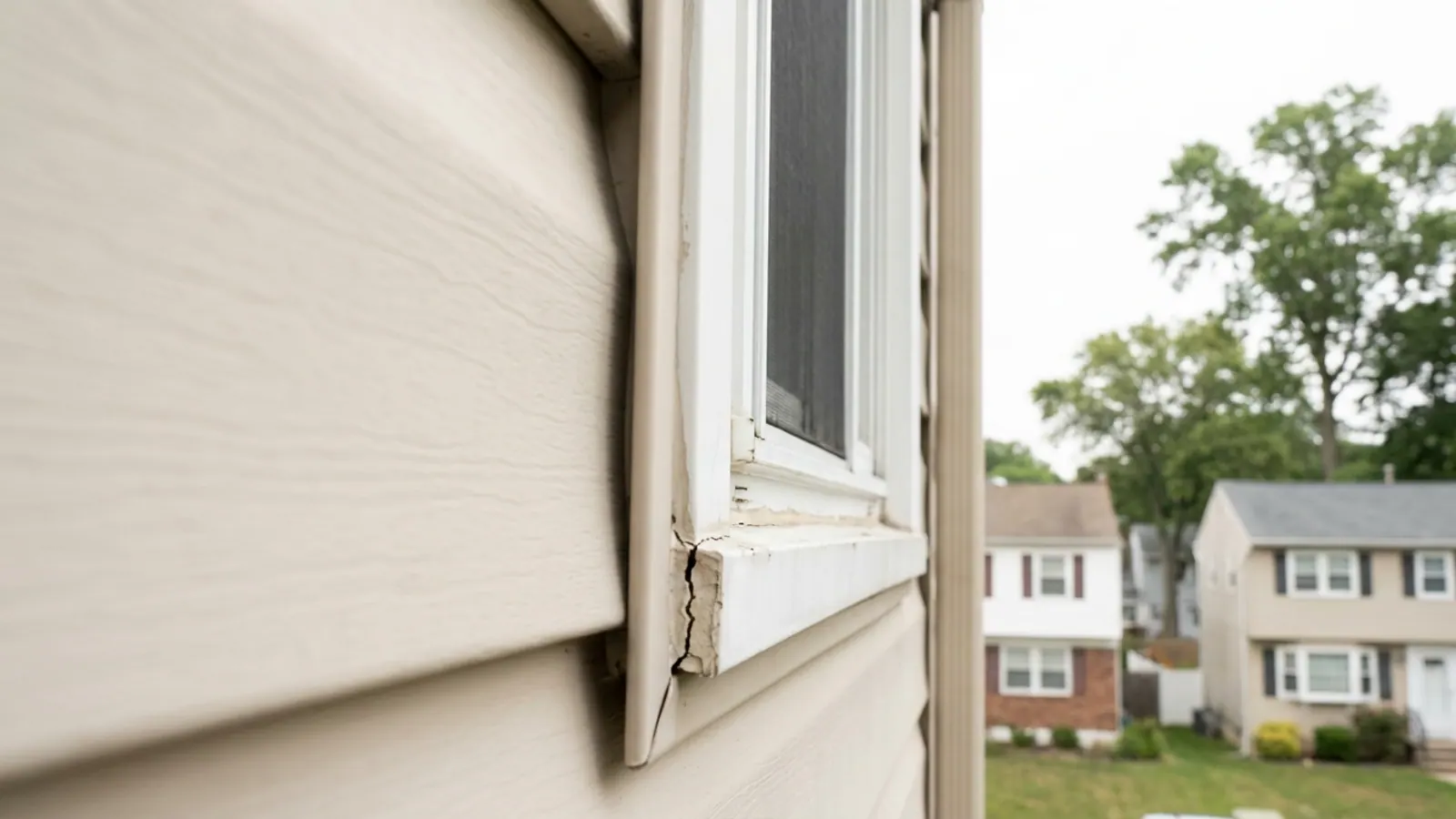
What you usually find on a 1960s or 1970s New Jersey wall is no head flashing at all, and a run of J-channel caulked solid across the top. That caulk is holding water in a trough directly above the window. When it cracks, and it always cracks, the water goes into the header.
The sides
The side J-channels have to lap behind the head channel, never on top of it. The standard detail is to notch and tab the head piece so it drops over the side pieces and sheds onto them. Reversed, every bit of water in the head channel pours straight into the side channel and sits against the jamb.
The sill
The bottom J-channel should be open. Installers sometimes caulk the bottom corners to make the miter look tight, which seals the only exit the channel has. Water then backs up in the side channels until it finds the sheathing.
The order the work has to happen in
On a tear-off, the sequence at each opening is fixed:
- Strip the old siding and old trim and look at the sheathing under the window. Soft, dark or crumbling sheathing is found here, at the corners, and nowhere else surprising.
- Repair any rotted sheathing and framing before anything new goes on.
- Hang house wrap and cut the openings with the head flap left loose so flashing can tuck under it.
- Install sill flashing or a sill pan, then the side flashing, then the head flashing, each lapping over the one below it.
- Fold the house wrap head flap down over the head flashing and tape it.
- Set the J-channel or lineal trim, side pieces first, head piece last and notched to drain over them.
- Run the siding, cut to leave the normal expansion gap, with the panel edge seated in the channel rather than jammed to the back of it.
Step four is the one that gets skipped when a crew is moving fast, and it is invisible the moment the trim goes on.
J-channel, lineal trim and how the window will look
These are real choices, and they change the look of the front of the house more than the siding color does.
| Detail | What it looks like | Where it fits |
|---|---|---|
| DetailStandard J-channel | What it looks likeA thin line at the edge of the opening, siding reads as continuous | Where it fitsRanches and splits with flat window casings, lowest cost |
| DetailLineal trim | What it looks likeA wide board-style frame around the window with a receiving channel built in | Where it fitsColonials and anywhere the original wood casing gave the window a visible frame |
| DetailWrapped existing casing | What it looks likeAluminum bent to the profile of the wood casing, J-channel against it | Where it fitsOlder houses keeping the original molding profile |
| DetailCorner-key lineals | What it looks likeMitered corners with a locking key, no visible butt joint | Where it fitsFront elevations where the joint would be at eye level |
One thing to be clear about: Lightning does roofing, metal roofing, siding and gutters. It does not sell or install windows or doors. The crew trims and sides around the units you already have, and if you are planning to change a window, do that first so the siding goes on around the new unit.
Signs the trim on your house is already failing
- A stain on the drywall or plaster below a window head, showing up only after wind-driven rain.
- Caulk across the top of a window that has split, or that is visibly the only thing there.
- J-channel that has pulled away from the casing enough to see daylight or sheathing.
- Paint or finish lifting on the interior stool and apron.
- Soft trim when you press on it near the lower corners of the opening.
- Siding panels at the opening that rattle or have slipped out of the channel.
Also look up. A gutter that overflows above a window washes the wall every storm and will produce the same stain as a flashing failure. If that is what is happening, the fix is at the gutters, not at the window trim, and it is a far smaller job.
What to ask for in writing
Get these on the estimate, not promised in conversation:
- Head flashing at every window and door opening, by name, not just "J-channel."
- What happens if rotted sheathing is found at an opening, and at what price. Lightning finds that at the free inspection and prices it into the quote, which is why there is no change order on the day.
- Which trim profile is being used at the openings, and at which elevations.
- Whether existing wood casings are being wrapped or replaced with lineals.
- Whether a permit is being pulled. Lightning pulls it from the municipality's own construction office under the New Jersey Uniform Construction Code and attends the inspection; you file nothing.
Siding runs $10,000 to $22,000 in standard-value towns, $16,000 to $38,000 in higher-value towns, and $30,000 to $70,000 for large or luxury homes. The band comes from the municipality's median home value in the ACS 2024 five-year estimates. The number of openings on the house, and how they are trimmed, is one of the real drivers inside that range — a wall with eight windows and a bay is far more labor than a blank gable of the same square footage.
What to do next
If you have a stain under a window and you do not know why, have someone open a section and look rather than caulking it again. Caulk over a flashing problem buys a season at most.
Lightning Construction inspects the wall, photographs what is behind the trim, and writes a free estimate with no obligation — and a salesperson does come to the house for it. There is no deposit, nothing is due until the work is finished and you have inspected it, and the written estimate is the final price. See the siding page for what is covered, or book a free estimate and have the openings looked at before the next nor'easter.