Short answer
Fan-fold backer is a thin sheet of foam, usually a quarter inch, that flattens the wall and gives the siding a solid surface to lay against. Rigid foam insulation board is thicker, commonly half an inch to a full inch, and adds measurable R-value to the wall assembly. You are paying for a flat wall in one case and for insulation in the other, and an estimate that calls both of them insulation is hiding the difference.
On this page
Fan-fold backer and rigid foam insulation board look similar on a wall and cost very different amounts, and plenty of siding estimates use the word "insulation" for both. They are not the same product and they do not do the same job. Fan-fold is a thin sheet, usually a quarter inch of extruded polystyrene, that flattens the wall and gives vinyl a solid surface to lay against. Rigid foam board is thicker, commonly half an inch to a full inch, and its purpose is R-value.
Here is what each one is, what it does on a New Jersey house, and how to read the line item on your estimate.
What fan-fold backer board actually is
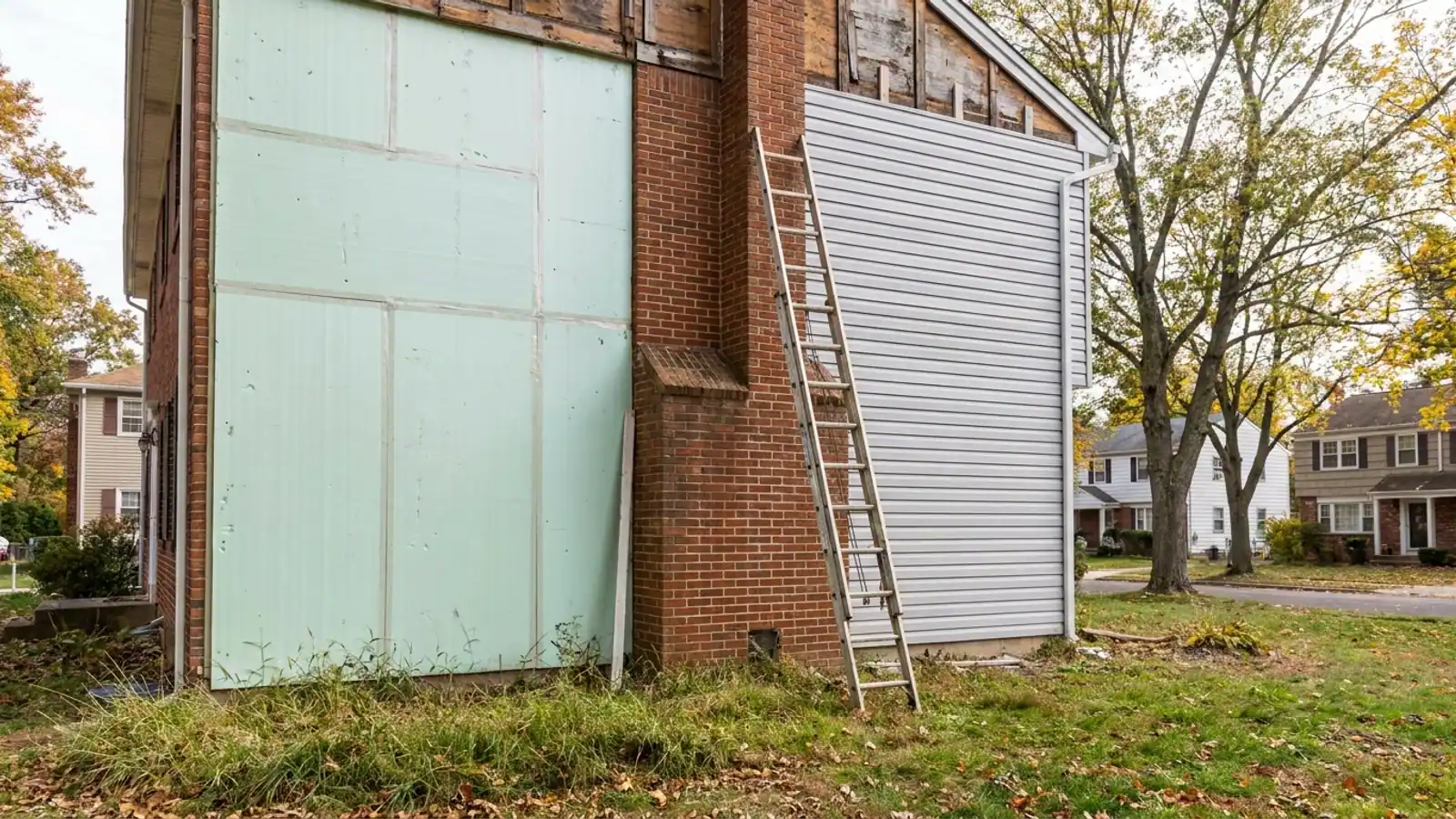
Fan-fold ships folded like an accordion in bundles that open out to cover a wide section of wall in one piece. Most of it is extruded polystyrene at a quarter inch or three-eighths of an inch thick. It has a facer on one or both sides, and better products have drainage grooves on the back and small perforations so vapor can move.
What it does:
- Flattens a wall so new siding does not follow every dip in old sheathing or a wavy stud line.
- Gives vinyl panels something solid behind them, so a thrown baseball or a ladder foot dents instead of punching through.
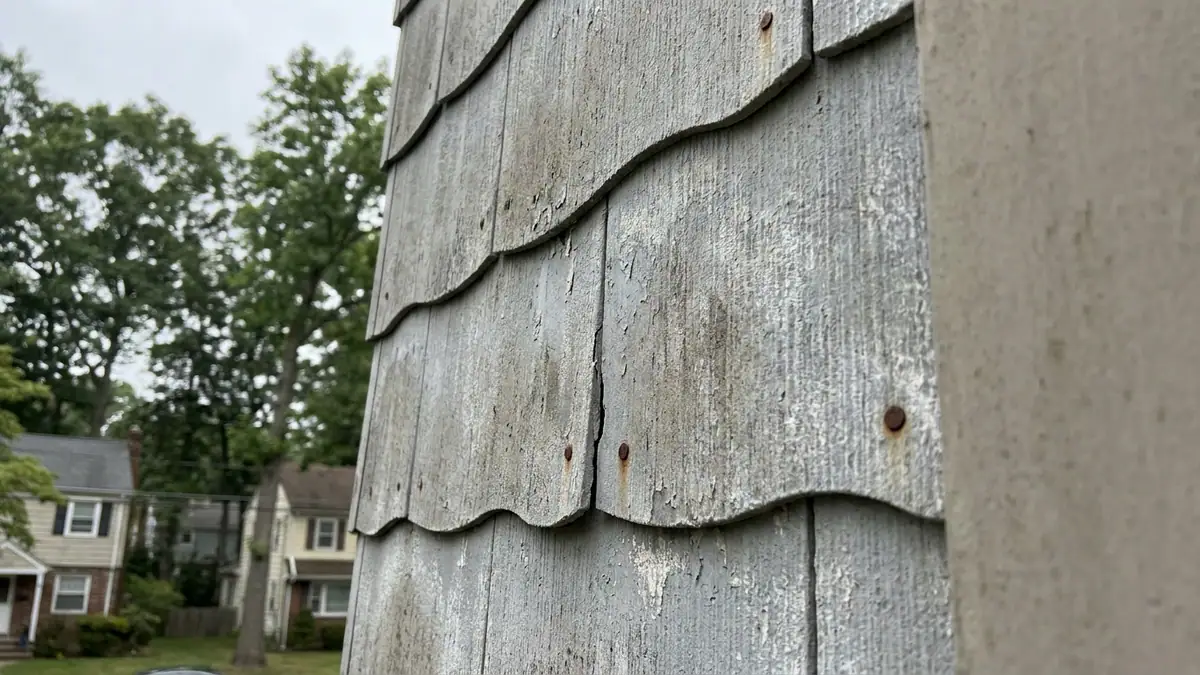
- Bridges the gaps left when old clapboard or shake is stripped off and the wall is left uneven.
What it barely does is insulate. A quarter-inch sheet is worth roughly R-1, give or take depending on the product, and the data sheet for the exact board on your estimate will say. That is not nothing, but it is not a reason to choose one contractor over another, and it is not what a homeowner pictures when the word insulation appears in a quote.
What rigid foam insulation board actually is
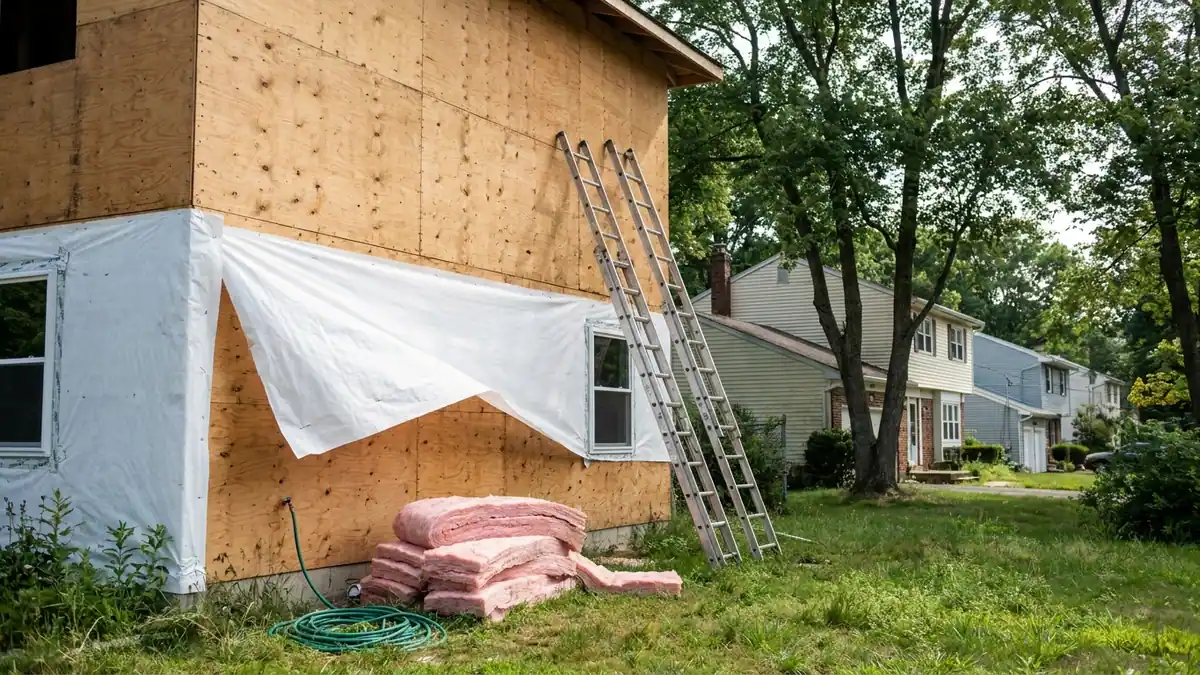
Rigid foam board for exterior walls is normally extruded polystyrene, expanded polystyrene or polyisocyanurate, in thicknesses from half an inch up. It is installed as continuous insulation, meaning it runs across the studs as well as the cavities between them, which is the part that matters. Wood studs conduct heat straight through an insulated wall, and a continuous foam layer is the only thing that interrupts that path.
Typical values run around R-2.5 for half-inch extruded polystyrene, R-5 for a full inch, and higher for polyisocyanurate at the same thickness. Confirm the number against the product sheet for what is being installed rather than the category. On a New Jersey house, the layer is doing real work in January and in July, and unlike attic insulation you only get one practical chance to add it, which is when the old siding is off.
Side by side
| Fan-fold backer | Rigid foam insulation board | |
|---|---|---|
| Typical thickness | Fan-fold backer1/4 inch to 3/8 inch | Rigid foam insulation board1/2 inch to 1 inch or more |
| Main purpose | Fan-fold backerFlat substrate and impact resistance | Rigid foam insulation boardContinuous R-value across the studs |
| Approximate R-value | Fan-fold backerAbout R-1 | Rigid foam insulation boardRoughly R-2.5 to R-6 depending on type and thickness |
| Effect on wall thickness | Fan-fold backerMinimal | Rigid foam insulation boardPushes the siding plane out, so trim at openings and corners must be built out |
| Fastener length | Fan-fold backerStandard | Rigid foam insulation boardLonger, sized to the foam thickness |
| Effect on installed price | Fan-fold backerSmall | Rigid foam insulation boardMaterial cost plus added labor for trim and detailing |
| Usually included by default | Fan-fold backerOften yes, on vinyl jobs | Rigid foam insulation boardNo, it is an upgrade you have to ask for |
What neither board does: water and air
This is where estimates get misread. Foam board of either thickness is not a weather-resistive barrier on its own, and it is not an air barrier unless every seam and edge is taped and sealed as a deliberate system. Water that gets behind siding, and some always does, has to run down a drainage plane and back out. That plane is the house wrap, installed over the sheathing, lapped shingle-style and sealed at the openings.
If a quote lists foam board but says nothing about house wrap, ask what is going on the sheathing and in what order. A siding job that skips the wrap because there is foam on the wall is the kind of job that rots quietly for a decade. Our siding page lays out what a full wall assembly includes, and the siding options guide compares vinyl against fiber cement if you have not settled on the material yet.
Does the added R-value pay for itself in New Jersey?
Honestly, not quickly on energy savings alone. New Jersey's climate gives you a real heating season and a real cooling season, so continuous insulation does work year round, but the payback on the foam upgrade by itself is measured in a long stretch of years, and it depends on what is already in your walls, how airtight the house is and what you pay for fuel.
The better way to decide is this. If the siding is coming off anyway, the marginal cost of upgrading from a quarter-inch backer to a proper insulation board is the cheapest that layer will ever be. Once new siding is on, adding it later means paying for the whole tear-off again. Older housing stock across much of the state has little or nothing in the way of continuous insulation, and the walls of a 1950s or 1960s house are usually where the comfort problem lives.
If anyone tells you a siding job qualifies for a federal energy tax credit, do not take that from a contractor. Ask a tax professional to confirm what programs are current and what they actually require.
How thicker foam changes the installation
Adding half an inch or an inch to the outside of the wall is not a drop-in substitution. It changes several details, and a crew that has not planned for them will improvise badly.
- Fasteners get longer. Nails have to pass through the foam and still hold in the sheathing or framing to the siding manufacturer's specification.
- Trim at openings and corners has to be built out so the casings still stand proud of the finished siding plane rather than being buried by it.
- The starter strip, corner posts and J-channel all reference the new plane, so everything at the base and the corners is set differently.
- Seams get taped or sealed depending on the assembly, and the sequence with the house wrap has to be decided before the first board goes up, not while the wall is open.
- Soffit, fascia and the roof edge above have to be checked, because the wall is now thicker where it meets them.
All of that is labor. It is the reason a real insulation upgrade shows up as more than just the price of the foam, and it is the reason a suspiciously cheap "insulated" siding quote is usually a fan-fold quote wearing a better word.
What to get in writing before you sign
Ask for these by name on the estimate:
- The product and thickness of the board, stated as a brand and a thickness, not as "insulation board."
- The R-value from the manufacturer's data sheet.
- Whether house wrap is included, what brand, and whether it goes under or over the foam.
- How trim at openings and corners will be handled once the wall gets thicker.
- Whether insulated vinyl panels are included on top of this, which is a separate product and a separate cost.
Siding in New Jersey runs $10,000 to $22,000 in standard-value towns, $16,000 to $38,000 in higher-value towns, and $30,000 to $70,000 for large or luxury homes. The band comes from the municipality's median home value in the ACS 2024 five-year estimates. Where your job lands inside a band depends on wall area, the number of corners and openings, the material and what is found behind the old siding.
What to do next
Have someone open a section of wall and tell you what is behind the siding before you decide how much foam belongs on the outside of it. Lightning Construction is veteran-owned, family-operated, licensed and insured, and works in all 21 New Jersey counties and 544 municipalities. The inspection and the written estimate are free with no obligation, and a salesperson does come to the house. There is no deposit, nothing is due until the work is finished and you have inspected it, and the written estimate is the final price, so the rot or the uneven sheathing found behind your old siding is priced in the quote rather than turned into a change order on the day.
When you are ready for a real number on your own walls, book a free estimate and ask to see the foam spec in writing.