Short answer
Bundling siding and gutters means the gutters come down once instead of twice, the fascia and soffit are open and visible while the walls are stripped, and the color decisions get made as one set instead of two. The labor overlap is real because the gutters have to be removed for the siding work regardless, so paying a separate crew to rehang old gutters later is money spent twice. The trade-off is a bigger single project and a longer stretch of your house being under scaffolding and ladders.
On this page
- The gutters come down for siding work either way
- What the crew can see with the walls open
- Fascia, soffit and the board the gutter hangs on
- What changes when you bundle
- The order the work actually runs
- Color, and the decisions you make once
- What a bundled estimate should say
- When to split the two jobs
- What to do next
Bundling siding and gutters changes three things: the gutters only come down once, the fascia and soffit are exposed while the walls are open, and you pick every exterior color in one sitting. Those three are not small. On a house where both are at end of life, doing them as one project is almost always the cheaper and cleaner path than doing siding this year and gutters in two years.
Here is what actually happens differently on a bundled job, and the narrow case where splitting them still makes sense.
The gutters come down for siding work either way
This is the part homeowners miss. Siding does not stop politely below the gutter. It runs up behind the fascia and the trim at the rake edges, and the crew needs clear access to the top course and the corner posts. On most houses that means the gutters, the downspouts and often the fascia cover come off before the first panel goes on.
So you are paying for gutter removal no matter what. The only question is what goes back up. Aluminum gutters that have been hanging for fifteen or twenty years are dented at the hangers, slightly out of straight, and sealed at the miters with caulk that has already shrunk. Taking them down and rehanging them over new siding is labor spent on a part that is going to be replaced soon anyway, and you will have paid twice for the ladder work.
If the existing gutters are genuinely recent and sound, say so and ask for them to be removed and reinstalled as a line item. If they are not, new seamless aluminum gutters go up at the end of the siding job on a roof edge that has just been rebuilt.
What the crew can see with the walls open
Stripped walls show you things no inspection from the ground can. The sheathing behind the old siding, the condition of the house wrap if there is any, the framing around the roof edge, and the back side of the fascia board are all visible for a few days and then covered for the next thirty years.
That window matters most at the roof edge, because that is where gutter problems and siding problems share a cause. Water running behind a gutter instead of into it soaks the fascia, then the band board, then the top of the wall. You see it as a soft fascia and a dark stain on the sheathing. Fixing the fascia without correcting the drip edge and gutter line means the new board rots the same way.
Fascia, soffit and the board the gutter hangs on
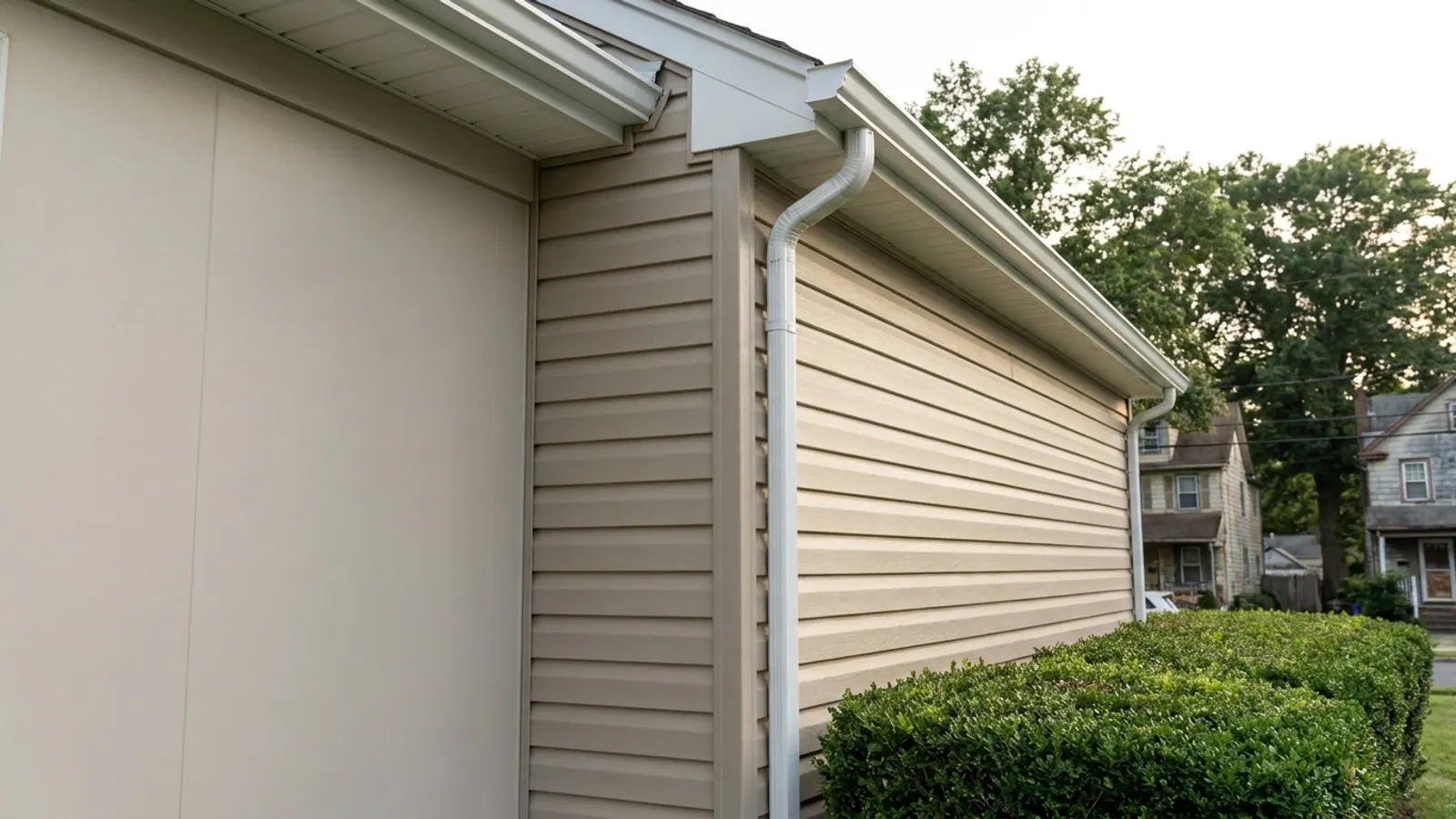
Gutters hang on fascia. If the fascia is soft, the hangers have nothing to bite, and no amount of new gutter solves it. On a bundled project the fascia gets replaced or capped as part of the siding scope, and then the gutter is hung on sound wood with hidden hangers screwed into it.
Soffit is the other piece. Vented soffit feeds air to the attic, and if it is being replaced during the siding job, the ventilation path either gets opened up properly or gets blocked for good. Ask whether the new soffit is vented, how much net free area it provides, and whether the attic insulation is pushed into the vent channels. The attic ventilation guide covers how intake at the soffit and exhaust at the ridge have to be balanced.
What changes when you bundle
| Siding and gutters together | Siding now, gutters later | |
|---|---|---|
| Gutter removal | Siding and gutters togetherOnce, as part of the siding tear-off | Siding now, gutters laterOnce now, then again when the gutters are replaced |
| Fascia and soffit repair | Siding and gutters togetherDone with the wall open and priced into one estimate | Siding now, gutters laterDone later, often with the siding cut back to reach it |
| Color match | Siding and gutters togetherSiding, trim, soffit, fascia and gutter chosen as one set | Siding now, gutters laterGutter color matched to siding that has already weathered |
| Downspout placement | Siding and gutters togetherPlanned against the finished wall and the grade | Siding now, gutters laterWorked around new siding and corner posts |
| Scheduling | Siding and gutters togetherOne crew, one mobilization, one permit file | Siding now, gutters laterTwo projects, two site setups |
| Gutter condition at finish | Siding and gutters togetherNew seamless run on new fascia | Siding now, gutters laterOld gutters rehung over new siding |
The order the work actually runs
- Free inspection and a written estimate covering siding, trim, soffit, fascia and gutters as one scope.
- Permit pulled by Lightning from the municipality's construction office under the New Jersey Uniform Construction Code.
- Gutters and downspouts removed, old siding stripped, sheathing inspected.
- Rot repair, house wrap and flashing at windows, doors and wall penetrations.
- Siding installed, then corner posts, trim, soffit and fascia.
- Seamless gutters run on site, hung to pitch, downspouts set and tied to the drainage you are using.
- Cleanup, then the municipal inspection, which Lightning attends.
Notice gutters are last. That is the point of bundling. Hanging gutters before the trim is finished means cutting them back later or caulking a gap.
Color, and the decisions you make once
A bundled project forces every exterior color choice at the same time, which is an advantage. You choose the siding field color, the trim, the soffit, the fascia cover and the gutter together, against the brick or stone you are keeping and the roof you already have.
The practical rule: the gutter matches the trim or fascia, not the siding. A gutter in the siding color reads as a stripe across the roof edge. A gutter in the trim color reads as part of the same band as the fascia and disappears. Hold the samples up at the house in daylight, not in a showroom. Material choice between vinyl and fiber cement affects the trim details too, and the siding options guide walks through how the two systems handle corners and trim differently.
What a bundled estimate should say
One written number, with the scope spelled out. Siding in New Jersey runs $10,000 to $22,000 in standard-value towns, $16,000 to $38,000 in higher-value towns, and $30,000 to $70,000 for large or luxury homes. Seamless gutters run $1,200 to $3,500, $2,500 to $6,500 and $4,000 to $12,000 across the same three bands. The band is set by the municipality's median home value from ACS 2024 five-year estimates. Those are ranges, not quotes, and the only number that matters is the one written for your house.
What to look for on the page:
- Siding product, line and color, plus the house wrap being used.
- Trim, corner posts, soffit and fascia listed separately from the wall siding.
- Rot and sheathing repair priced in, not listed as an allowance.
- Gutter size and downspout size, with downspout count and where each one discharges.
- Gutter guards included or excluded, stated plainly.
- Permit and inspection handled by the contractor.
Lightning takes no deposit and writes no change orders. Nothing is due until the work is finished and you have inspected it, and the conditions that normally trigger a change order on an exterior job, meaning rot behind the siding, bad flashing and failed fascia, are found at the free inspection and included in the quote. What gutter guards do and do not solve is covered in the seamless gutters guide.
When to split the two jobs
Two cases. First, if the gutters are only a few years old, correctly sized and pitched, and the fascia behind them is sound, then remove and reinstall is honest work. Second, if the roof is also near the end of its life, the roof should come first, because siding tucks under the roof edge and flashing. In that case the gutters usually go with the roof and the siding follows.
If the walls are the urgent problem and the gutters are overflowing every storm, bundle them. Doing both at once avoids a second tear-down at the roof edge and gets the drainage right on the first pass.
What to do next
Walk the house after a heavy rain and look at three things: streaking or staining on the siding below the gutter line, any soft spot in the fascia you can press with a screwdriver, and water pooling at the foundation under a downspout. If two of the three are there, the siding and the gutters are failing on the same cause and should be scoped together.
Lightning Construction is veteran-owned, family-operated, GAF certified, licensed and insured under New Jersey Home Improvement Contractor registration 13VH12437000, and serves all 21 New Jersey counties. The inspection and written estimate are free and carry no obligation, and a salesperson does come to the house. See the siding services page for what the work covers, then book a free estimate and ask for the siding and the gutters priced as one scope.