Short answer
Most New Jersey roofs have one layer of asphalt shingles, a large number have two, and three is rare because the code has not permitted it for years. You can usually count the layers yourself from the ground by looking at the rake edge, the gutter line, or where a pipe boot sits proud of the surface. The count matters because every extra layer adds tear-off labor and dumpster weight, and an uncounted second layer is one of the most common reasons a roofing price goes up in the middle of the job.
On this page
Most New Jersey roofs have one layer of asphalt shingles. A large share of them have two, especially in towns where the housing stock is older and the roof has been replaced twice since the house was built. Three layers turns up occasionally on older work, but it is not code-compliant and it is not something a roofer can leave in place.
Knowing your number before you take a single quote is worth doing. The layer count changes what the job costs, how long it takes, what the crew has to carry off your property, and whether an "overlay" is even legally on the table. It is also the single most common thing a low quote quietly leaves out.
How to count shingle layers from the ground
You do not need to climb anything. Pick up a pair of binoculars and walk the perimeter of the house. Four places give the count away.
The rake edge on a gable end
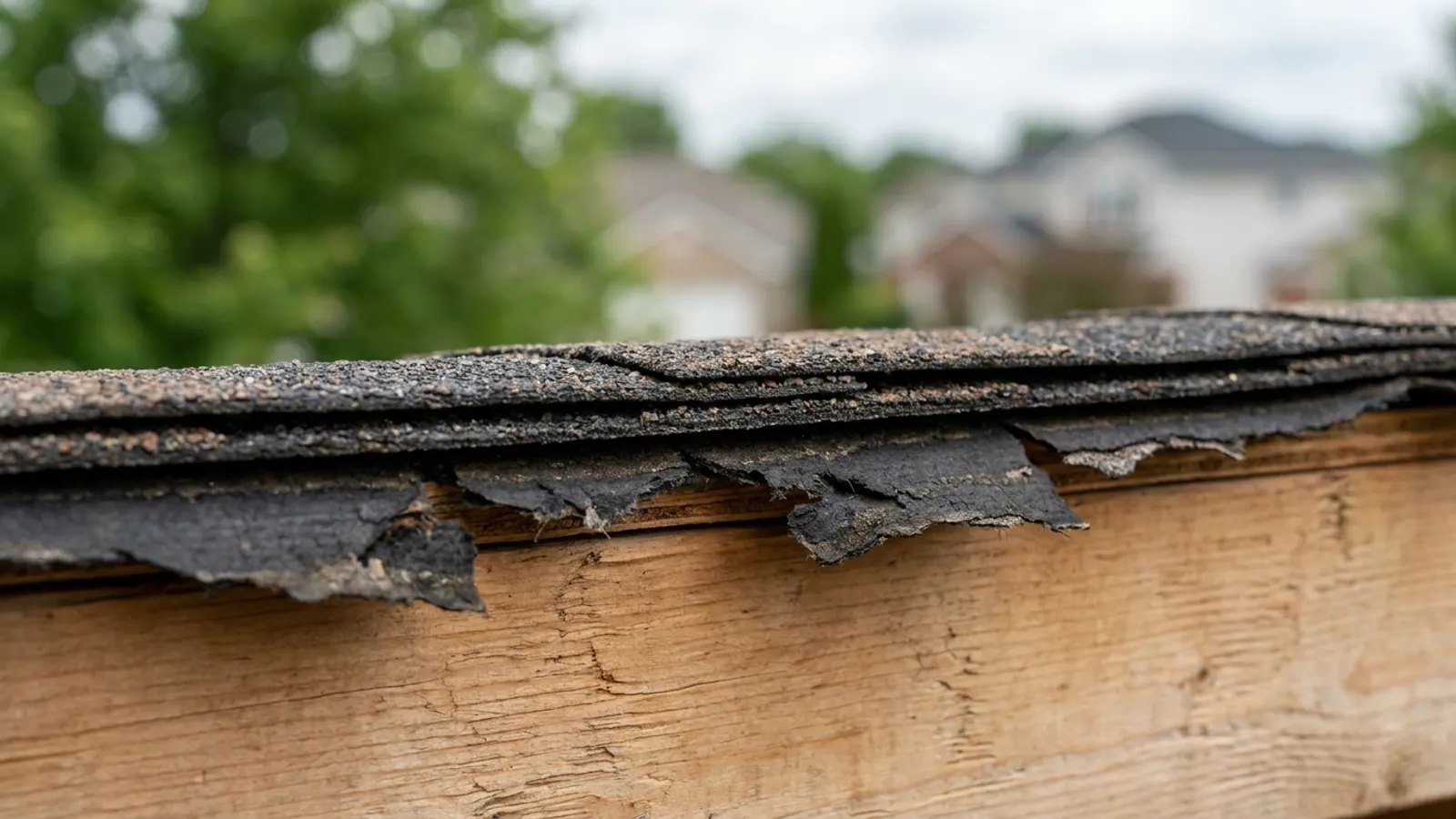
The rake is the sloped edge of the roof on a gable end, where the shingles stop and you can see their cut edge in profile. One layer reads as a single thin line of shingle sitting on the drip edge. Two layers reads as a visible stack, often with a shadow line between them and sometimes a strip of old felt paper showing at the seam. On an architectural shingle over a three-tab, the difference is obvious once you know to look for it.
The shingle edge above the gutter
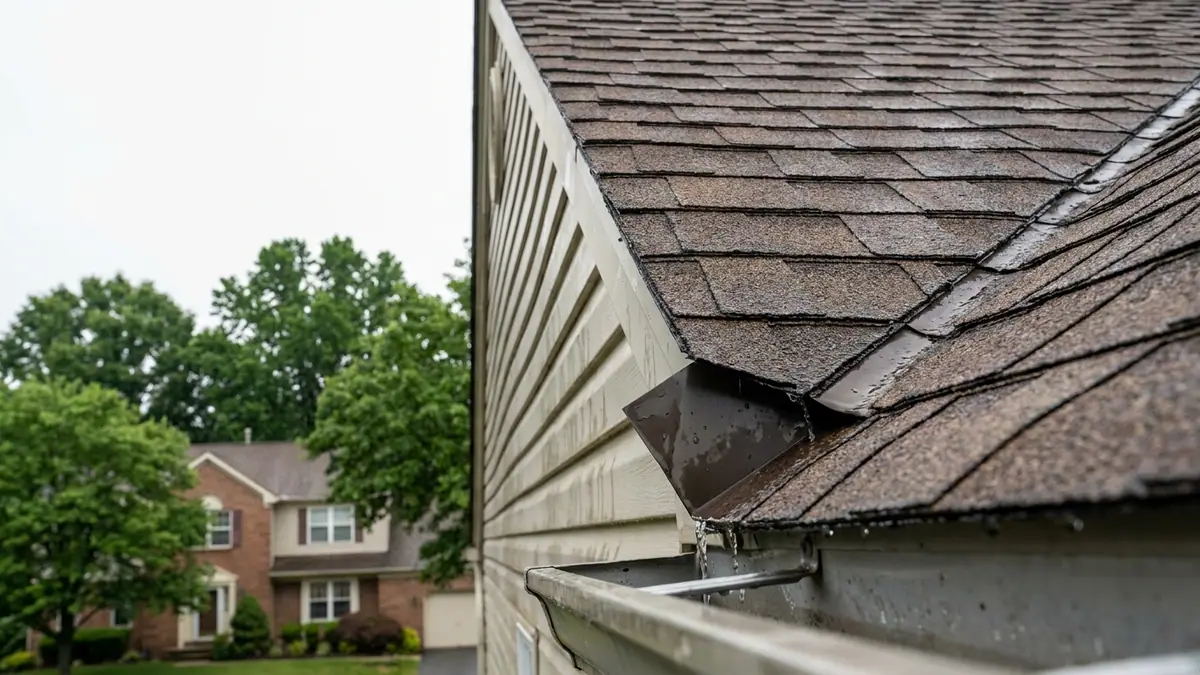
The eave gives you the same profile from a lower angle. Stand back from the house, look at where the shingles overhang the gutter, and count the courses of thickness. A second layer usually pushes the overhang further out and makes the roof edge look heavy relative to the fascia.
Pipe boots, vents and flashing
When a roof gets covered over, the plumbing vent boots and the exhaust vent flanges are often reused or re-set on top of the added thickness. The result is a boot that stands unusually proud of the shingle surface, or a vent whose flange sits high with a shim of shingle underneath it. Step flashing against a wall gives it away, too: on an overlay, the exposed leg of the old flashing looks short because the new shingles came up around it.
The attic
Go up with a flashlight on a bright day. You are not counting layers directly, you are counting nails. Two-layer roofs show a second set of nail points coming through the sheathing between the original set, and often show more daylight-free, tightly packed nailing than a single layer would. While you are up there, look for dark staining, soft spots and rusted nail shanks. Those tell you about the decking under the shingles, which matters more than the shingles do.
What New Jersey code allows
New Jersey's Uniform Construction Code generally permits one new layer of asphalt shingles over one existing layer, provided the existing roof is sound, dry and lying flat. It does not permit a third. So a roof already carrying two layers has one option: complete tear-off to the decking.
That rule is enforced through the permit, and the permit is inspected. Lightning Construction pulls the permit from your municipality's own construction office and attends the inspection, in every municipality, so nothing about the layer count is your paperwork problem. The permit guide walks through what the office actually reviews and when the inspector shows up.
What a second layer does to the price of your next roof
Tear-off is labor plus weight, and both roughly double when there are two layers instead of one. Disposal is billed by weight, not by area, so the same 2,000 square feet of roof costs meaningfully more to strip when there are two layers on it. On a steep roof, the second layer also slows the crew down, because more material has to be moved by hand rather than dropped straight into a chute.
| Layer count | What the tear-off involves | Effect on the job |
|---|---|---|
| Layer countOne layer | What the tear-off involvesSingle strip to decking, one pass with the shovel | Effect on the jobThe baseline most quotes assume |
| Layer countTwo layers | What the tear-off involvesTwo passes, roughly double the debris weight | Effect on the jobMore labor, more disposal cost, longer day |
| Layer countTwo layers plus felt and rotted decking | What the tear-off involvesStrip, replace sheathing, re-nail | Effect on the jobDecking sheets priced per sheet on top |
| Layer countThree layers | What the tear-off involvesNot code-compliant, full strip required | Effect on the jobOverlay is off the table entirely |
Asphalt roof replacement in New Jersey runs $9,000 to $22,000 in standard-value towns and $14,000 to $35,000 in higher-value towns, with the band set by the municipality's median home value. Layer count is one of the things that moves you within a band. The roof cost guide breaks down the rest of the variables, including pitch, access and roof complexity.
What two layers do to the roof while they are up there
Weight is the obvious one. A second layer of asphalt adds dead load the framing was not designed to carry twice, which matters more on older homes with lighter rafters and on roofs that carry snow. Ground snow loads in New Jersey range from 30 psf in Somerset County up to 50 psf in Sussex County under DCA Bulletin 19-1, and the roof structure carries the shingles and the snow at the same time.
Heat is the second. Two layers of asphalt hold more heat through a July afternoon than one, and the top layer ages faster because of it. A second layer of architectural shingles almost never reaches the service life the same shingle would have reached over bare decking.
The third problem is the one that costs money. An overlay covers the original decking and, in a lot of cases, the original step flashing and valley metal. Anything wrong with those is now sealed under a new roof. A soft sheet of plywood does not firm up because there are shingles over it, and a corroded piece of step flashing keeps leaking behind the siding. When the roof finally comes off, the damage underneath has had a full shingle life to spread.
Get the layer count in writing before you sign
Ask every contractor who quotes you to state, on the estimate, how many layers they found and what the price includes for removing them. Ask them how they determined it. "We assumed one" is a real answer some of them will give, and it means the number on the page is provisional.
Also get a written per-sheet price for replacement decking, because on a two-layer roof the odds of finding bad sheathing are higher than on a single layer. A quote that names neither the layer count nor a decking price is a quote that can change on the day the dumpster arrives.
Lightning Construction handles this differently. Layers, decking condition and flashing are established at the free inspection and priced into the written estimate, and there are no change orders, so the estimate is the final price. There is no deposit either; nothing is due until the work is finished and you have inspected it. Most asphalt replacements, including two-layer tear-offs, are done in a single day.
What to do next
Count your layers from the ground this weekend, then have someone confirm it from the roof. If you already know there are two up there, plan on a full tear-off and price it that way from the start rather than hoping an overlay quote holds.
Lightning Construction is GAF Certified, licensed and insured, registered in New Jersey as Home Improvement Contractor 13VH12437000, and rated 4.9 out of 5 from 264 Google reviews. See what a roof replacement includes, or book a free inspection and written estimate. It is free and there is no obligation, and a salesperson does come to the house.