Short answer
Some granule loss is normal, and a new roof sheds loose granules for its first few rains. It becomes a warning sign when the granules keep coming years later, when a single gutter cleaning fills a bucket, or when you can see bare black asphalt patches on the shingles themselves. At that point the shingle has lost its UV protection and the roof is near the end of its service life.
On this page
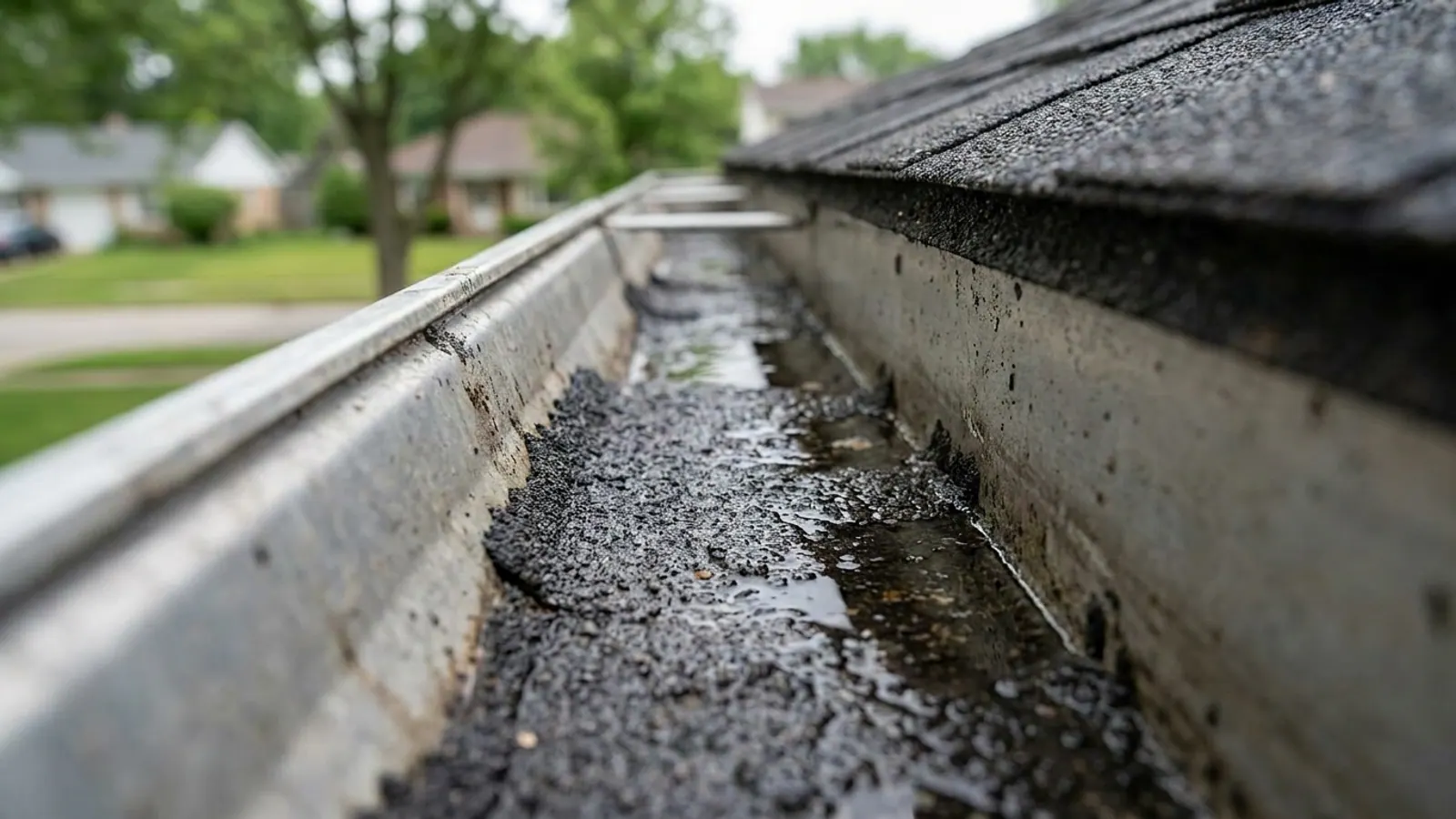
A few granules in the gutter are not a problem. A trough with a layer of grit along the bottom of every run, on a roof past 15 years old, usually is. Granules are the crushed mineral surface pressed into the top of an asphalt shingle, and once they are off the shingle they do not come back.
Here is how to tell a roof that is shedding a little from a roof that is finished.
What the granules on a shingle actually do
An asphalt shingle is a fiberglass mat saturated with asphalt and surfaced with crushed mineral granules while the asphalt is still hot. Those granules do three jobs: they block ultraviolet light from reaching the asphalt, they add fire resistance, and they give the shingle its color.
The asphalt is the waterproofing. UV light is what destroys asphalt. As long as the granule layer is intact, the asphalt under it stays shaded. Once granules are gone in patches, sun hits raw asphalt, the asphalt dries out and hardens, and the shingle begins to curl, crack and lose its seal to the course below.
So the granules in your gutter are not the damage. They are a measurement of how much protection has already left the roof. The condition of the shingles is the actual diagnosis. Product differences matter here too, and the GAF shingles guide explains how the lines differ in weight and surfacing.
How much granule loss is normal
Three kinds of granule loss are ordinary and not worth worrying about.
- The first few rains on a new roof. Granules that never fully bonded at the factory wash straight off. Homeowners often see this in the downspout discharge a week after installation and assume something is wrong. It stops within a few weeks.
- Light, steady shedding through middle life. A thin dusting of grit mixed in with leaves and roof dirt at each cleaning. Every asphalt roof does this from the day it goes on.
- A short burst after a hard storm. Wind-driven rain and hail knock granules loose mechanically. One heavy event can produce more grit than a whole quiet year.
A practical test: flush the gutters clean, then look again after a full season of rain. A cup of granules collected from the whole house is normal. Half a bucket from one 30-foot run is not.
Granule loss that means the roof is done
Get off the ladder and look at the roof, from the ground, with a phone zoom or binoculars. Four things turn granule loss from a nuisance into a replacement conversation.
Bare patches you can see from the ground
The roof reads as blotchy, with dark black or shiny gray areas where the color has gone. That is exposed asphalt. It shows up first on south and west slopes, under the runoff path from an upper roof, and in the middle of long open planes.
Granules that never stop coming
A roof that sheds heavily every single cleaning, year after year, is past the shedding stage and into the wearing-out stage. The volume should trend down after the first month, not up after the tenth year.
Curling, cracking and a visible mat
When granule loss comes with shingle edges lifting off the roof, hairline cracks across the tabs, or a fibrous look where the fiberglass mat is showing, the shingle is done as a waterproof layer. The full list of what to look for is in the guide on signs you need a new roof.
Granules in the gutter plus a leak inside
One stain on a ceiling with a heavily worn roof above it is a different problem than one stain under a 6-year-old roof. On an old, granule-poor roof, a leak is usually the first of several.
Roof age changes the answer completely
| Roof age | Granules in the gutter | What it usually means |
|---|---|---|
| Roof ageUnder 1 year | Granules in the gutterNoticeable, then fading | What it usually meansFactory loose granules, normal |
| Roof age1 to 10 years | Granules in the gutterLight dusting each cleaning | What it usually meansNormal wear, no action |
| Roof age1 to 10 years | Granules in the gutterHeavy, localized in one spot | What it usually meansWater or foot traffic damage, worth a look |
| Roof age10 to 18 years | Granules in the gutterSteady, moderate | What it usually meansMid-life roof, inspect and monitor |
| Roof ageOver 18 years | Granules in the gutterHeavy, with bare patches above | What it usually meansRoof is at the end of its service life |
| Roof ageAny age, right after a storm | Granules in the gutterSudden spike | What it usually meansPossible storm damage, document and inspect |
This is why age is the first question. New Jersey has a lot of housing built between the 1950s and the 1970s, which means a lot of houses are on their second or third roof and nobody in the house was present for the last one. If you do not know the installation date, the permit record at the municipal construction office often does.
What else strips granules besides age
Four things take granules off a roof that still has years left in it.
- Water dumped from above. An upper-roof downspout discharging onto a lower slope carves a clean stripe of bare asphalt. The fix is a diverter or a downspout extension to the gutter below, not a new roof.
- Foot traffic. Walking a hot roof drags granules loose. Satellite installers, chimney sweeps and gutter cleaners all leave a trail.
- Pressure washing. Never let anyone pressure wash an asphalt roof. It removes granules by the pound and shortens the roof by years.
- Overhanging branches. Limbs scraping in the wind abrade the surface in an arc you can see from the driveway.
What the granules do to your gutters
Granules are heavy and they settle. They do not float out with the leaves. Over years they build a sediment layer in the bottom of the trough that holds standing water, adds weight to the hangers, and blocks the downspout outlet from underneath, where you cannot see it from the ladder.
If you are cleaning gutters and finding grit rather than leaves, flush each run with a hose and confirm water leaves the downspout at full flow. A seasonal routine is laid out in the gutter maintenance guide. And if the roof is being replaced anyway, that is the moment to deal with gutters that are already sediment-packed and sagging.
What to do next
If the roof is under ten years old and the shingles look uniform in color, clean the gutters and move on. If you can see bare patches, or the roof is past 18 years, get it inspected before the next winter rather than after a leak.
Lightning Construction inspects and quotes for free with no obligation, and a salesperson does come to the house. The inspection is where the things that normally become change orders get found, so extra shingle layers, soft decking and failed flashing are priced into the written estimate up front. There is no deposit, nothing is due until the work is finished and you have inspected it, and the written estimate is the final price. Lightning pulls the permit and attends the municipal inspection under the New Jersey Uniform Construction Code. Most asphalt replacements are torn off and finished in a single day.
Most New Jersey asphalt roof replacements run $9,000 to $22,000 in standard-value towns and $14,000 to $35,000 in higher-value towns, with large or luxury homes at $25,000 to $60,000. The band follows the municipality's median home value from ACS 2024 five-year estimates.
See what is involved in a full roof replacement, or book a free inspection and written estimate and get an honest answer on whether your granule loss is cosmetic or terminal.