Short answer
When crews find rot behind siding, the wet sheathing gets cut out, the framing underneath gets checked, and the leak that caused it gets corrected before any new panel goes on. On most New Jersey houses the damage is limited to a few square feet around a window, a deck ledger or a wall under an overflowing gutter. Lightning Construction finds these conditions at the free inspection and prices them into the written estimate, so they never turn into a change order on the day.
On this page
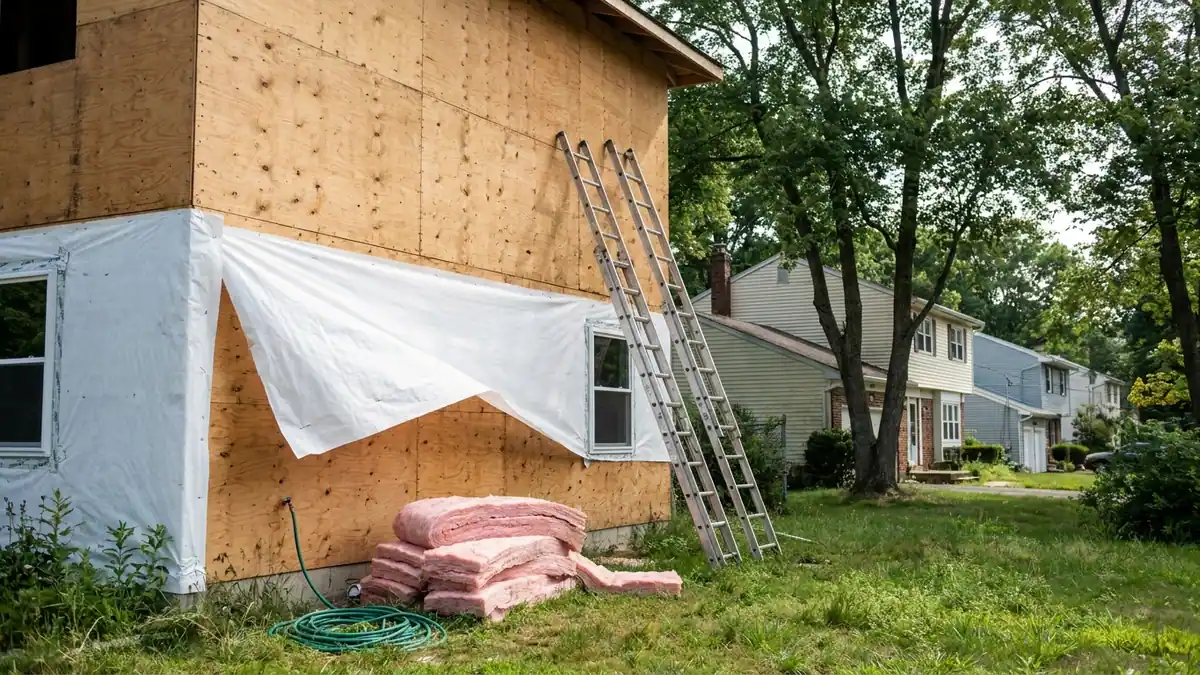
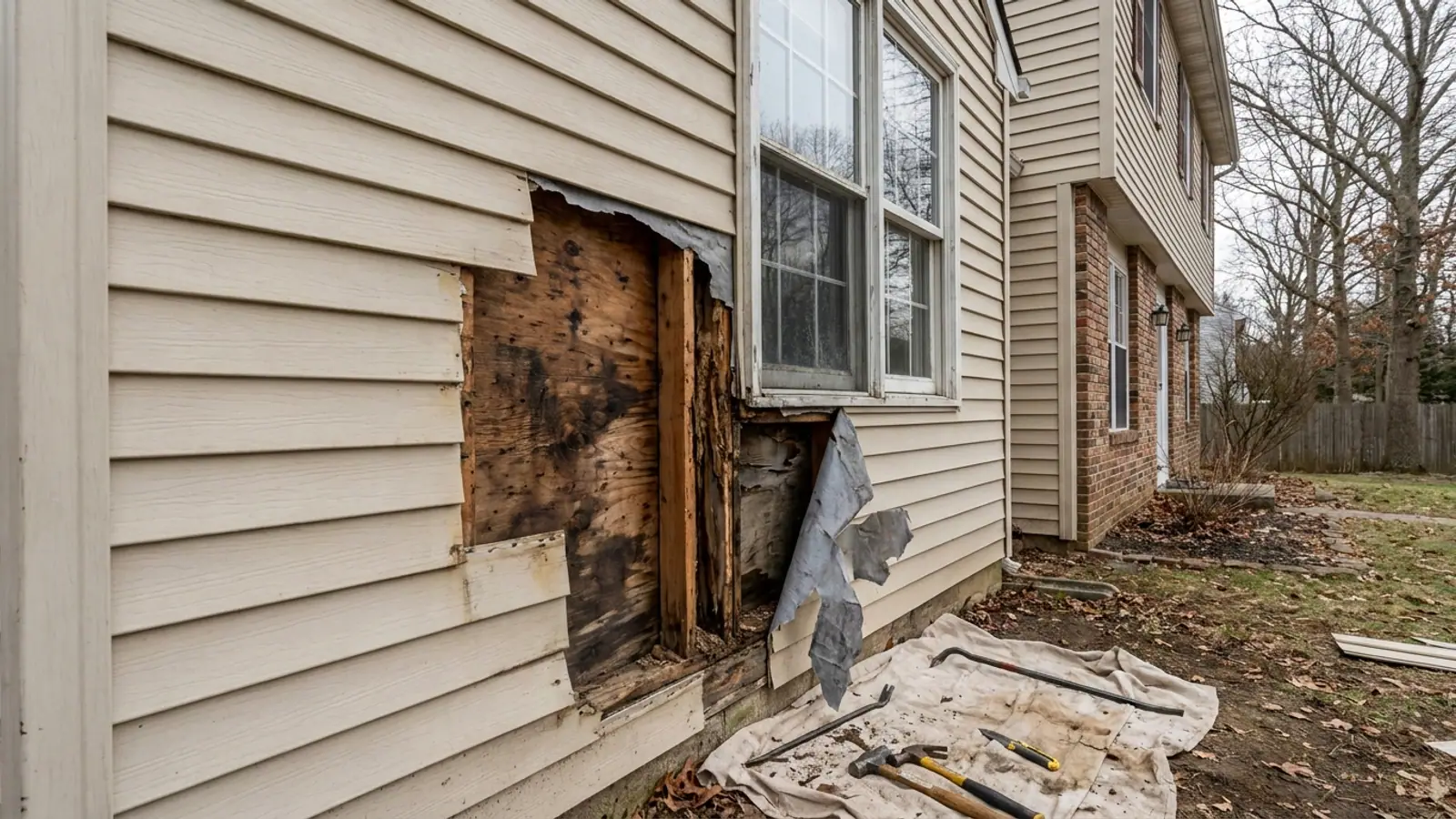
When a crew pulls the old siding and finds rot, the work stops being about panels and starts being about water. The wet sheathing gets cut back to sound wood, the framing behind it gets probed, the source of the leak gets corrected, and only then does new house wrap and siding go on. Skipping any of those steps means the new wall looks finished and keeps rotting underneath.
This is the single most common surprise on a siding job in New Jersey, and it is entirely predictable. Most of the housing stock in this state was built between the 1950s and the 1980s, before kick-out flashing and drainable house wrap were standard practice. Water has had decades to find the gaps.
Where rot behind siding actually starts
Rot is not random. It shows up at the same handful of details on house after house, because those are the places where two materials meet and the water has to be steered rather than shed.
| Where the water gets in | What you see on the wall | What is wet behind it |
|---|---|---|
| Where the water gets inWindow and door corners with no flashing pan | What you see on the wallBuckled panels, peeling interior paint | What is wet behind itSheathing under the sill, sometimes the rough sill framing |
| Where the water gets inMissing kick-out flashing where a roof edge meets a wall | What you see on the wallStained siding in a vertical band | What is wet behind itA tall wet stripe of sheathing, often the worst rot on the house |
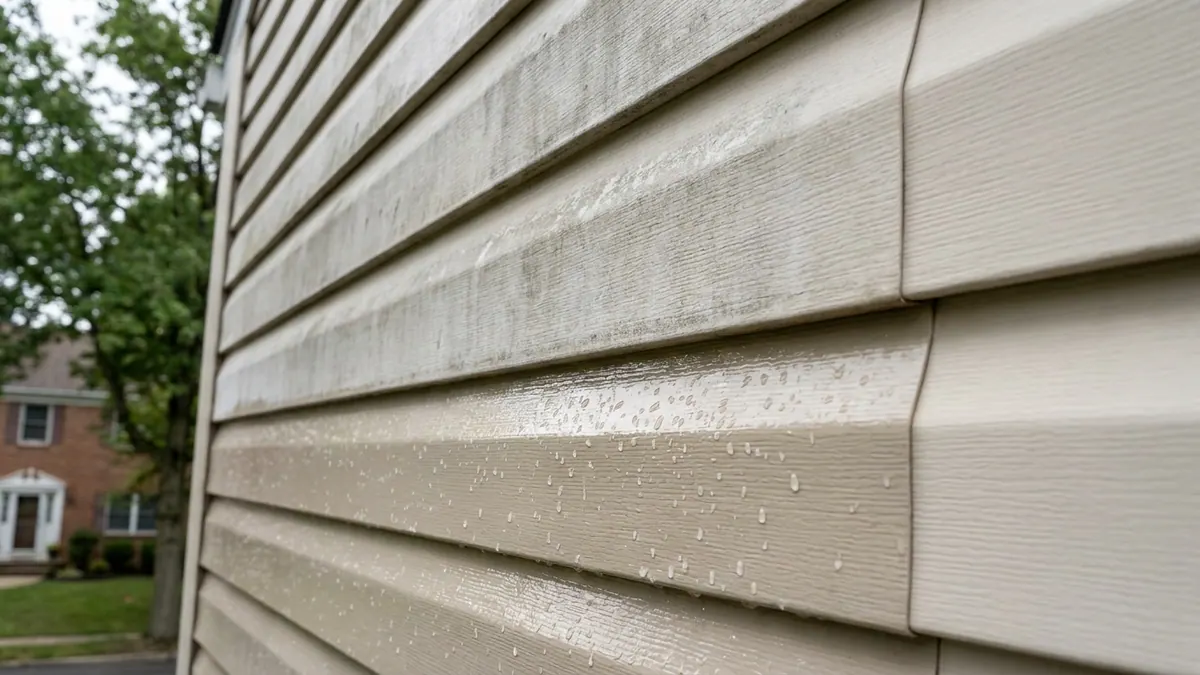
| Where the water gets inOverflowing or back-pitched gutters | What you see on the wallStreaking and mildew on the wall below | What is wet behind itSheathing behind the top course, fascia and soffit above it |
| Where the water gets inDeck ledger bolted through siding | What you see on the wallNothing visible until the boards come off | What is wet behind itBand joist and rim, the most serious of the group |
| Where the water gets inSiding buried in soil or mulch | What you see on the wallPanels tight to grade, no clearance | What is wet behind itBottom plate and the first foot of sheathing |
| Where the water gets inHose bibs, dryer vents, light blocks | What you see on the wallA small dark ring at the penetration | What is wet behind itA localized soft patch, usually under a square foot |
If you want to guess where a crew will find rot on your house, look at those six places before anyone shows up. You will be right most of the time.
What the crew does the moment rot is uncovered
The order matters, and a good crew follows it the same way every time.
- Pull siding back past the stained area until the sheathing is dry and firm on all four sides. The wet zone is almost always bigger than the stain.
- Probe the sheathing with an awl or a screwdriver. If it sinks in without resistance, that wood is gone regardless of how it looks.
- Cut out the bad sheathing to the center of the nearest studs so the new panel has something to land on.
- Check the framing underneath. Studs, the rough sill under a window, the bottom plate and the band joist behind a deck are the members that take the water.
- Find and fix the source. New flashing, a kick-out at the roof-to-wall junction, a properly lapped window pan, a re-pitched gutter, or grade cut back away from the wall.
- Install new sheathing, then house wrap lapped shingle-style over the flashing so water running down the wrap is carried out over the siding below, not behind it.
- Re-side, with the trim and J-channel details built so the wall can drain and dry.
Step five is the one that gets skipped on cheap jobs. New plywood over an unfixed leak is a repair with an expiration date.
Sheathing rot versus framing rot
These are two different jobs and it is worth knowing which one you have.
Sheathing
Sheathing is the plywood, OSB or diagonal plank layer nailed to the outside of the studs. It is the first thing to get wet and the easiest thing to replace. On an older New Jersey house you may find plank sheathing with gaps between the boards, which is normal for the era and not a defect by itself. Replacing a few sheets adds material and labor to the day but does not change the shape of the project.
Framing
Framing rot means a structural member has softened. Around a window it is usually the rough sill and the bottom of the trimmer studs. At the bottom of a wall it is the plate sitting on the foundation. Behind a deck it is the band joist, and that one is a safety issue because the deck is bolted to it. Framing repair means sistering new lumber alongside the sound portion of the member or cutting out and replacing a section. It takes longer and it should be described in writing, not handled with a verbal 'we took care of it.'
Why this should be in the estimate before anyone starts
Rot behind siding is the classic change-order trigger. A contractor quotes the wall from the driveway, opens it, finds wet sheathing, and hands you a number while your house is half open. You have very little leverage in that moment and everybody involved knows it.
Lightning Construction does not write change orders. The conditions that normally cause them are looked for at the free inspection and priced into the written estimate, so the number you sign is the number you pay. There is also no deposit on any job. Nothing is due until the work is finished and you have inspected it, which means you are not paying in advance for a wall nobody has opened yet.
New Jersey siding runs $10,000-$22,000 in standard-value towns, $16,000-$38,000 in higher-value towns and $30,000-$70,000 on large or luxury homes. The band is set by the median home value of the municipality using ACS 2024 five-year estimates, and the range covers the work as scoped, including the sheathing repair that is written into it. Treat any quote as a range until it is in writing.
Fix the water before you buy the siding
Rot is a symptom. If the gutter above a wall is overflowing every heavy rain, new siding will look excellent and the sheathing will be wet again in a few seasons. Re-pitching or replacing the gutters on that elevation, and running the downspout well away from the foundation, is a small part of the budget that protects the largest part of it.
Same with the roof-to-wall junctions. Anywhere a lower roof dies into a wall, there needs to be step flashing under the siding and a kick-out at the bottom of the run to throw water into the gutter instead of behind the wall. That detail is missing on a great many houses built before it was enforced.
What the new wall should have on it
When the rot is out and the flashing is right, the rebuild is straightforward. Ask for these in writing:
- New sheathing where the old sheathing was cut out, matched in thickness to the existing wall.
- House wrap over the whole wall, taped, and lapped over the top flange of any flashing.
- Flashing pans under window and door openings, not just caulk.
- Kick-out flashing at every roof-to-wall termination.
- Bottom course clearance above grade so soil and mulch are not touching the panels.
Material choice matters less than the layers behind it, but it still matters. The guide to siding options for NJ homes covers how vinyl, insulated vinyl and fiber cement compare on cost, maintenance and how they hold up in this climate.
What to do next
If you have buckled panels, a soft spot under a window or staining on a wall below a gutter, get the wall looked at before you price the siding. Lightning Construction is veteran-owned and family-operated, licensed and insured, and registered as a New Jersey Home Improvement Contractor, 13VH12437000. Lightning pulls the permit from your municipality's construction office and attends the inspection, so you file nothing.
The inspection and the written estimate are free with no obligation, and a salesperson does come to the house. That is a straight sales appointment, and it is also where the rot gets found and priced. Start with a look at the siding page, then request a free estimate and have someone open the suspicious spot while it is still a small one.