Short answer
A dumpster and debris removal line should cover container delivery, placement and protection of the surface it sits on, all tear-off material loaded into it, the tipping fees at the transfer station by weight, pickup, and a magnet sweep of the property. The part homeowners get burned on is tonnage, because disposal is billed by weight and an extra shingle layer nobody counted doubles it. Get the number of existing layers written into the estimate, and get confirmation that disposal is included at any weight.
On this page
- What the dumpster line actually pays for
- Why tonnage is the number that changes the price
- What should be included, and what often is not
- Driveway protection and who pays if the surface cracks
- Where the container goes, and who gets the town permit
- Nails, the magnet sweep, and what clean actually means
- What to get in writing before you sign
- What to do next
A dumpster and debris removal line should cover the entire disposal chain, not just the container sitting in your driveway. That means delivery, where it sits and what goes under it, every piece of tear-off loaded into it, the tipping fees at the transfer station, pickup, and a magnet sweep of the lawn and driveway afterward. If the estimate does not say disposal is included regardless of weight, you have an open-ended number sitting in the middle of a five-figure job.
Here is what that line really pays for, and the three places it quietly turns into a surprise bill.
What the dumpster line actually pays for
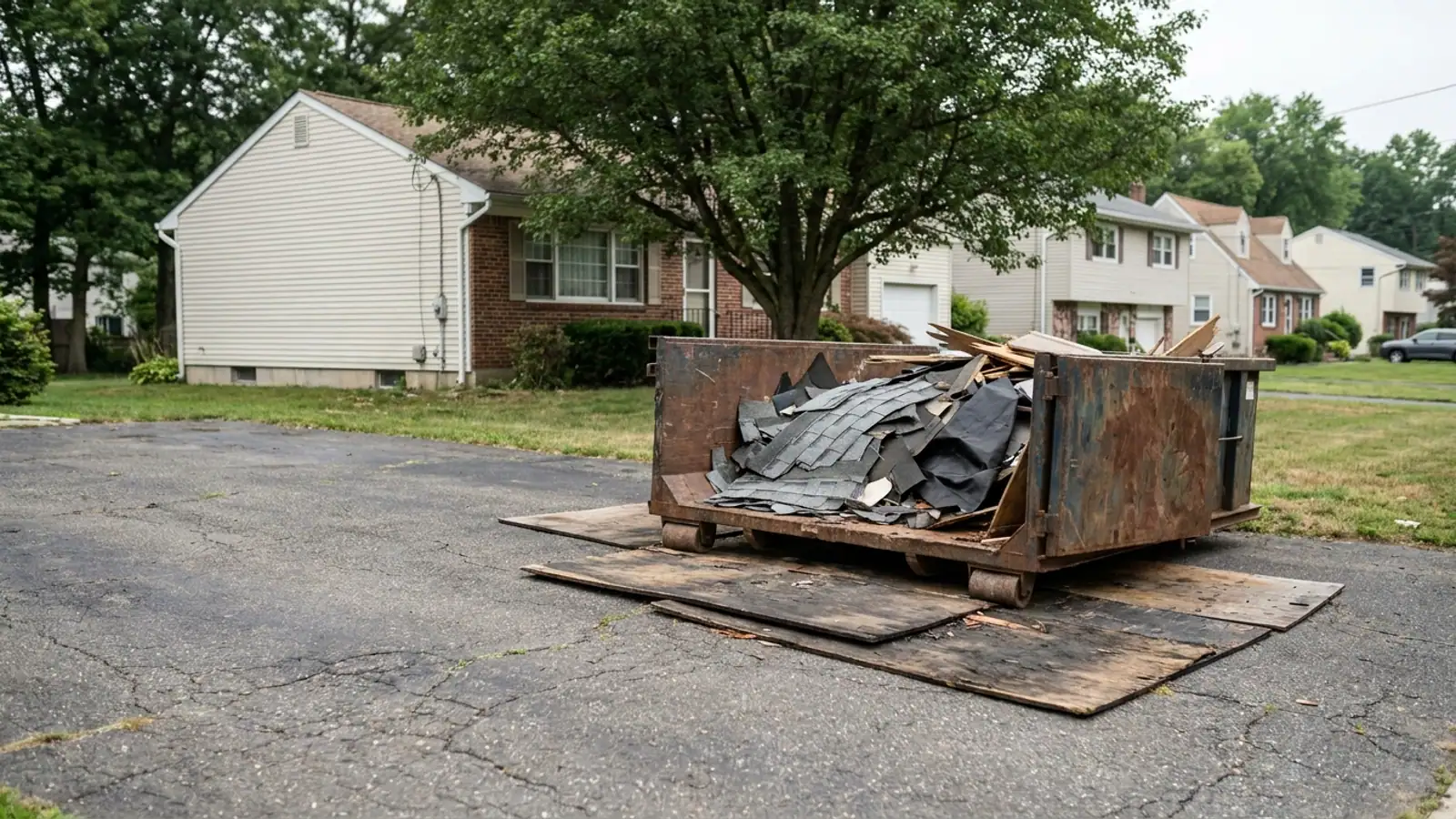
A tear-off generates far more material than homeowners expect. A single-layer asphalt roof produces the shingles, the old underlayment, the nails, the rusted drip edge, the old step and counter flashing, the pipe boots, and whatever rotted decking comes off with it. All of it has to leave the property the same day, which is part of why most asphalt replacements are finished in one day.
The disposal cost has four moving parts:
- Delivery of the roll-off container or positioning of a dump trailer, including the drive to and from the yard.
- Protection of whatever the container sits on, which should be plywood or planking on an asphalt or paver driveway.
- The tipping fee at the transfer station, billed by weight, not by how full the box looks.
- Pickup, plus a second haul if the first container fills before the roof is stripped.
Tipping is the one that moves. Everything else is roughly fixed for a given house. Weight is not.
Why tonnage is the number that changes the price
Disposal is sold by the ton. Asphalt shingles are heavy, and architectural shingles weigh noticeably more per square than three-tab because they are two or more laminated layers instead of one. Put a second layer over the first, as was common on New Jersey houses through the 1970s and 1980s, and the tonnage leaving your roof roughly doubles. So does the labor to strip it.
That is exactly why a roofer who priced your job from the driveway, or from a satellite image, can be honestly wrong. He bid one layer. The crew finds two. Under a normal contract, that becomes a change order on the morning of the tear-off, when your roof is already open and you have no leverage. Lightning Construction does not write change orders. The number of layers, the condition of the decking and the state of the flashing are established at the free inspection and priced into the written estimate, so the price on the paper is the price at the end.
If you are comparing bids, the layer count is one of the first things to check. A low number with no layer count stated is a number that can move. The New Jersey roof cost guide walks through the other drivers that actually set the total.
What should be included, and what often is not
| Usually included | Often billed separately or excluded |
|---|---|
| Usually includedContainer delivery and pickup | Often billed separately or excludedWeight over a stated tonnage cap |
| Usually includedAll asphalt shingles and underlayment | Often billed separately or excludedA second container when a layer count was missed |
| Usually includedOld nails, drip edge and flashing | Often billed separately or excludedOld gutters and downspouts taken down |
| Usually includedRotted decking replaced during the job | Often billed separately or excludedChimney masonry or demolished structures |
| Usually includedTipping fees at the transfer station | Often billed separately or excludedHousehold junk the homeowner adds to the box |
| Usually includedMagnet sweep of lawn and driveway | Often billed separately or excludedStreet-occupancy permit for an on-road container |
Two rows there cause most of the arguments. The first is a tonnage cap, which is a line that says disposal is included up to a set weight and billed after that. Ask directly whether a cap exists. The second is old gutters. If the gutters are coming down as part of the job, confirm they are being hauled with the roof debris and not left stacked beside the garage.
The last row is yours to resist. Once there is an open container in the driveway, the old swing set starts to look like a candidate. Do not add anything to a roofing dumpster without asking. Mixed loads can be rejected at the transfer station or billed at a different rate, and it is not your contractor's cost to absorb.
Driveway protection and who pays if the surface cracks
A loaded roll-off is heavy, and the truck delivering it is heavier. Asphalt driveways soften in summer heat, and paver and stamped-concrete driveways crack under point loads from the container's rails and wheels.
The fix is plywood or planking laid under the container and along the path the truck wheels take. Ask for that specifically, and ask that it be noted on the estimate. Also ask where the container will sit, whether it will block a garage door or a car you need during the day, and whether any low branches are in the delivery path.
If your driveway cannot take a container at all, say so when the salesperson is at the house. A dump trailer, a second staging spot on the street, or a tarp-and-load setup are all workable. What is not workable is finding out at 7 a.m. on the day of the tear-off.
Where the container goes, and who gets the town permit
On your own driveway, you generally do not need anything from the town. The moment the container has to sit on the street or encroach on a sidewalk, many New Jersey municipalities require a street-occupancy or road-opening permit, sometimes with reflective markings or a time limit attached. That is separate from the construction permit for the roof itself.
Lightning pulls the roofing permit from your municipality's own construction office under the New Jersey Uniform Construction Code and attends the inspection. You file nothing. If your container needs to go in the street, ask who obtains that separate approval so it is settled in advance rather than discovered by a code officer. The roof permit guide covers what the construction permit itself involves.
Nails, the magnet sweep, and what clean actually means
A tear-off throws thousands of nails. They land in the lawn, in mulch beds, in the driveway, and in the gaps between pavers. A proper cleanup is a rolling magnet run over the driveway, the walkways and the perimeter of the house, plus a hand check of the beds and a tarp pulled from under the drip line with the debris still on it.
Ask what the cleanup includes and whether anyone comes back the next day. Nails work their way up through turf after the first good rain, so a second pass a few days later is a reasonable thing to request. If you have a dog, a pool, or kids who play barefoot in the yard, tell the crew where they spend their time so those areas get walked twice.
What to get in writing before you sign
Five things, and all five fit on the estimate:
- The number of existing shingle layers the price assumes, and what happens if the crew finds more.
- That disposal of all tear-off debris is included, with no tonnage cap or weight surcharge.
- That plywood or planking will be placed under the container and the truck path.
- Where the container will be set and whether a street permit is needed.
- That a magnet sweep of the lawn, driveway and walkways is part of the job.
A contractor who will not put those on paper is telling you something. The contractor selection guide covers the rest of the questions worth asking before you sign anything.
What to do next
Have someone get on the roof and in the attic before anyone quotes a disposal number. Layer count, decking condition and flashing condition are what set the tonnage, and none of them can be judged from the ground. Lightning Construction's roofing inspections and written estimates are free with no obligation, and a salesperson does come to the house. There is no deposit, nothing is due until the work is finished and you have inspected it, and the written estimate is the final price.
To get the layers counted and the disposal priced into a number that will not move, request a free estimate.