Short answer
A deck or a finished basement walkout under the eave does not stop a roof replacement, and on most New Jersey houses it does not add a day either. What it changes is staging: the crew has to cover and sometimes unload the deck, keep debris out of the walkout stairwell, and plan where the tear-off lands when the ground under the eave is a wood surface instead of grass. Ask how the deck will be protected and who sweeps it for nails before you sign anything.
On this page
- Why the area under the eave matters more than the roof above it
- How a crew protects a deck during a roof tear-off
- What the crew does with each feature under the eave
- Basement walkouts: the stairwell and the drain
- Deck ledger flashing, and what a roofer can and cannot touch
- Low-slope roofs over a deck or a walkout cover
- What to settle before the work is scheduled
- Next step
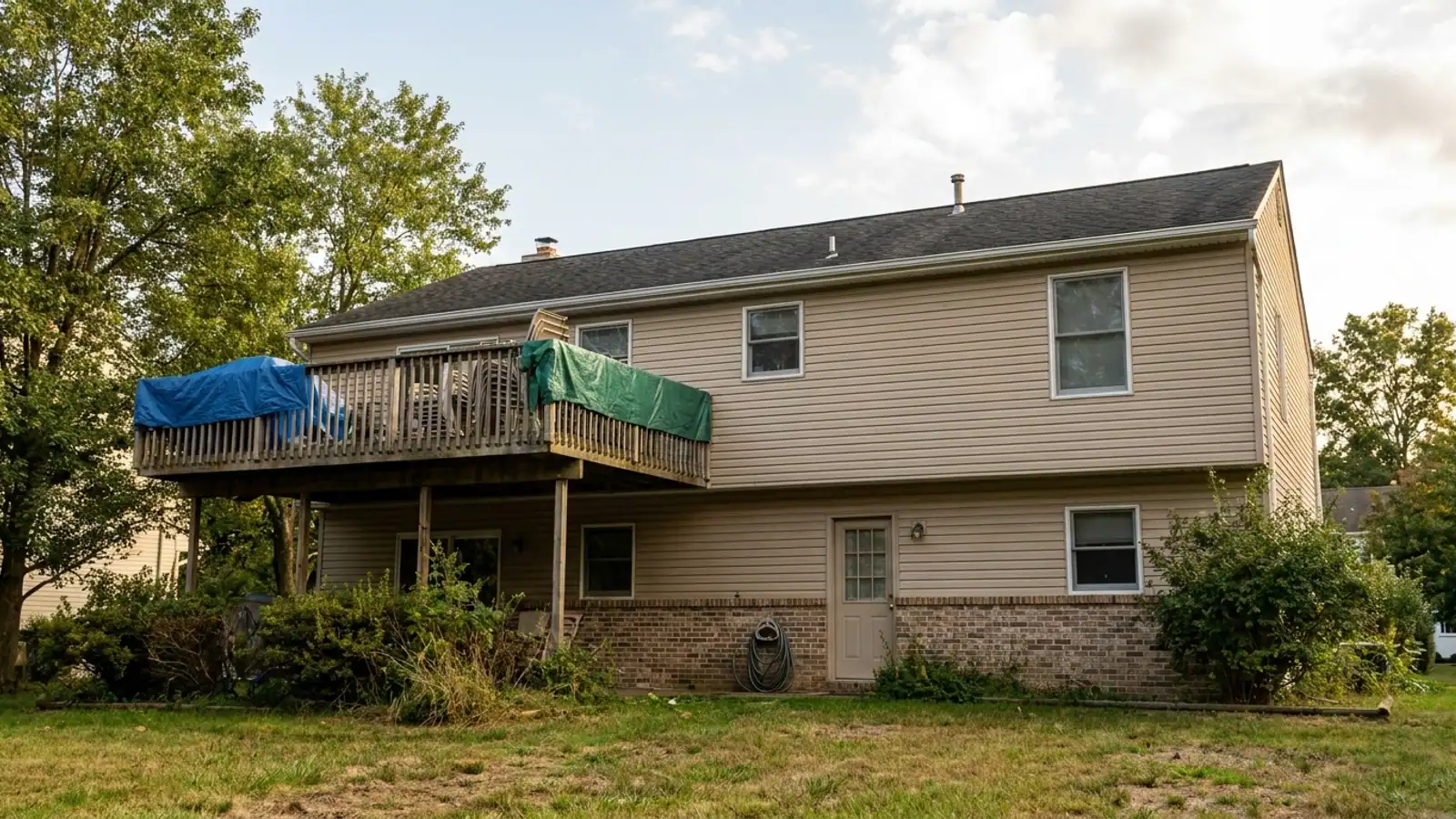
A deck under the eave or a finished basement walkout does not stop a roof replacement, and it rarely adds a day to it. Most New Jersey asphalt roofs are still torn off and finished in a single day with a deck in the way. What changes is staging. The crew has to decide where tear-off debris lands when the ground below the eave is a wood deck, a paver patio or a concrete stairwell instead of a lawn, and that decision has to be made before the first shingle comes off.
Here is what actually happens on a house like that, and what to confirm with the contractor before you sign.
Why the area under the eave matters more than the roof above it
On a tear-off, gravity does most of the work. Shingles, felt, old flashing and a few thousand nails come off the slope and go down. On a typical front elevation they land on tarps over the lawn and shrubs, get raked into piles and go into the dumpster.
A deck changes three things at once. It is a finished surface that scratches and dents. It has gaps between the boards that swallow nails and granules. And it is usually the highest-traffic outdoor space on the house, so everything missed gets found by somebody in bare feet in July.
A basement walkout adds a fourth problem. It is a hole in the ground directly below a roof edge, with a door at the bottom and a drain that is rarely large. Debris funnels into it faster than anywhere else on the property.
How a crew protects a deck during a roof tear-off
The sequence a good crew uses is specific, and it happens before anybody gets on the roof.
- Clear the deck. Furniture, grill, planters, rugs, umbrellas and anything hanging on the rail come off or get moved to the far end.
- Cover the deck surface. Heavy tarps over the boards, and on long runs under a full eave, sheets of plywood over the tarps so falling debris hits something sacrificial.
- Cover the railing and any attached structure. The outside face of the rail catches as much as the floor does.
- Protect what cannot move. A hot tub, a built-in bench, an outdoor kitchen cabinet gets its own covering, not just the deck tarp.
- Set the fall zone. On a deck too narrow to tarp safely, shingles get bundled and carried down a ladder or sent down a chute instead of being dropped.
- Lift the covering with the debris on it at the end of the day, rather than sweeping a loaded tarp.
Step six is the one that separates a clean job from a bad one. Sweeping debris across a tarp drives granules and nail heads into the seams and the gaps. Rolling the whole covering up and carrying it off takes the mess with it.
What the crew does with each feature under the eave
| Under the eave | What has to happen |
|---|---|
| Under the eaveOpen wood deck | What has to happenTarp plus plywood, rail covered, lifted out with debris on it, hand pick between boards |
| Under the eaveComposite decking | What has to happenSame covering, plus care with ladder feet, which mark composite more easily than wood |
| Under the eavePaver or concrete patio | What has to happenTarped; pavers chip when a bundle of wet shingles lands on an edge |
| Under the eaveFinished basement walkout | What has to happenStairwell fully covered, drain checked and cleared before and after |
| Under the eaveUnder-deck ceiling or drainage panels | What has to happenTreated as a second roof surface, since debris that gets above it is hard to retrieve |
| Under the eaveScreened porch or sunroom below | What has to happenScreens covered; a torn screen is the most common collateral damage on these houses |
| Under the eaveHot tub or outdoor kitchen | What has to happenCovered separately and never used as a work platform |
Basement walkouts: the stairwell and the drain
The walkout stairwell is the single worst place for roof debris to end up. It is enclosed, it is below grade, and the drain at the bottom is often a small grate tied into a line nobody has looked at in years. Fill that drain with shingle granules and the next heavy rain puts water against a finished basement door.
Three things to insist on. The stairwell gets covered, not just the landing at the top. The drain gets checked before work starts and cleared after. And the door at the bottom is not used as a crew entrance, because that is how debris gets tracked inside.
If the roof edge above the walkout dumps water into that stairwell, a roof replacement is the right time to fix it. A downspout discharging two feet from a below-grade door is a drainage problem that no shingle solves. Repositioning the downspout, extending it, or re-pitching the gutter run above the walkout is gutter work and it is cheap next to the roof. Have it priced on the same estimate.
Deck ledger flashing, and what a roofer can and cannot touch
Where the deck attaches to the house, there is a ledger board bolted to the rim joist and a flashing over it. That flashing keeps water out of the wall. It is not roof flashing, and replacing a roof does not replace it.
What the inspection should tell you is whether the water coming off your roof edge is landing on that ledger. A gutter that overflows, a missing or short drip edge, or a downspout elbow pointed at the deck will rot a ledger from the top down, and the first sign is usually soft trim or a stain on the siding above the deck boards.
Deck rebuilding is not roofing work. But the roof edge, the drip edge and the gutter that feed water onto a deck all are, and those get looked at as part of a roof replacement on any house with a deck under the eave.
Low-slope roofs over a deck or a walkout cover
Plenty of New Jersey houses have a small roof over the deck itself, or a shed roof over the walkout door. These are usually low-slope sections, and low slope is its own system. Shingles on a pitch that is too shallow will leak no matter how well they are nailed, and the correct answer is a membrane rather than more shingles. The flat and low-slope roofing guide covers what belongs on those sections.
If your estimate shingles a section that water sits on, ask why. A contractor who cannot name the pitch of that section has not measured it.
What to settle before the work is scheduled
The deck questions belong in the estimate, not in a conversation on the morning of the job. At the free inspection, get answers to these:
- How is the deck covered, and is plywood going over the tarps.
- Who moves the furniture, you or the crew.
- Where does the dumpster sit, and how does debris get from the back of the house to it.
- Who sweeps the deck, the gaps and the stairwell, and when.
- Is the walkout drain checked before and after.
- Does any gutter or downspout get moved as part of the job.
All of it should be written down. At Lightning Construction the conditions that normally turn into a surprise, including extra shingle layers, rotted decking and flashing that cannot be reused, are found at the free inspection and priced into the quote, so there are no change orders. There is no deposit either, and nothing is due until the work is finished and you have inspected it, which on a house like this means walking the deck yourself before anybody gets paid.
Lightning pulls the permit and attends the municipal inspection under the New Jersey Uniform Construction Code; you file nothing. The permit guide explains how that works in each municipality.
Next step
If your roof is due and there is a deck or a walkout under the eave, have it inspected before you collect quotes, so the staging is priced rather than improvised. The inspection and the written estimate are free with no obligation, and a salesperson does come to the house. Book a free estimate and have them walk the deck and the stairwell with you, not just the roof.