Short answer
Pitch raises the price of a roof because a steep roof is slower and more dangerous to work on, holds more surface area than its footprint suggests, and needs staging the crew does not set up on a walkable roof. Below roughly 8/12 the effect on a New Jersey quote is small. Above that it grows fast, and below 2/12 the roof stops being a shingle roof at all, which changes the material and the price entirely.
On this page
- How roof pitch is measured
- Why a steeper roof costs more to replace
- The pitch breakpoints that change a quote
- Pitch changes how much roof you actually have
- Low slope is a material question, not a labor question
- What pitch does not change
- How pitch shows up in a New Jersey price band
- What to ask for in writing
Pitch is the second-biggest thing driving your roof price, after square footage. It changes how fast a crew can move, what safety equipment goes up before a single shingle comes off, how much material lands in the dumpster instead of on the ground, and on the low end, whether shingles are even legal on that slope.
What follows is where pitch actually shows up in a number, and where homeowners think it matters but it does not.
How roof pitch is measured
Pitch is rise over run, written as inches of vertical rise per 12 inches of horizontal run. A 6/12 roof climbs 6 inches for every 12 inches it travels sideways. A 12/12 roof climbs a full 12 inches, which is a 45-degree angle.
You can measure it from inside the attic. Hold a 2-foot level horizontally against the underside of a rafter, mark 12 inches out from where it touches, and measure straight down from that mark to the rafter. That measurement in inches is your rise. You can do the same thing from a ladder at the gable end without climbing onto the roof.
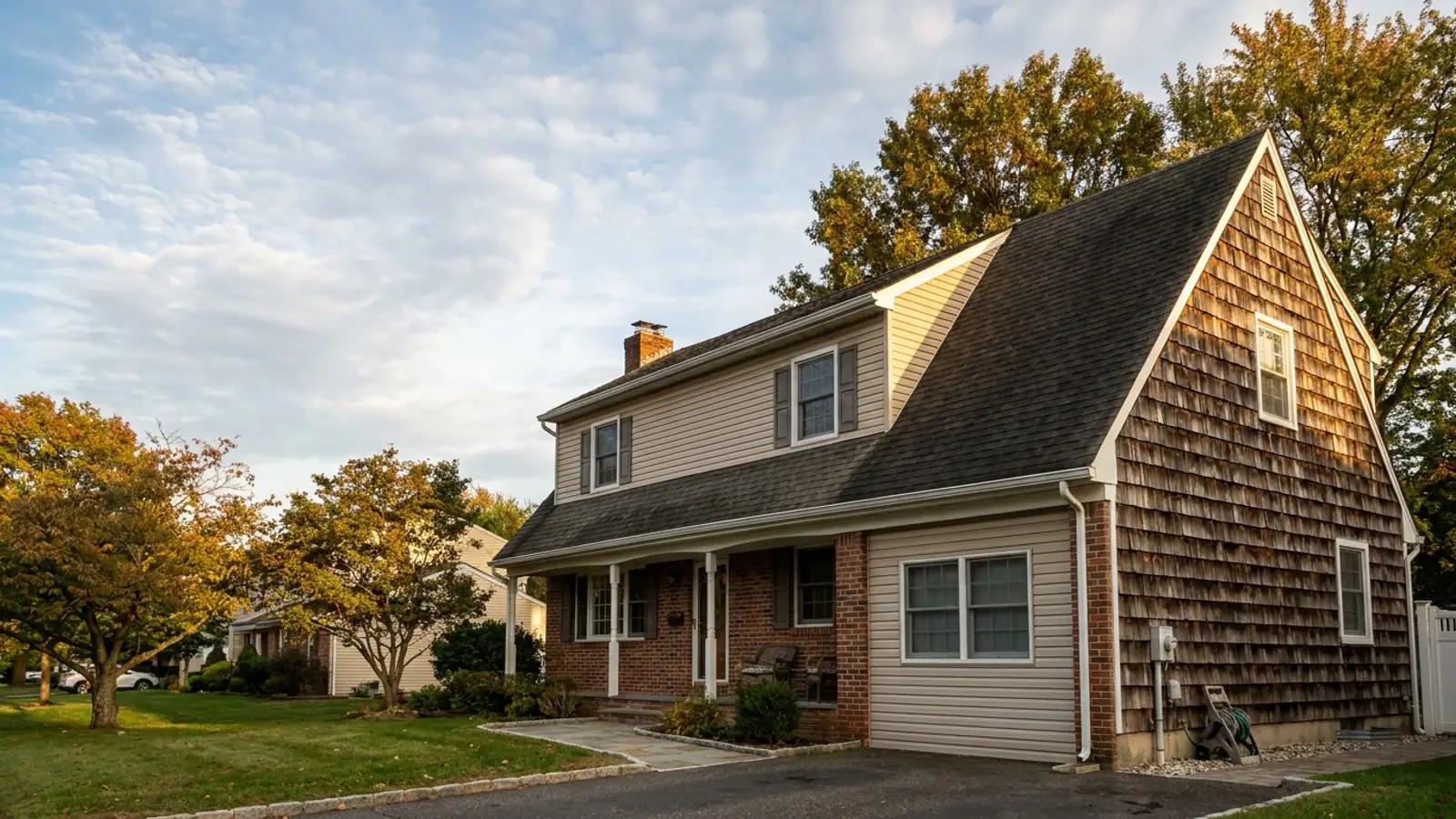
Most New Jersey housing sits between 4/12 and 8/12. Post-war ranches and split levels run shallow, often 3/12 to 5/12. Colonials, Cape Cods and Victorians run steeper, and a lot of older homes in Passaic, Essex and Hudson counties have main roofs at 10/12 or higher with dormers cut into them.
Why a steeper roof costs more to replace
The crew stops walking and starts staging
Up to about 7/12, a roofer walks the roof. Bundles get carried up and set down. Tear-off debris slides to a chute or lands in the dumpster.
At 8/12 and above that ends. The crew installs roof jacks and planks to stand on, sets more ladders, uses harnesses and anchors, and moves material in smaller loads. All of that is labor that produces no finished roof. It happens before the first shingle is stripped and comes back down at the end of the day.
Every task takes longer
On a steep roof a roofer works with one hand on the roof and one on the tool. Nailing patterns take longer to hit correctly. Chalk lines take longer to snap. Valleys and step flashing at a dormer, already the slowest part of any roof, get slower still. The same house with the same square footage takes materially more crew hours at 12/12 than at 5/12.
Tear-off and cleanup get harder
Debris on a shallow roof stays where it lands. On a steep roof it comes off fast, which is good for the dumpster and bad for landscaping, gutters and the crew below. Steep jobs need more ground protection and more people managing where material goes. Nail sweeps take longer because the debris scattered wider.
The pitch breakpoints that change a quote
| Pitch | What it means on site | Effect on price |
|---|---|---|
| PitchUnder 2/12 | What it means on siteNot a shingle roof. Needs a membrane system | Effect on priceDifferent material and crew entirely |
| Pitch2/12 to 4/12 | What it means on siteWalkable, but code and manufacturers require doubled underlayment | Effect on priceSmall material increase |
| Pitch4/12 to 7/12 | What it means on siteThe standard New Jersey roof, fully walkable | Effect on priceBaseline |
| Pitch8/12 to 9/12 | What it means on siteRoof jacks and planks, fall protection, slower production | Effect on priceNoticeable |
| Pitch10/12 and above | What it means on siteFull staging, smaller material loads, most hours per square | Effect on priceLargest |
The breakpoint that surprises people is 8/12. Below it, pitch barely moves a quote. Above it, the labor line climbs steadily with every additional inch of rise.
Pitch changes how much roof you actually have
A 1,600 square foot footprint is not 1,600 square feet of roof. The slope adds surface. At 4/12 the roof surface is roughly 5 percent larger than the flat area beneath it. At 8/12 it is about 20 percent larger. At 12/12 it is about 41 percent larger.
That is more shingles, more underlayment, more ice and water shield, more ridge cap and more disposal weight. Two houses with identical floor plans can carry very different amounts of roof, and the steeper one buys more of everything. This is also why a per-square number quoted over the phone tells you nothing until somebody measures the actual planes. The New Jersey roof cost guide breaks down what else moves the total on a real house.
Low slope is a material question, not a labor question
Go the other direction and the problem flips. Asphalt shingles have a code minimum slope of 2/12. Between 2/12 and 4/12 they can be used, but the underlayment has to be doubled, because water moves slowly at that angle and wind-driven rain pushes back up under the courses.
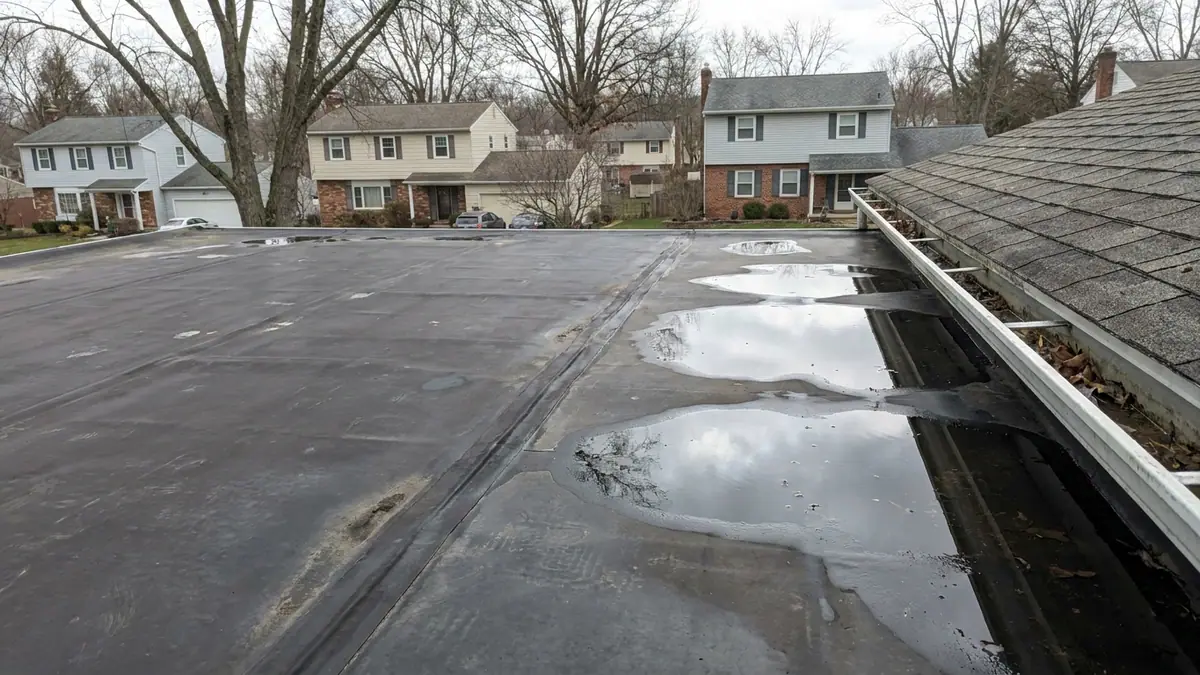
Below 2/12, shingles do not belong there at any price. That roof needs a membrane, which means TPO, EPDM or modified bitumen. Plenty of New Jersey houses have exactly this situation: a steep main roof over the house and a nearly flat porch, addition or rear kitchen roof tied into it. That is two systems, two material sets and two ways of detailing the junction between them. It is also one of the most common places these roofs leak. The flat and low-slope roofing guide covers what goes on those sections.
If a quote for a house with a low-slope porch shows shingles across the whole thing at one price, ask specifically what is going on the porch. The answer tells you how carefully the roof was looked at.
What pitch does not change
It does not change who pulls the permit. Lightning Construction pulls it from your municipality's construction office under the New Jersey Uniform Construction Code and attends the inspection. You file nothing, on a 3/12 ranch or a 12/12 Victorian.
It does not change the shingle you are allowed to buy, above 2/12. Architectural shingles install on shallow and steep roofs alike.
And it does not change the terms. Most New Jersey asphalt roof replacements are torn off and finished in a single day. There is no deposit, and nothing is due until the work is done and you have inspected it. There are no change orders, because pitch, layer count, decking condition and flashing are all assessed at the free inspection and written into the estimate before you sign.
How pitch shows up in a New Jersey price band
Most asphalt roof replacements run $9,000 to $22,000 in standard-value towns, $14,000 to $35,000 in higher-value towns, and $25,000 to $60,000 for large or luxury homes. The band itself comes from the municipality's median home value using ACS 2024 five-year estimates, not from your roof.
Pitch moves you within your band. A steep, cut-up roof with dormers and valleys lands toward the top of the range for its town. A simple walkable gable with two planes lands near the bottom. Anyone quoting your specific house should be able to tell you the pitch they measured and where the staging cost sits.
What to ask for in writing
- The measured pitch of each roof plane, not an estimate from the driveway.
- Total roof area in squares, and whether low-slope sections were counted separately.
- The exact system going on any section under 4/12, and the underlayment spec on anything between 2/12 and 4/12.
- Whether the price is final or subject to change once the old roof is off.
- Who pulls the permit and who meets the inspector.
A contractor who cannot answer the first three has not been on your roof. The contractor selection guide has the rest of the questions worth asking.
When you want your own pitch measured and a final written number, book a free estimate. The inspection and the written price cost nothing, there is no obligation, and a salesperson comes to the house to walk the roof and go through it with you.