Short answer
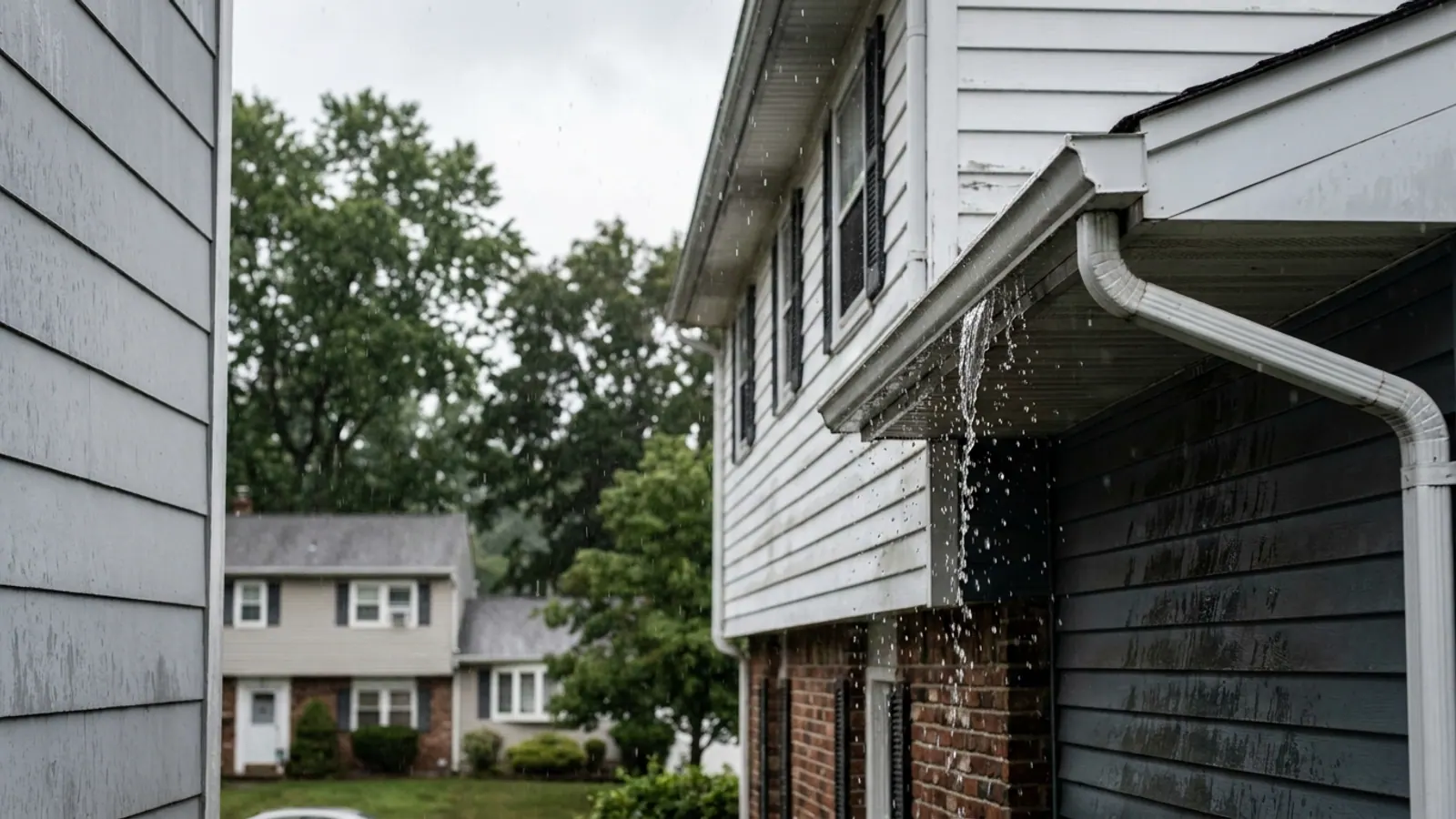
Timing and location separate the two. Gutter overflow shows up only during heavy rain, drips in a sheet off the front or back edge of the gutter, and stains the fascia, siding and soil directly below the roof edge. A roof leak shows up inside the house, often keeps dripping after the rain stops, and usually traces back to a flashing point, a pipe boot or a valley rather than to the gutter.
On this page
Stand outside during the next hard rain and watch the roof edge. If water pours over the front lip of the gutter in a sheet, or runs down the fascia behind it, you have a gutter problem. If the gutters are moving water fine and you still have a wet spot inside the house, you have a roof problem. Those two causes get mixed up constantly because they produce some of the same damage on the outside of the house, and because the fix for one costs a fraction of the fix for the other.
The first question: when does the water show up?
Timing separates the two faster than anything else.
Gutter overflow is tied to rain intensity. A steady light rain causes nothing. A thunderstorm or the front edge of a nor'easter produces water over the lip within a few minutes, and it stops within a few minutes of the rain stopping. If your water event always lines up with the heaviest part of a storm and ends when the storm does, you are looking at drainage, not the roof covering.
A roof leak is tied to rain duration and wind direction. It often starts an hour into a long soaking rain, keeps dripping for a while after the sky clears because water is still working out of the insulation and decking, and sometimes only appears when the rain is blowing from one particular direction. A leak that only happens with wind-driven rain from the northeast and never in a calm downpour is almost never a gutter.
Where the water shows up
Location is the second test, and it is nearly as reliable.
| What you see | Usually gutter overflow | Usually a roof leak |
|---|---|---|
| What you seeWater sheeting off the front of the gutter in heavy rain | Usually gutter overflowYes | Usually a roof leakNo |
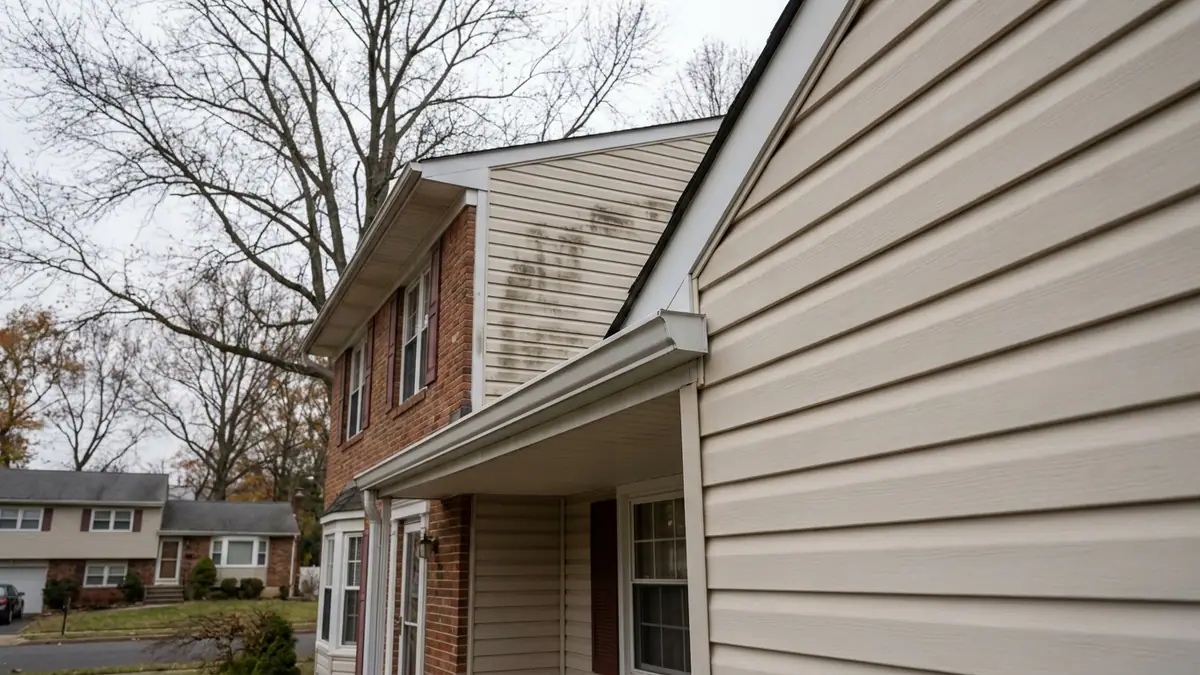
| What you seeDark vertical streaks on the fascia and the siding under the roof edge | Usually gutter overflowYes | Usually a roof leakNo |
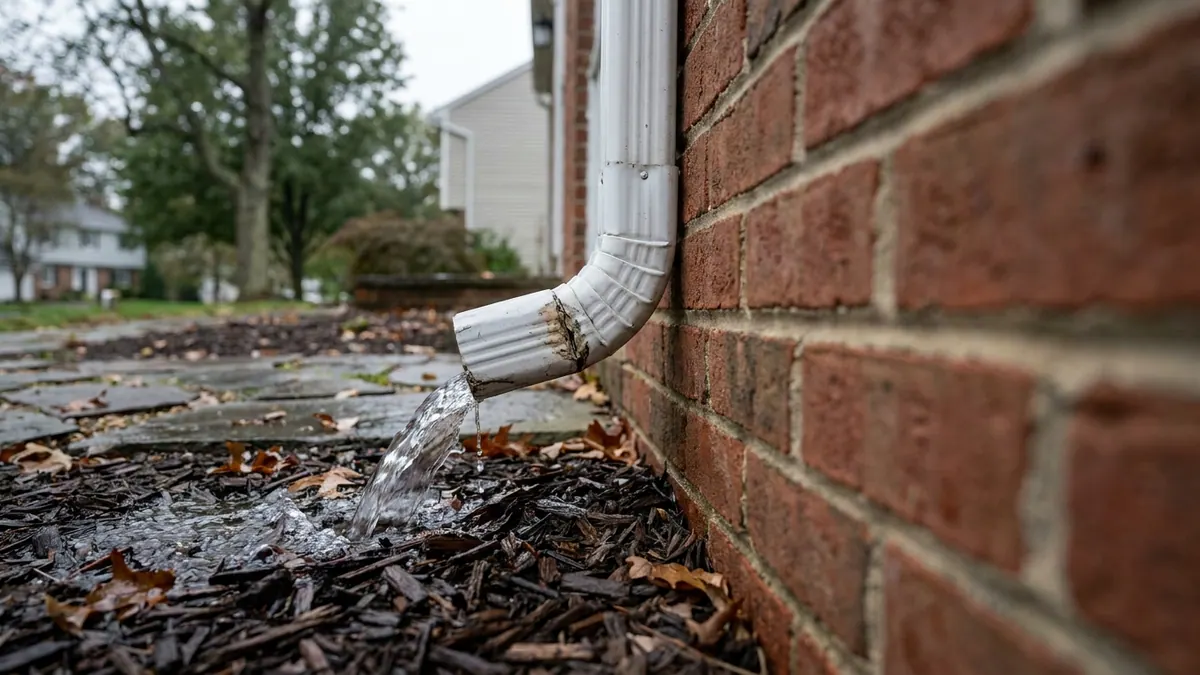
| What you seeTrench or splash marks in the mulch and soil at the foundation | Usually gutter overflowYes | Usually a roof leakNo |
| What you seeWater in the basement along one wall after storms | Usually gutter overflowYes | Usually a roof leakRarely |
| What you seeStain on a ceiling in the middle of a room | Usually gutter overflowNo | Usually a roof leakYes |
| What you seeStain on the ceiling right at the outside wall | Usually gutter overflowSometimes, if water backs up under the eave | Usually a roof leakYes |
| What you seeWet sheathing or rafters visible in the attic | Usually gutter overflowNo | Usually a roof leakYes |
| What you seePeeling paint and soft wood on the fascia board | Usually gutter overflowYes | Usually a roof leakSometimes |
The one row that causes arguments is the stain at the outside wall. In a New Jersey winter, a clogged or undersized gutter holds standing water, that water freezes, ice backs up under the first course of shingles, and it melts into the wall cavity. The ceiling looks exactly like a roof leak because by that point it is one. The ice dams guide covers why that happens and what actually stops it.
Six checks you can do yourself
- Go outside during a hard rain and watch each gutter run. Note which run overflows and at what point along its length.
- Look at the back of the gutter where it meets the fascia. Water running down there instead of into the trough is a drip edge or gutter apron issue at the roof edge, not a gutter capacity issue.
- Check that every downspout is actually discharging. Put a hand near the outlet. A downspout that is dry during a downpour is blocked.
- Walk the foundation after the rain. Splash erosion, trenches in the mulch and a wet basement wall all sit directly under the failing run.
- Go into the attic with a flashlight during or right after the rain. Look for wet sheathing, dark staining around nails, rusty nail shanks and damp insulation. Trace upslope from any wet spot, because water travels down rafters before it drips.
- Note whether the inside stain grows during the storm or hours later. Slow growth after the rain stops points to water stored in the assembly, which means a roof leak or condensation.
Why clean gutters still overflow
Cleaning is not the only variable, and a contractor who blames leaves for everything is not looking hard enough. Four other things cause overflow on gutters that are clean:
Capacity. Most New Jersey houses are correctly served by 5-inch seamless aluminum gutters with 2x3-inch downspouts. A steep roof throws water fast, and a long run that drains a big plane of roof into one outlet will overflow at the corner no matter how clean it is. That is a 6-inch gutter with 3x4-inch downspouts.
Downspout count. One downspout serving a 40-foot run is the single most common cause of overflow at the low end. Adding an outlet is a small job with a large effect.
Pitch. Gutters hung dead level or back-pitched hold standing water, and standing water takes up the volume you need during the storm. Re-pitching an otherwise sound gutter is often the whole repair.
Valleys. Where two roof planes meet, the valley dumps a concentrated stream into one spot. Water hits the far side of the trough and jumps the lip. A valley splash guard fixes it.
The seamless gutters guide goes through sizing, guards and materials in detail, and the seasonal maintenance guide covers what to clear and when.
When it is the roof and not the gutter
Roof leaks start where the roof meets something else. Chimneys, sidewalls, valleys, skylights and plumbing vent boots account for most of them. Shingles in the middle of a plane rarely leak unless they are missing, cracked or badly curled.
That is why a leak traced to the center of a ceiling is almost never a gutter. Water entering at a flashing point runs down the deck or a rafter, sometimes ten or fifteen feet, then drops through at a ceiling joist. The stain is not under the hole. Finding the actual entry point takes someone in the attic with a light, and then on the roof.
Both can be true at once
Often they are. An old gutter that has pulled away from the fascia has usually been overflowing for years, and years of overflow rot the fascia board, soak the sheathing edge and work back under the first shingle course. By the time a homeowner calls, the fascia is soft, the drip edge is wrong, and the shingles at the eave are shot.
That is a real repair, and it is one of the reasons to settle it before the work starts rather than during. At Lightning Construction, the conditions that normally become change orders on the day are found at the free inspection and priced into the written estimate. There is no deposit, and the written estimate is the final price.
What each repair costs
Gutter work is the cheaper outcome by a wide margin. Seamless aluminum gutters in New Jersey run $1,200 to $3,500 in standard-value towns, $2,500 to $6,500 in higher-value towns, and $4,000 to $12,000 on large or luxury homes. The band is set by the municipality's median home value from ACS 2024 five-year estimates, not by how bad the overflow is. Re-pitching a run, adding a downspout or installing a splash guard sits well below a full replacement.
A roof leak can be a $0 answer if the problem turns out to be gutter capacity, or it can be a flashing repair, or it can be a replacement. Nobody can tell you which from the driveway, and anybody who does is guessing.
What to do next
Watch the next storm, make the six checks above, and write down which gutter run fails and whether anything shows up inside. Then get eyes on it. Lightning Construction inspects the roof edge, the gutters, the downspouts and the attic together, photographs what it finds, and shows you the photos. The inspection and the written estimate are free with no obligation, and a salesperson comes to the house.
If the answer is drainage, see what seamless gutter work involves. If you already know you want it looked at, book a free estimate and have the storm notes ready.