Short answer
Seamless aluminum gutter replacement in New Jersey runs $1,200 to $3,500 in standard-value towns, $2,500 to $6,500 in higher-value towns, and $4,000 to $12,000 on large or luxury homes, and a one-story house usually lands in the lower half of its band. The surprise is that a ranch is not always cheap, because a wide, spread-out footprint can carry as many linear feet of gutter as a two-story colonial with half the ground coverage. Price follows linear feet, downspout count, gutter size and the condition of the fascia behind the old gutter, not the number of floors.
On this page
- What actually sets the price on a one-story house
- Ranch versus two-story: where the cost really differs
- How to measure your own gutter run before the estimate
- Why downspout placement matters more on a ranch
- Seamless aluminum, hangers and what to specify
- Guards, maintenance and the low-eave advantage
- What to do next
Seamless aluminum gutter replacement in New Jersey runs $1,200 to $3,500 in standard-value towns, $2,500 to $6,500 in higher-value towns, and $4,000 to $12,000 on large or luxury homes. The band is set by the municipality's median home value from ACS 2024 five-year estimates, not by how tall your house is. A one-story home generally sits in the lower half of whichever band it falls in, but not always, and the reason catches people off guard.
A ranch spreads its roof out instead of stacking it. The same square footage that a colonial covers with two stories sits on one level here, which means a longer roof edge and more gutter to buy and hang. Height makes the work easier. Footprint makes the job bigger. Those two pull against each other, and on a long ranch the footprint usually wins.
What actually sets the price on a one-story house
Five things move the number, in roughly this order.
Linear feet of gutter. This is the single biggest driver. Every foot is material, every foot needs hangers, and every foot has to be hung to pitch.
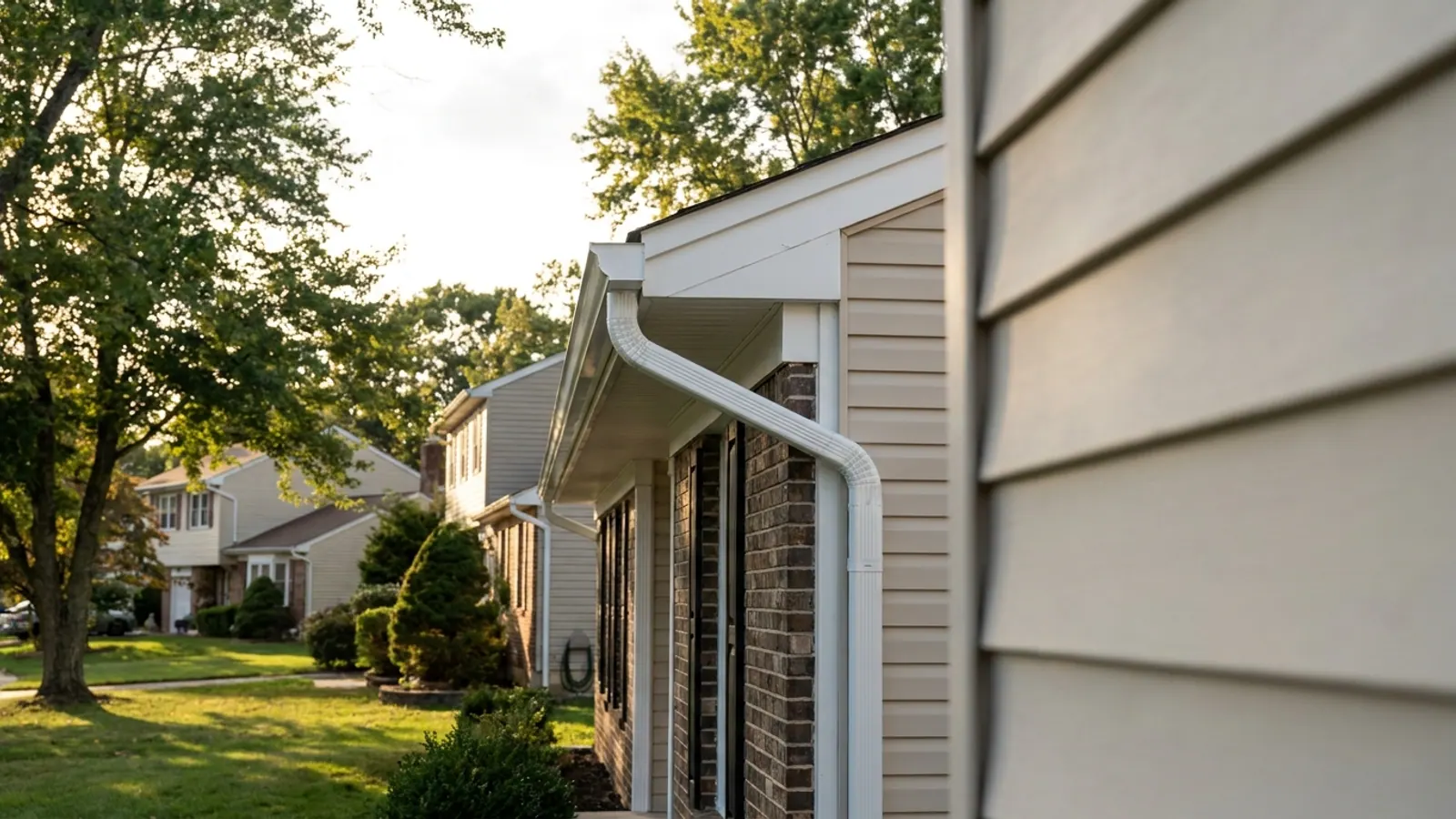
Number of downspouts. Downspouts are priced separately from the gutter run. A ranch with a long unbroken eave often needs more of them than the old system had, because one downspout cannot drain 60 feet of gutter in a summer downpour.
Gutter and downspout size. Standard 5-inch K-style with 2x3-inch downspouts covers most New Jersey homes. A 6-inch gutter with 3x4-inch downspouts costs more per foot and is the right call on a steep roof or where one run drains an unusually large area.
Corners, miters and ends. Every inside and outside corner is a fabricated joint. An L-shaped or U-shaped ranch with a breezeway and an attached garage has more corners than a plain rectangle, and corners are where gutters leak first.
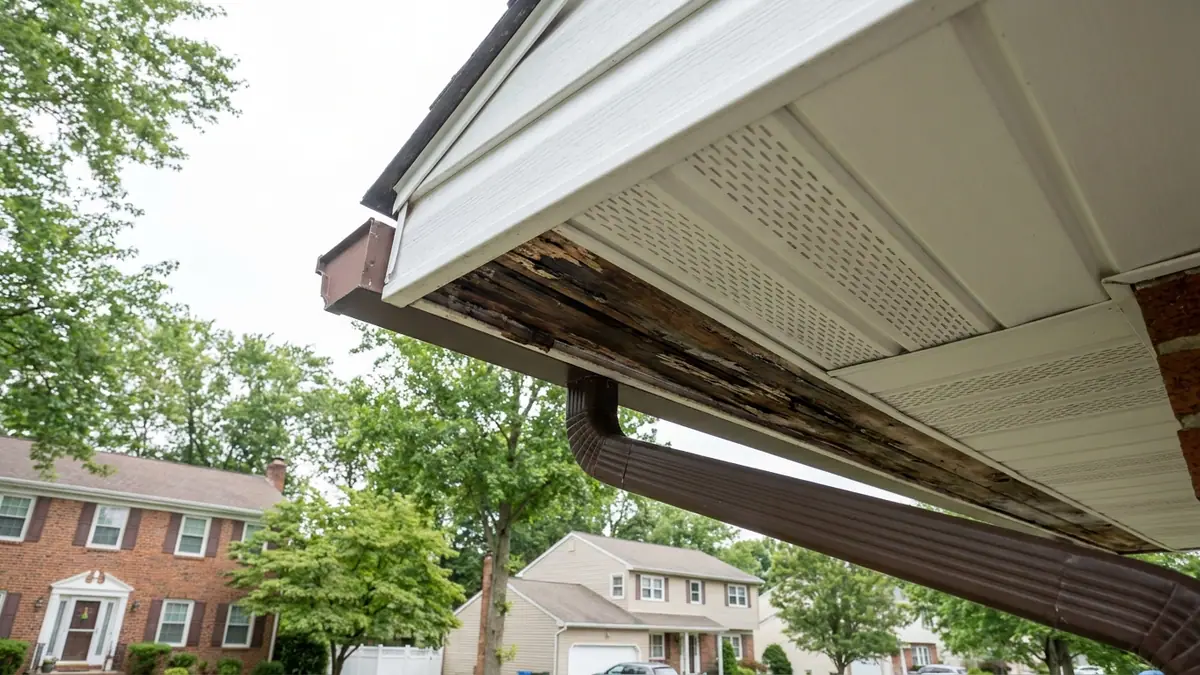
The condition of what is behind the gutter. Fascia board, the sub-fascia and the bottom edge of the roof deck. If the old gutter overflowed for years, the wood behind it is soft, and new gutter hung on rotted fascia pulls away.
Ranch versus two-story: where the cost really differs
| Factor | One-story ranch | Two-story colonial |
|---|---|---|
| FactorLinear feet of gutter | One-story ranchOften high, because the footprint is wide | Two-story colonialOften lower for the same house size |
| FactorLadder and staging time | One-story ranchLow, most runs reached from a short ladder | Two-story colonialHigher, setup on every elevation |
| FactorDownspout length | One-story ranchShort drops, less material per downspout | Two-story colonialLong drops, more material per downspout |
| FactorFascia access for repair | One-story ranchEasy to inspect and replace | Two-story colonialHarder, more labor per board |
| FactorRisk of overflow damage | One-story ranchWater lands close to the foundation | Two-story colonialWater lands close to the foundation |
| FactorTypical NJ price position | One-story ranchLower half of the town's band | Two-story colonialUpper half of the town's band |
The honest summary: a ranch saves you on access labor and loses some of that back on linear feet. If your house is a 1,200 square foot rectangle, the job is small. If it is a sprawling 1960s ranch with a garage wing and a rear addition, it is not.
How to measure your own gutter run before the estimate
You can get a usable number in fifteen minutes with a tape measure and a notepad. Do it before anyone comes out, so you can tell whether a quote is in the right neighborhood.
- Walk the perimeter and mark which sides have eaves. Gable ends have no gutter. Only the eave sides do, unless there is a wing or dormer with its own eave.
- Measure each eave run along the ground, standing at the drip line. Round up to the next foot.
- Add them together. That total is your linear feet of gutter.
- Count your existing downspouts, and note any run longer than about 35 or 40 feet that has only one.
- Look at the fascia under each run from the ground. Peeling paint, dark staining, a gutter that tilts outward or a visible gap between gutter and fascia all point to wood that needs attention.
- Note where every downspout currently empties, and whether that spot drains away from the house or puddles against it.
Bring that list to the estimate. A contractor who measures the same way you did is quoting your house. One who quotes without measuring is quoting an average.
Why downspout placement matters more on a ranch
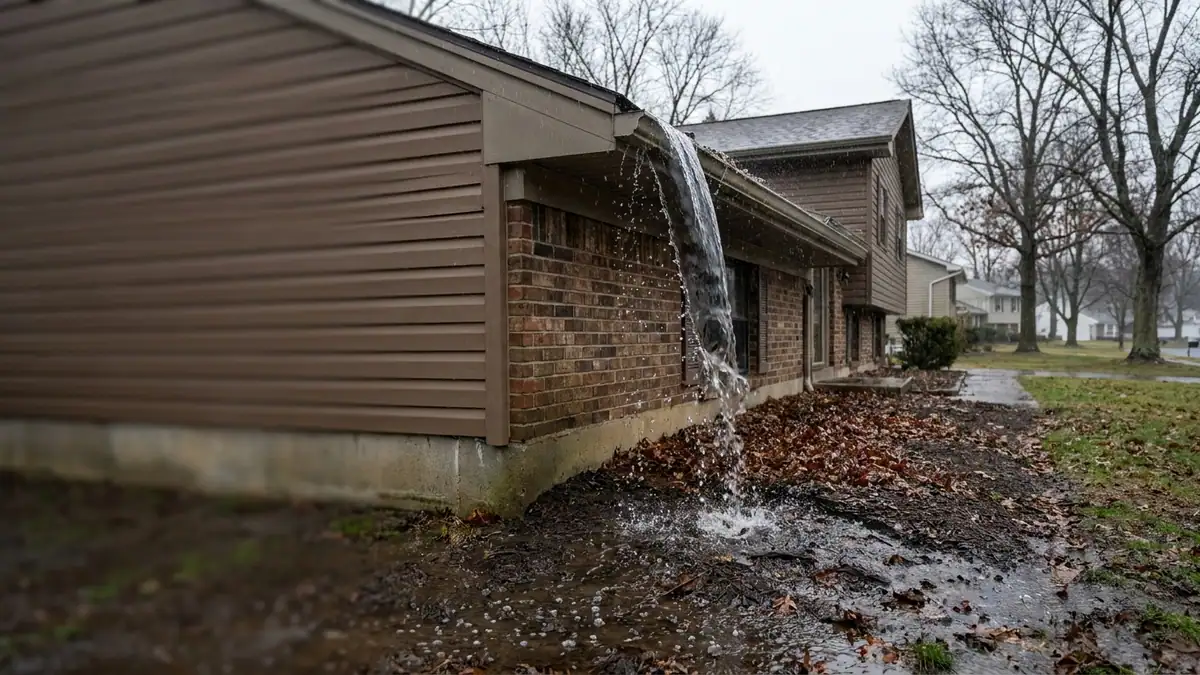
A one-story roof is closer to the ground, so the water coming off it has less distance to disperse. It lands in a concentrated line a foot or two from the siding. On a slab or crawl space ranch, that is the exact spot where you do not want standing water.
Add downspouts where the run is long, and extend the discharge away from the foundation instead of letting it dump at the corner of the house. Splash blocks are the minimum. Buried extensions to daylight are better where the grade allows it. This is the part of a gutter job homeowners skip to save money and regret during the first heavy spring rain.
Pitch matters just as much. A gutter should fall roughly a quarter inch for every ten feet toward the outlet. On a long ranch eave, that adds up to a visible drop over the length of the run, and it has to be set correctly during installation. Standing water in a level gutter breeds mosquitoes, holds leaf sludge and freezes into a solid block in January.
Seamless aluminum, hangers and what to specify
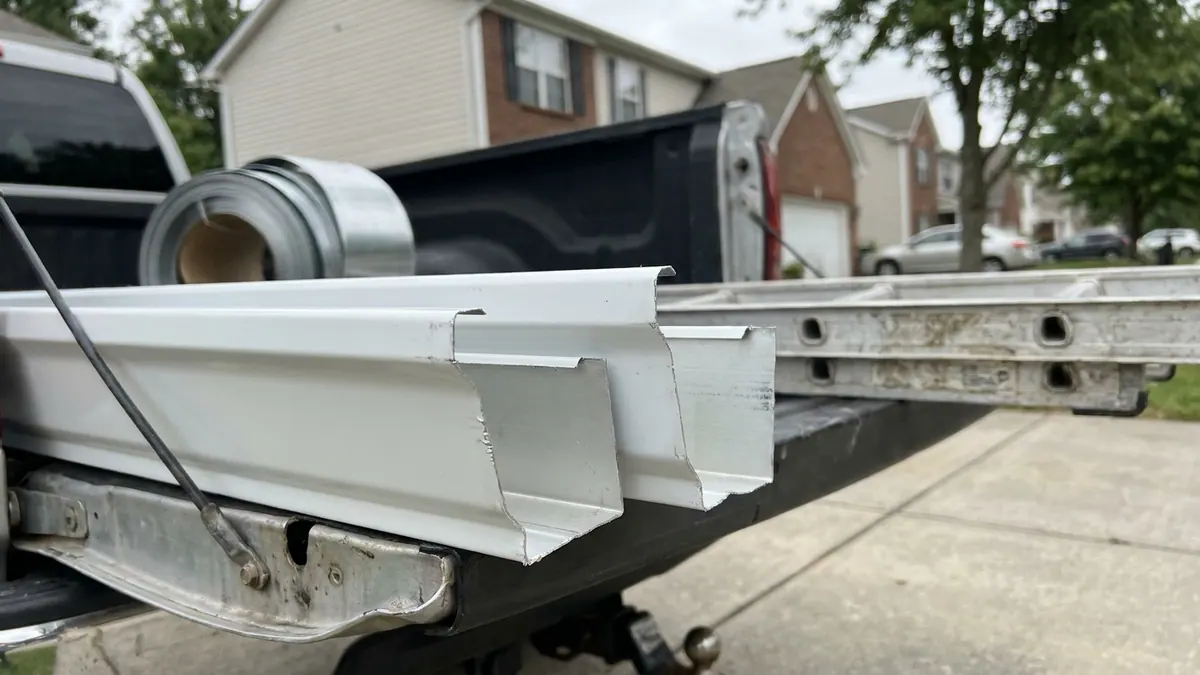
Seamless gutter is roll-formed on site from a single coil, so a 60-foot ranch eave gets one continuous piece with no seams except at the corners and outlets. That is the whole point of it, and it matters most on exactly the kind of long uninterrupted run a ranch has. The seamless gutters and gutter guards guide covers the material, the guard options and how the two interact.
The things worth putting in writing on your estimate:
- Gutter size and profile, usually 5-inch or 6-inch K-style.
- Aluminum thickness and color.
- Downspout size and the exact count.
- Hidden hangers screwed into the fascia, with the spacing stated. Spikes and ferrules are the old method and they work loose.
- Any fascia or sub-fascia replacement, by the foot.
- Where each downspout discharges.
Guards, maintenance and the low-eave advantage
A one-story house is the one case where cleaning your own gutters is genuinely reasonable for a lot of homeowners. If you are comfortable on a short ladder and your runs are reachable, twice-a-year cleaning is realistic and guards become optional rather than necessary. Under heavy tree cover, guards still earn their keep. The seasonal gutter maintenance guide lays out what to do and when.
One caution on low eaves: clogged, overflowing gutters on a ranch cause ice to build at the roof edge in winter, and a one-story roof often has a shallower pitch that holds snow longer. Clean gutters do not prevent ice dams by themselves, but overflowing ones make the problem worse. The ice dams guide explains what actually causes them.
What to do next
Measure your eaves, count your downspouts, and get a written estimate against those numbers. Lightning Construction inspects for free, writes the estimate for free, and a salesperson comes to the house with no obligation to buy. There is no deposit, so nothing is due until the work is finished and you have looked at it, and there are no change orders, so rotted fascia found at the inspection is in the price rather than added on the day.
See what is included on the gutters page, or request a free estimate and get a real number for your own roof edge.