Short answer
Micro-mesh keeps out the most debris, including shingle grit and pine needles, and is the right default on most New Jersey houses. Perforated screen costs less and handles leaves, but lets small debris through and needs rinsing. Reverse curve covers shed leaves well on steady rain and are the most likely to overshoot in a heavy downpour or ice up at the lip in winter.
On this page
Micro-mesh is the right default on most New Jersey houses. It keeps out leaves, pine needles, maple seeds and the granules that wash off an aging asphalt roof, which is the full list of what actually clogs a gutter here. Perforated screen is cheaper and stops leaves only. Reverse curve covers look clean from the street and work well in steady rain, but they are the most likely to throw water over the edge in a downpour and the most awkward to service when something does get inside.
That is the short version. Here is what separates the three designs, where each one fails, and what to check before anyone bolts anything to your roof edge.
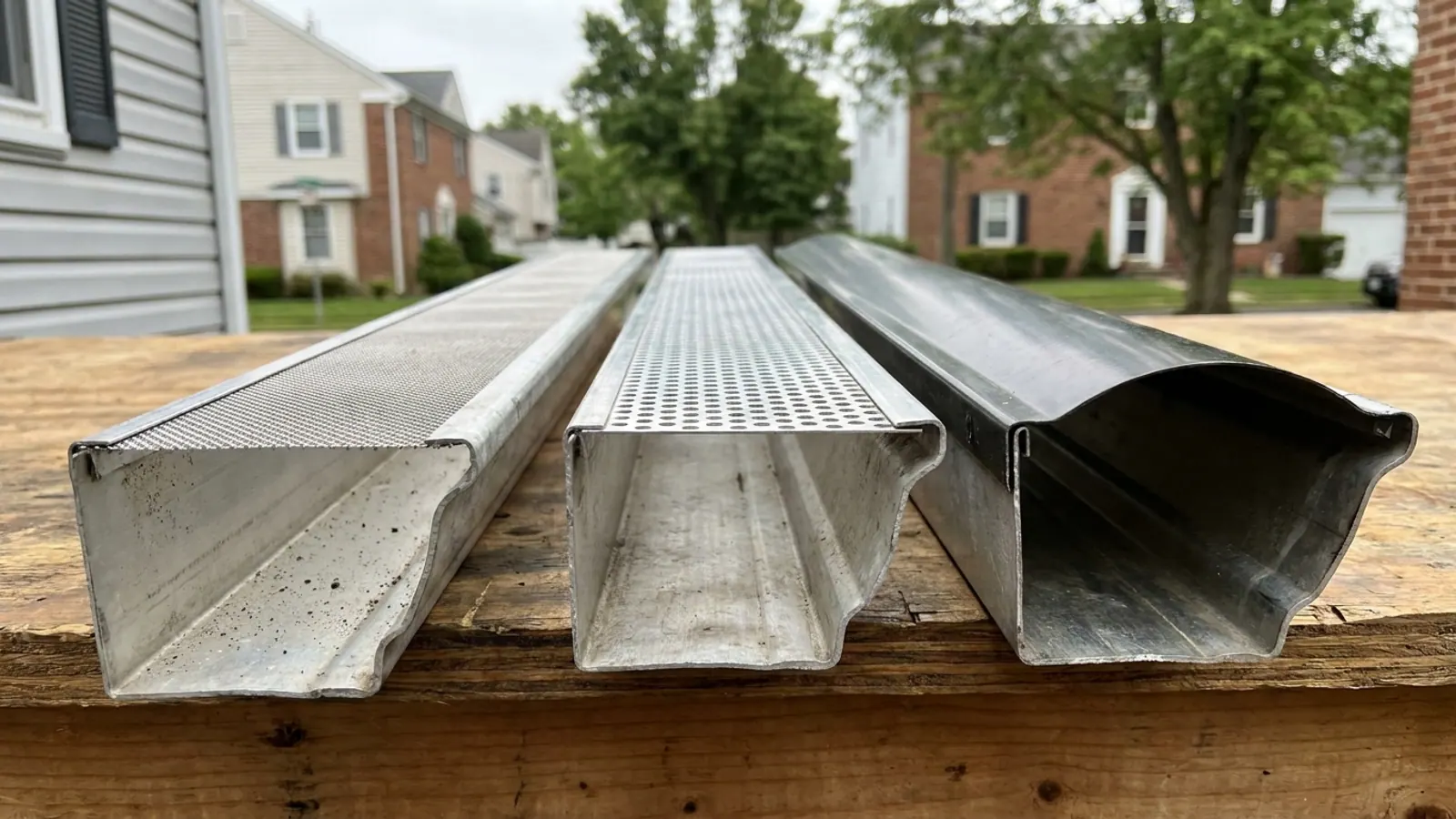
The three gutter guard designs, and how each one works
Micro-mesh
A micro-mesh guard is a frame, usually aluminum, carrying a fine stainless steel screen stretched across the top of the gutter. The openings are measured in thousandths of an inch. Water passes through by surface adhesion and gravity, and anything solid stays on top, where wind and rain are supposed to move it off.
The mesh is the part that matters. Stainless holds its shape and does not corrode at the cut edges the way plain aluminum mesh does. The frame should be rigid enough that you can press on it without it dishing into the gutter, because a dished panel holds a puddle, and a puddle on a mesh is where silt builds into a crust.
What micro-mesh does better than anything else: it blocks shingle granules. On a roof past the midpoint of its life, granules wash into the gutter every storm, settle into a sludge and choke the downspout outlet from below. A screen guard with quarter-inch holes does nothing about that.
Perforated and mesh screen
This is a flat or slightly curved aluminum panel punched with round or slotted holes, dropped over the gutter and either clipped to the front lip or slid under the first course of shingles. Hole sizes run from roughly a quarter inch down to a sixteenth.
Screens are the least expensive option and the easiest to lift for service. On a house surrounded by oaks and sycamores, with gutters sized properly and a roof with plenty of life left, a heavier-gauge screen does a real job. The honest limits: anything narrower than the hole gets through, needles stand up in the perforations and stay, and thin aluminum screen oil-cans and lifts in high wind if it is only clipped at the front.
Reverse curve, also called surface tension covers
A reverse curve guard is a solid cover that caps the gutter and curls down and back in at the front, leaving a narrow slot. Water clings to the curve and follows it into the slot. Leaves keep going and fall off the front.
The physics works, with conditions. Surface tension holds only up to a certain flow rate. Push more water over the lip than the curve can grab, which is what a summer thunderstorm or a fast-melting snow load does, and the sheet separates from the curve and overshoots the gutter entirely. The slot also admits small debris, grit and seeds, and the only way to inspect what is inside is to take the cover off.
Reverse curve covers are typically the deepest profile of the three, so they are the most visible from the ground, and on a dark roof with a white gutter they read as a band of trim you did not ask for.
Side by side
| Micro-mesh | Perforated screen | Reverse curve | |
|---|---|---|---|
| Blocks leaves | Micro-meshYes | Perforated screenYes | Reverse curveYes |
| Blocks pine needles | Micro-meshYes | Perforated screenNo | Reverse curvePartly |
| Blocks shingle granules | Micro-meshYes | Perforated screenNo | Reverse curveNo |
| Performance in a downpour | Micro-meshGood if kept clear | Perforated screenGood | Reverse curveCan overshoot |
| Visibility from the street | Micro-meshLow | Perforated screenLow | Reverse curveHighest |
| Ease of inspecting inside | Micro-meshLift panel | Perforated screenLift panel | Reverse curveRemove cover |
| Relative cost | Micro-meshHighest | Perforated screenLowest | Reverse curveMiddle to high |
| Common failure | Micro-meshSilt film on the mesh | Perforated screenSmall debris passes straight through | Reverse curveWater overshoots the lip |
What New Jersey actually drops into a gutter
The debris decides the guard. Walk the perimeter of your house and look up.
Oaks, maples and sycamores give you broad leaves in October and November, plus maple seeds in spring. Any guard handles broad leaves. White pine, spruce and hemlock give you needles year round, and needles defeat screens and work their way through a reverse curve slot. Needles are the single strongest argument for micro-mesh.
Then there is the roof itself. An asphalt roof sheds granules as it ages, and those granules are heavier than any leaf. They do not blow off a mesh, they sit there and compact. If your gutters are full of coarse black sand, that tells you something about the roof's remaining life as much as it tells you about the gutters. It is worth reading the seamless gutters and gutter guards guide alongside this, because sizing and the guard decision are tied together.
Winter, ice and what a guard will and will not do
No guard prevents an ice dam. Ice dams come from warm air leaking into the attic, melting snow on the upper roof and refreezing at the cold eave. The gutter is downstream of the problem, not the cause of it. Once a dam forms, ice sits on top of a guard the same way it sits in an open gutter, and heavy ice can bend a light-gauge panel or pull a front-clipped screen loose.
If you get ice at the eaves every winter, deal with the attic first. The ice dam guide covers the insulation and ventilation side. Adding a guard to an iced-up roof edge moves nothing.
How the guard is attached matters more than the brand
Three attachment methods, and they are not equal.
- Clipped to the front lip and resting on the back of the gutter. Least invasive, easiest to remove, most likely to lift in wind if the panel is thin.
- Screwed to the front lip and to a back flange that sits flat on the gutter's rear wall. Solid, reversible, and it does not touch the roof.
- Slid under the first course of shingles. Common with reverse curve systems. This lifts the shingle edge and can break the seal strip, and on some roofs it voids coverage from the shingle manufacturer. Ask the question in writing before you let anyone do it.
Also check that the guard does not cover the gutter so tightly that water coming off a valley can no longer get in. A valley dumps a concentrated stream at one point, and that one point is where overshoot shows up first. A diverter or a wider gutter below a valley is often the real fix.
What to settle before you buy
Fix the gutter before you cap it. A guard on a gutter that is pitched wrong, leaking at the miters or hanging on old spikes just hides the problem. Confirm the gutters are seamless, hung on hidden hangers, pitched toward the outlets and correctly sized for the roof area above them. Then put a guard on.
Get the maintenance expectation in writing. Every system still needs a look in late fall and again in spring. The seasonal gutter maintenance guide lays out what to check and when.
Lightning Construction NJ is veteran-owned and family-operated out of Manalapan, licensed and insured under New Jersey Home Improvement Contractor registration 13VH12437000, and rated 4.9 out of 5 from 264 Google reviews. Gutter work runs $1,200 to $3,500 in standard-value towns, $2,500 to $6,500 in higher-value towns and $4,000 to $12,000 for large or luxury homes, with the band set by your municipality's median home value from ACS 2024 five-year estimates. There is no deposit, nothing is due until the work is finished and you have inspected it, and the written estimate is the final price with no change orders.
If your gutters are overflowing, sagging or full of grit, start with a free inspection. See what Lightning does on gutters and guards, or book the free estimate and a salesperson will come to the house, look at the roof edge and the tree cover, and put a written number in your hand with no obligation.