Short answer
You have three real options when cedar shake siding fails - new cedar, fiber cement shake panels, or vinyl shake. Siding replacement in New Jersey runs $10,000 to $22,000 in standard-value towns, $16,000 to $38,000 in higher-value towns and $30,000 to $70,000 for large or luxury homes, with the band set by the municipality's median home value. The cost driver nobody can quote over the phone is what is behind the shakes, because cedar that has been failing for years often took the sheathing with it.
On this page
Cedar shake siding does not fail all at once. It fails in one direction first, usually the south or west wall, and by the time the shakes are splitting and cupping badly enough that you are searching for replacement costs, the walls that look fine are two or three years behind, not twenty. That is the first thing to understand before you price anything.
The second is that the number on your estimate is driven less by which new siding you pick than by what is behind the old one.
Why cedar shake siding fails on New Jersey houses
Cedar is a wood product exposed to weather on a vertical plane. In New Jersey it takes humid summers, freeze-thaw cycling all winter, and wind-driven rain off the coast and off nor'easters that arrive every year. Four failures show up over and over:
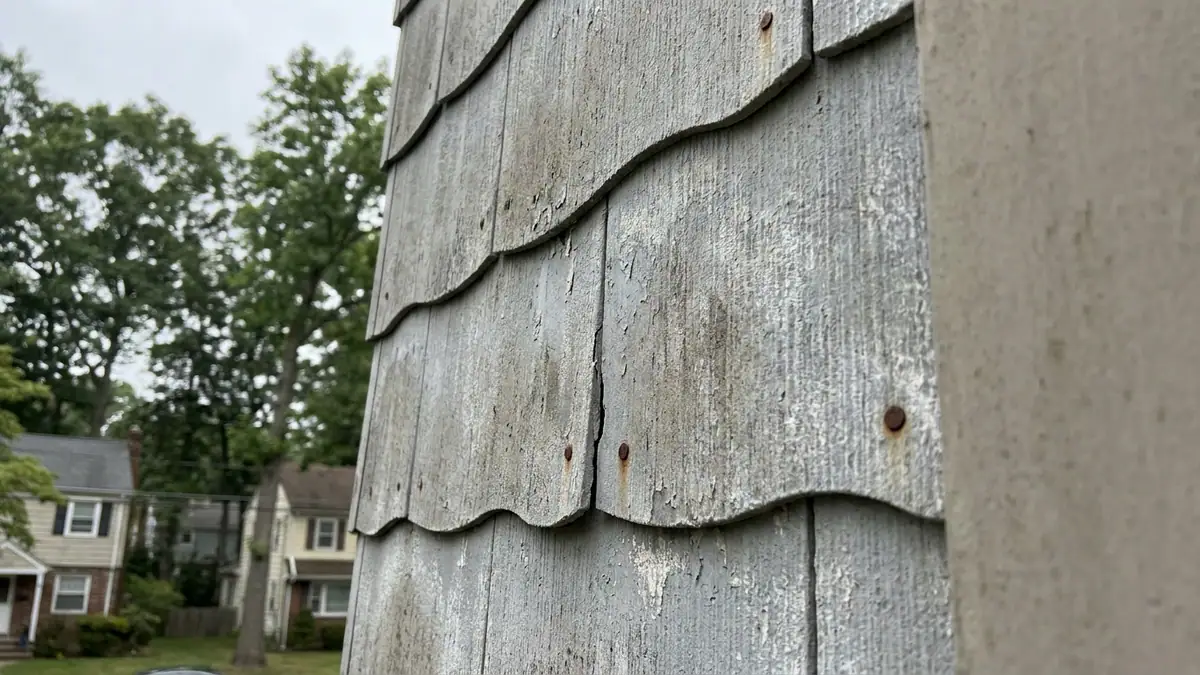
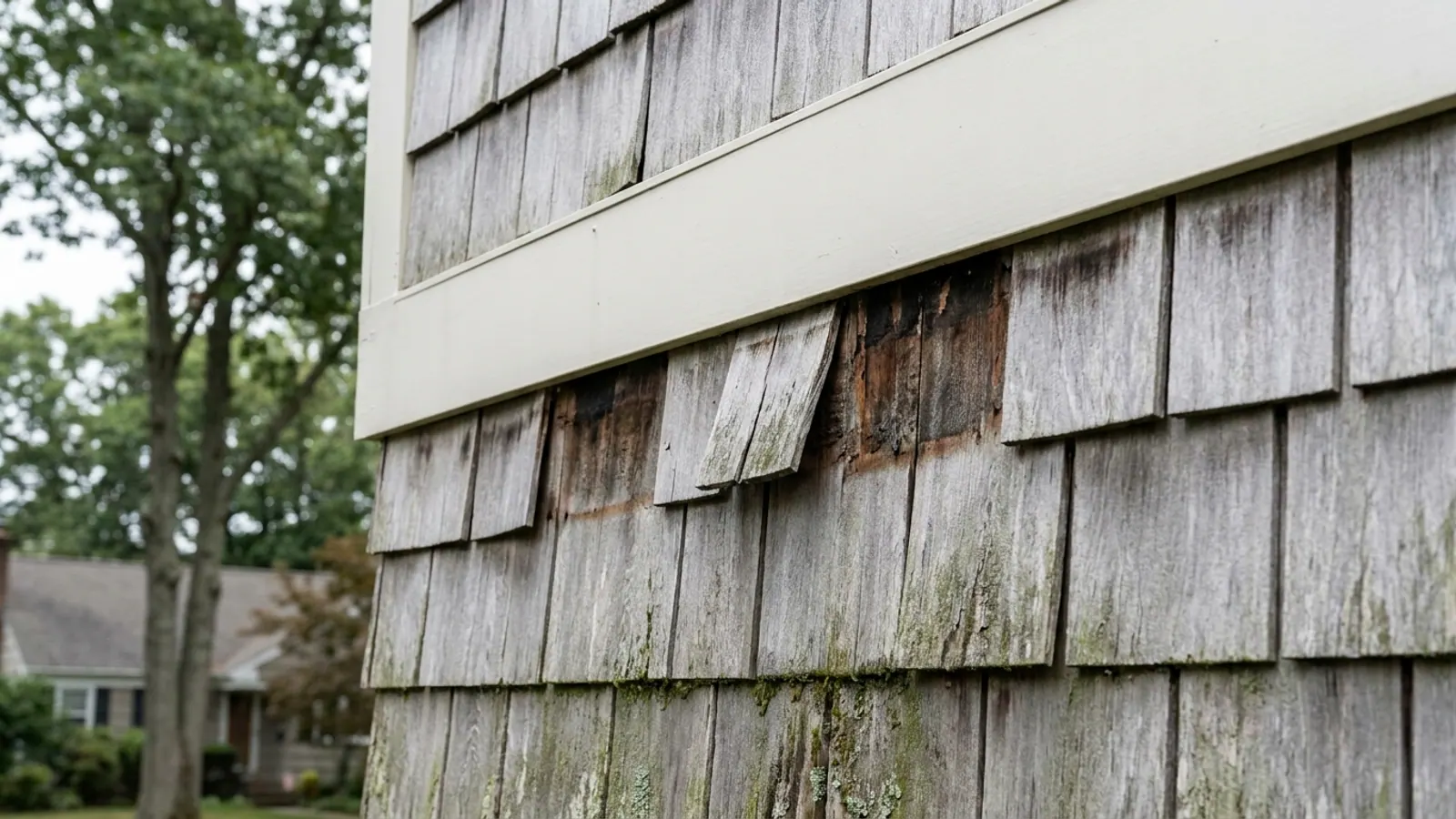
- Splitting. Shakes check along the grain, and once a split runs the full exposure, water goes behind the course below it every time it rains.
- Cupping. The face dries faster than the back, the shake curls away from the wall, and the butt end lifts. A cupped course catches wind.
- Missing shakes. Once a few are gone, the felt or wrap behind them is holding back the weather by itself, and it was never meant to do that on its own.
- Moss and dark staining at the lower courses. That is a moisture problem, usually splash-back from grade or a gutter that overflows above it. The stain is a symptom, not the disease.
Paint and solid stain hide the early stages and make the later ones worse, because coating traps moisture in a shake that is already holding water. A cedar wall that has been painted twice is usually closer to replacement than one that was left to weather.
What is behind the shakes, and why it decides the price
On most older New Jersey homes, cedar shake was installed over board sheathing or plywood with felt paper between. Some was installed over furring strips with nothing solid behind it at all. Once water has been getting past the shakes for a few seasons, it lands on that layer and stays there.
What the crew finds when the shakes come off is one of three things. Sound sheathing and intact felt, which is the good case. Stained but solid sheathing that needs new weather-resistive barrier and nothing else. Or soft, delaminated sheathing that will not hold a fastener, most often in a band around window heads, at the bottom two or three feet of a wall, and anywhere a downspout has been dumping.
This is the part that turns a fixed quote into a moving one at other companies. Lightning Construction finds it at the free inspection, prices the sheathing work into the written estimate, and writes no change orders afterward. The written number is the price, and nothing is due until the work is finished and you have walked the house.
Your three options, side by side
| New cedar shake | Fiber cement shake | Vinyl shake | |
|---|---|---|---|
| Look on an older house | New cedar shakeExact, because it is the original material | Fiber cement shakeVery close, with a cast wood grain and real panel depth | Vinyl shakeGood from the street, varies a lot by product line |
| Ongoing maintenance | New cedar shakePeriodic cleaning and re-staining for the life of the wall | Fiber cement shakeRepainting eventually, no rot or insect issue | Vinyl shakeWashing, essentially nothing else |
| Weight and fastening | New cedar shakeLight, nailed to sheathing or furring | Fiber cement shakeHeavy, needs solid sheathing and the specified fastener pattern | Vinyl shakeLight, hangs on nailing hems and must be left free to move |
| Impact damage | New cedar shakeSplits, and a split spreads | Fiber cement shakeCracks under a hard hit, repairs cleanly | Vinyl shakeCracks in cold weather, panels swap out |
| Where it makes sense | New cedar shakeHistoric districts, homes where matching original material matters | Fiber cement shakeHomeowners who want the shake look with far less upkeep | Vinyl shakeFull-wrap projects where budget and maintenance both matter |
The honest summary is that new cedar is the right answer when the house, the neighborhood or the district requires it, fiber cement is the right answer for most people who liked the look and are done maintaining it, and vinyl shake is the right answer when you want the profile on gables and accents without paying for it across the whole house. Our guide on vinyl versus fiber cement for New Jersey homes goes through the material differences in more depth than a blog post should.
A common middle path
You do not have to do the whole house in one material. A very common New Jersey combination is shake profile on the gable ends, dormers and entry, with horizontal lap on the main walls. It reads correctly on a colonial, a split level or a cape, and it costs less than shake everywhere.
What replacing cedar shake costs in New Jersey
Siding replacement in New Jersey runs $10,000 to $22,000 in standard-value towns, $16,000 to $38,000 in higher-value towns, and $30,000 to $70,000 for large or luxury homes. Which band applies is set by your municipality's median home value from ACS 2024 five-year estimates, not by which shake you pick. You can find your town on the service area pages.
Within the band, the things that actually move a cedar shake replacement are:
- Wall area and the number of stories. Two full stories of shake with gable peaks is a staging job as much as a siding job.
- Sheathing condition. Replacing sheathing means labor, material and disposal on top of the siding work.
- Tear-off volume. Cedar shake is bulky and heavy when it is wet. Disposal on a full shake tear-off is not trivial.
- Trim, corners and detail work. Window and door casing, frieze boards, rakes, soffit and fascia. Cedar houses usually have more of it than vinyl houses do.
- Wrapping and flashing. New weather-resistive barrier, new window head and sill flashing, new kickout flashing where a roof meets a wall.
Anything quoted as a per-square-foot number over the phone, before anyone has looked at the walls, is a guess. Ask for a written estimate after an inspection instead.
What the job looks like
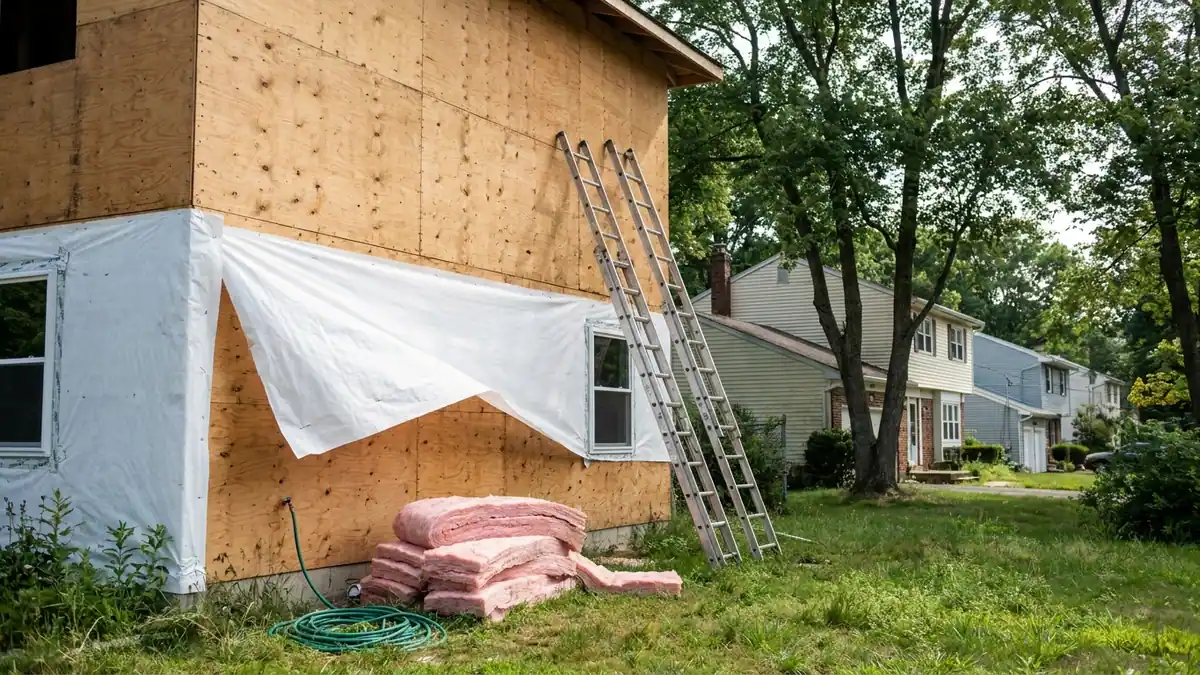
The crew strips one elevation at a time rather than opening the whole house at once, so the walls are not exposed overnight any longer than they have to be. Shakes come off to the sheathing. Any soft sheathing is cut out and replaced. New weather-resistive barrier goes on, lapped shingle-style so water running down the wall stays on the outside of it. Flashing is installed at every head, sill and roof-to-wall junction, not caulked. Then the new siding goes up with the corners, trim and accessories that belong to that system.
Two details worth watching on a cedar replacement specifically. First, the lower courses. If splash-back or an overflowing gutter caused the rot, new siding over the same drainage problem rots the same way, so the gutter and grade issue gets solved during the job. Second, the wall behind a deck ledger or a porch roof, which is where cedar houses hide their worst damage and where nobody looks until the shakes are off.
What to get in writing before you sign
- The exact siding product line and profile, not just "shake."
- Whether sheathing replacement is included and at what price, so nothing changes later.
- New weather-resistive barrier and new flashing at all openings, stated as included.
- What happens to the trim, corners, soffit and fascia.
- Who pulls the permit and who attends the municipal inspection.
- Cleanup and disposal of the old cedar.
On a Lightning Construction job, the permit is pulled by us from your municipality's construction office under the New Jersey Uniform Construction Code, and we attend the inspection. You file nothing. There is no deposit on any job, and payment comes after the work is done and you have inspected it.
Next step
If your shakes are splitting, cupping or going missing, get eyes on the walls before another winter. Lightning Construction is veteran-owned and family-operated out of Manalapan, licensed and insured under New Jersey Home Improvement Contractor registration 13VH12437000, and rated 4.9 out of 5 from 264 Google reviews. See what we do on the siding page, or book a free inspection and written estimate. It is genuinely no-obligation, and a salesperson does come to the house.