Short answer
Replacing aluminum siding means a full tear-off down to the sheathing, because new siding has to be fastened into solid wood and aluminum panels will not carry it. Siding replacement in New Jersey runs $10,000 to $22,000 in standard-value towns, $16,000 to $38,000 in higher-value towns, and $30,000 to $70,000 on large or luxury homes, with the band set by the municipality's median home value from ACS 2024 five-year estimates. What goes back on is almost always standard vinyl, insulated vinyl or fiber cement, plus new trim, soffit and fascia.
On this page
Aluminum siding comes off. It does not get covered over, because new siding has to be fastened into solid wood with the fastener set so the panel can still move, and a hollow aluminum panel crushes under a nail head instead of holding it. So an aluminum siding job in New Jersey is a tear-off job, and the price reflects stripping the wall, dealing with whatever is underneath, and installing a complete new system.
Siding replacement here runs $10,000 to $22,000 in standard-value towns, $16,000 to $38,000 in higher-value towns, and $30,000 to $70,000 on large or luxury homes. The band comes from the municipality's median home value in the ACS 2024 five-year estimates, not from the material you pick. Where you land inside the band is about wall area, the number of stories, how many gables, dormers and corners the house has, and how much trim, soffit and fascia goes with it.
Why aluminum siding reaches the end of its life
Aluminum does not rot and it does not burn, which is why so much of it is still on New Jersey houses sixty years later. It fails three other ways instead.
It chalks. The baked finish breaks down under UV and leaves a powdery residue that comes off on your hand and streaks the wall under every window. Once a panel is chalking, washing it only buys you a season.
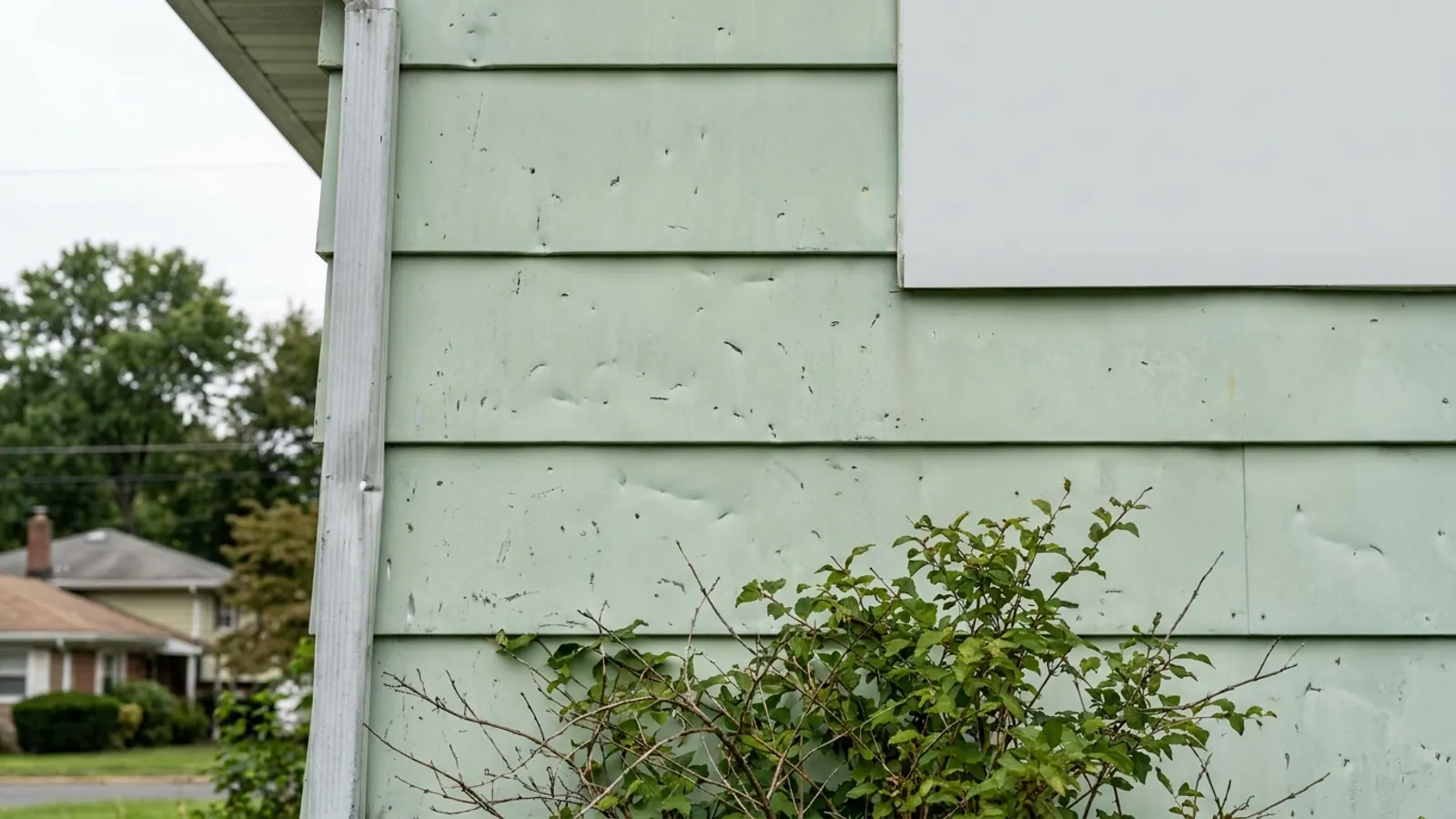
It dents. A ladder, a thrown ball, a hail event, a weed trimmer, a branch in a nor'easter. Aluminum takes a permanent impression and there is no fixing it short of replacing the panel, and matching a sixty-year-old color is not realistic.
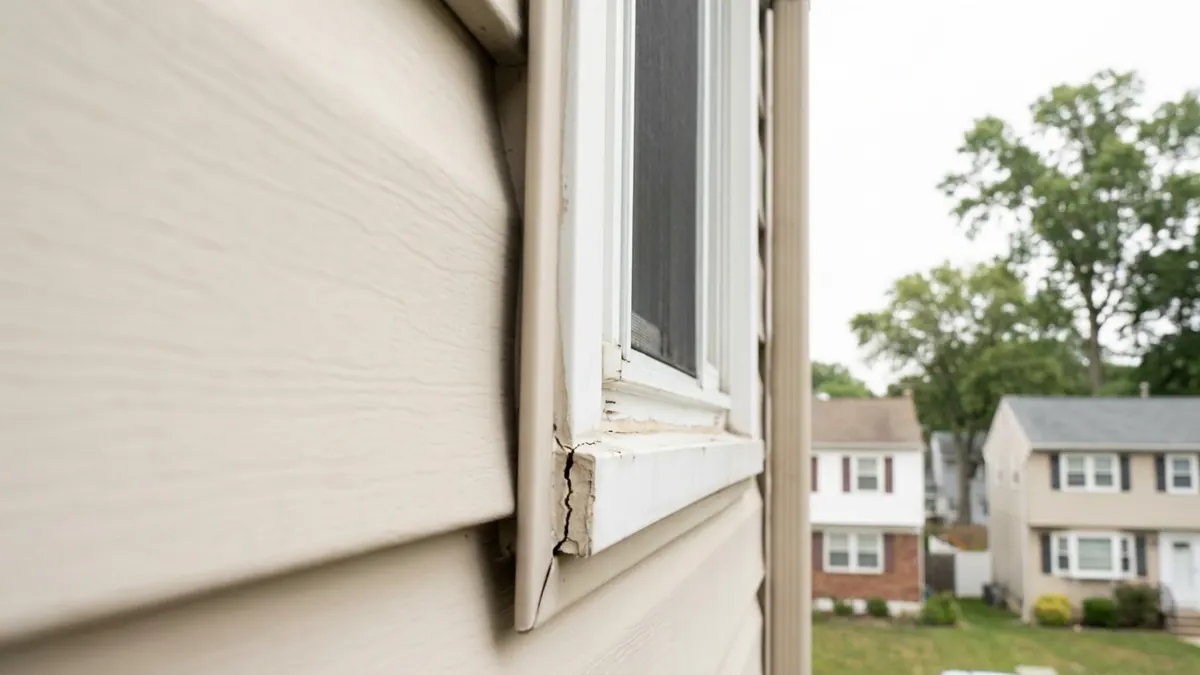
It loosens. The nailing hem tears at the top of a panel, corner posts pull away, and the original caulk at butt joints and around penetrations gives up. That is where water gets in, and because there is usually no house wrap behind a wall of that era, water that gets in runs on whatever is back there.
None of that is a defect. It is a material that did its job for decades. The question is only what replaces it.
What the crew finds when the aluminum comes off
This is the part that decides whether a quote holds. Aluminum went up on New Jersey houses mostly in the 1950s, 1960s and 1970s, and in a lot of cases it went up directly over the original wood siding. What is on the wall under your panels is one of these:
- Original wood clapboard or cedar shake, often still sound, sometimes with a layer of old paint on it.
- Black asphalt-impregnated fiberboard sheathing, which is common from that era and will not reliably hold a siding fastener.
- Board sheathing with gaps between the planks.
- Nothing but studs, on an older frame house where the aluminum installer added furring strips and called it a day.
You will also see the plugs. Homes that had blown-in insulation added had holes bored through the wall at every stud bay, and those plugs are hidden under the aluminum. Expect missing house wrap, because house wrap was not standard before the 1980s. Expect at least some soft wood at the bottom course, under windows and behind downspout elbows.
All of that is normal and all of it is findable before the job starts. At Lightning Construction the free inspection is where those conditions get identified and priced into the written estimate, and the written estimate is the final price. There are no change orders on the day, and no deposit is due before the work is finished and you have inspected it.
What goes back on the wall
Three systems cover almost every aluminum replacement in this state. The full comparison lives in the siding options guide; this is the short version as it applies to a house coming out of aluminum.
| Standard vinyl | Insulated vinyl | Fiber cement | |
|---|---|---|---|
| Wall appearance | Standard vinylFollows the wall, shows minor waviness | Insulated vinylFlatter, more solid-looking | Fiber cementFlattest, closest to painted wood |
| Impact resistance | Standard vinylLowest of the three | Insulated vinylBetter, foam backs the panel | Fiber cementHighest |
| Weight and labor | Standard vinylLightest, fastest to hang | Insulated vinylSlightly heavier | Fiber cementHeaviest, slowest, most cutting |
| Where it fits the price band | Standard vinylLow end | Insulated vinylMiddle | Fiber cementTop end |
| Dents like aluminum | Standard vinylNo | Insulated vinylNo | Fiber cementNo |
The one thing all three have over aluminum is that they do not take a permanent dent, and none of them chalk the way a sixty-year-old baked aluminum finish does. Color is through the panel on vinyl and factory-applied on fiber cement.
Whatever goes on, a house wrap or equivalent weather-resistive barrier goes on first. On a wall that has never had one, that is the single biggest improvement in the job, and it is not optional on new work.
Trim, soffit, fascia and the parts people forget
Aluminum siding houses usually have aluminum everything. Corner posts, J-channel at the windows, wrapped fascia, vented or solid aluminum soffit panels in the overhang, and frequently aluminum window and door casings that were wrapped at the same time as the siding.
If an estimate covers walls only, you end up with new siding against sixty-year-old chalky trim, and the eye goes straight to it. Worse, the soffit and fascia are the part of the exterior that sees the most water, so leaving them is leaving the oldest and wettest assembly on the house in place. Get trim, soffit and fascia itemized on the quote, and get a yes or no on whether the window casings are being rewrapped.
Same era, same story with the drainage. A house still wearing its original aluminum siding is very often still wearing the original aluminum gutters, hung on spikes, with seams at every corner. The hangers and the fascia behind them are exposed during siding work, which is the cheapest moment in the life of the house to deal with new seamless gutters rather than rehanging old sectional ones on new fascia.
What to ask for in writing before anyone starts
- The exact product line, panel profile and thickness, named on the estimate rather than described as "premium vinyl."
- Whether the wall is being stripped to sheathing, and what happens where the sheathing will not hold a fastener.
- The weather-resistive barrier being installed, by name, and whether flashing is being installed at window and door heads.
- Trim, corners, soffit, fascia and window wrap, listed as separate line items with a yes or no on each.
- Who pulls the permit and attends the municipal inspection. Lightning does both, in every municipality, under the New Jersey Uniform Construction Code, and you file nothing.
- What the price does if rot is found. On a Lightning estimate it does nothing, because that condition was priced at the inspection.
If your aluminum was repainted at some point, ask any contractor how they handle paint debris and site cleanup during the tear-off. On a house of that age it is a fair question and you should get a straight answer.
What to do next
Walk the house first. Press on the wall below each window and at the bottom course near every downspout, look for chalk on your palm, and count the dented panels on the side that faces the weather. That tells you whether you are looking at a finish problem you could live with for a few more years or a wall that needs to come off.
Then get it priced. Lightning Construction covers all 21 New Jersey counties, the inspection and written estimate are free with no obligation, and a salesperson does come to the house. Financing is available through GreenSky and FTL, including 24 months at 0% interest and 120-month terms with no prepayment penalty. Start with the siding page to see what the work includes, then book the free estimate and get a number you can hold.