Short answer
Yes, one damaged metal roof panel can be replaced, and on an exposed-fastener roof or a metal shingle roof it is straightforward. On a standing seam roof it is more involved, because the panels interlock and are held by hidden clips, so the crew has to unseam and lift the panels between the damaged one and the nearest edge or ridge. The harder questions are usually whether the damage is cosmetic and whether the replacement panel will match the weathered ones around it.
On this page
- How each metal system handles a single panel swap
- When a damaged panel does not need replacing at all
- What the crew actually does on a standing seam panel
- Will the replacement panel match
- Storm damage, insurance and the panel you did not cause
- When a panel repair stops making sense
- How Lightning prices a metal panel repair
- What to do next
Yes. One damaged metal roof panel can be replaced without redoing the roof. How hard that is depends entirely on which metal system you have, and a homeowner looking up at a dented panel usually cannot tell the difference from the driveway.
An exposed-fastener panel comes off in minutes. A metal shingle comes out of its course with a flat bar and a little patience. A standing seam panel is the difficult one, because it is locked to the panel on either side of it and held down by clips that are hidden under the seam. Nothing about that makes it impossible. It just means the crew is working across part of the slope rather than at one spot.
How each metal system handles a single panel swap
| System | How the panel is held | Single panel replacement |
|---|---|---|
| SystemStanding seam, concealed clips | How the panel is heldInterlocking seams over clips screwed to the deck | Single panel replacementPossible, but panels between the damage and the nearest edge or ridge usually have to be unseamed and lifted |
| SystemExposed-fastener panel | How the panel is heldScrews with washers driven through the face into the deck or purlins | Single panel replacementStraightforward, remove screws, lift panel, set new one, refasten with new gasketed screws |
| SystemMetal shingle or stamped panel | How the panel is heldSmall units interlocking on four sides, clipped or nailed | Single panel replacementStraightforward, the surrounding units are worked loose and the damaged shingle is swapped |
That table is the whole decision in miniature. If you have a standing seam roof, read on, because the cost and the schedule of the repair are driven by access, not by the panel itself. The standing-seam metal roofing guide covers how these systems are built in the first place.
When a damaged panel does not need replacing at all
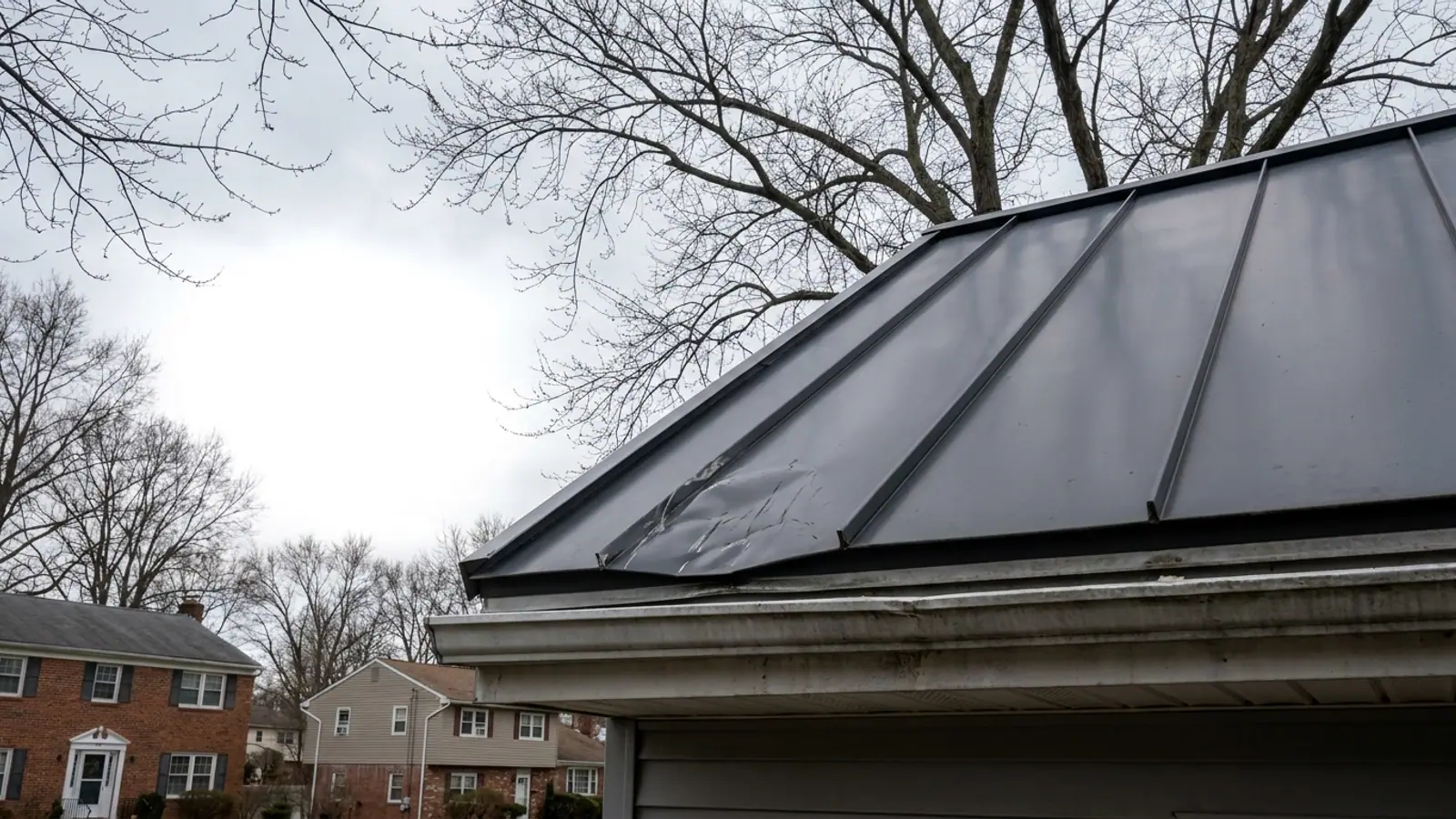
Most of the panels homeowners call about are cosmetically dented and functionally fine. A metal roof is a water-shedding surface. If the dent has not cracked the paint film down to bare metal, has not torn the panel, and has not pulled the seam open or broken a clip loose, the panel is still doing its job.
Things that genuinely call for replacement:
- A puncture or tear, usually from a falling branch or a dropped tool.
- A crease that runs across the seam and has opened the seam engagement, because water travels along that seam.
- Paint cracked through to bare steel over a large area, which is where corrosion starts on a steel panel.
- A panel that has lifted off its clips in wind and is no longer held down.
Things that usually do not:
- A shallow dent in the flat of the panel.
- Scuffs and marks on the finish from a limb dragging across it.
- Oil canning, which is a waviness in the flat part of the panel and is a characteristic of the material, not damage.
Ask the contractor to photograph the damage from the roof and show you the pictures before you authorize anything. If the panel is sound, the honest answer is to leave it.
What the crew actually does on a standing seam panel
Here is the sequence on a typical concealed-fastener roof.
- Identify the damaged panel and decide the direction of work, which is normally toward the nearest rake edge because that is the shortest run of panels to open.
- Remove the ridge cap and any hip or rake trim covering the panel ends. The trim is fastened and sealed, so it comes off in whole pieces where possible.
- Unseam the panels one at a time back to the damaged one. On a mechanically seamed roof this means running a de-seaming tool along the seam. On a snap-lock roof the panels are unlocked by hand with a flat tool.
- Lift each freed panel, release or remove its clips, and set the panels aside in order so they go back the same way.
- Inspect the underlayment and decking that was hidden under the panel. Water that got in through a tear has been sitting there, and this is the only time anyone will see it.
- Set the new panel on new clips, relock or reseam each panel back across the slope, then reinstall trim and ridge with new fasteners and sealant.
That is a half day to a day of work on most houses, which is a different scale from the two to four days a full standing seam installation takes. The length depends on how far across the slope the damage sits. A panel next to the rake is quick. A panel in the middle of a wide slope means opening half the roof.
Will the replacement panel match
It will match the paint code. Whether it matches what you see from the street is a separate question.
Metal roof finishes change over time. Gloss drops first, then shade shifts slightly, and a panel made this year sits next to panels that have taken a decade of sun. A PVDF finish holds color and gloss far longer than a polyester-based one, so on a quality system the difference is usually small and closes further after a season of weathering. On a cheaper finish it can be obvious.
Two other matching problems come up more often than color:
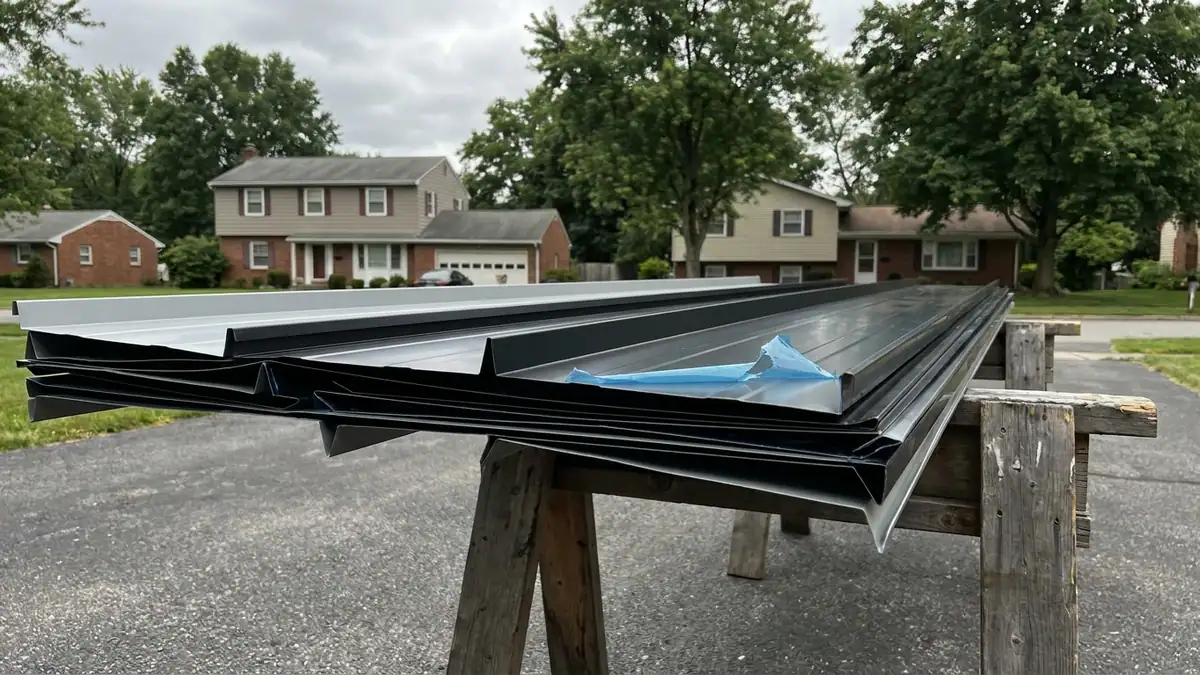
- Profile. Seam height and panel width are not standard across manufacturers. A 1 inch snap-lock panel does not interlock with a 1.75 inch mechanically seamed panel. The replacement has to be the same profile, which means identifying the original system.
- Gauge and substrate. A 24 gauge steel panel and a 26 gauge panel sit differently and reflect light differently. An aluminum panel next to Galvalume will weather differently too.
This is why keeping the original paperwork matters. If you have the manufacturer, the profile name, the gauge and the color code from the original job, a matching panel is usually a straight order. If you have nothing, a contractor can take a sample, measure the seam and identify the system, but it adds time.
Storm damage, insurance and the panel you did not cause
If a tree limb or wind took out the panel, document it before anyone touches the roof. Photographs from the ground, photographs from the roof, and the date. Most carriers want to see the damaged component in place, not after a repair.
A single panel is often below the deductible on a New Jersey homeowners policy, which means you pay for it directly and no claim gets filed. That is frequently the better outcome. If a storm hit multiple slopes, trim, gutters and the panel together, the claim math changes. The guides on storm damage to a roof in New Jersey walk through what to do in the first 48 hours.
When a panel repair stops making sense
There is a point where swapping panels costs more than it saves.
- Damage spread across several panels on one slope. Once the crew is unseaming most of the roof anyway, replacing the slope is cleaner and leaves continuous seams.
- A discontinued profile. If nobody makes that panel anymore, matching one piece is not an option.
- A roof with failing fasteners across the field. On an older exposed-fastener roof, the washers dry out and leak at the screws, and replacing one panel does nothing for the hundreds of fasteners around it.
- Decking problems found under the panel. Soft sheathing has to be replaced before anything new goes back on, and if it is widespread, the whole slope is the honest answer.
A contractor who will not name those cases is selling you a repair that will not hold.
How Lightning prices a metal panel repair
The inspection and the written estimate are free, with no obligation, and a salesperson comes to the house. On repairs, the things that normally turn into a surprise bill, decking that has rotted under the damaged panel, clips that have to be replaced, trim that cannot be reused, are identified at that inspection and priced into the quote. There are no change orders. The written estimate is the final price.
There is no deposit either. Nothing is due until the work is finished and you have inspected it. Where the municipality requires a permit for the work, Lightning pulls it from the local construction office and attends the inspection under the New Jersey Uniform Construction Code, in all 21 counties.
If the repair conversation turns into a replacement conversation, the full metal systems and what drives their price are laid out on the metal roofing page.
What to do next
Get the damage looked at from the roof, not from the ground, and get the photographs. If the panel is cosmetically dented and watertight, leave it and spend nothing. If it is torn, creased through a seam or lifted off its clips, get it replaced before the next freeze pushes water into the deck under it.
To have a metal roof panel looked at anywhere in New Jersey, book a free inspection and written estimate.