Short answer
Rain during a roof replacement is not a disaster, because a competent crew never leaves bare decking exposed. The old roof comes off only as fast as the new underlayment goes down, and a roof that is dried in sheds water the same way a finished roof does. If weather moves in faster than planned, the crew seals and tarps what is open, stops, and returns to finish.
On this page
Rain during a roof replacement is normal in New Jersey, and on a well-run job it changes nothing about the finished roof. The reason is simple: a crew never strips more roof than it can make watertight, so at any moment during the day your house is covered by either the old roof, the new underlayment, or the new shingles. Bare decking open to the sky is not a stage of the work. It is a mistake.
What rain does change is timing. A steady soaking can turn a single-day job into a job with a return visit, and it can stop shingle installation cold even after the sky clears. Below is what actually happens hour by hour, what your contract should say about it, and where the real risk sits.
What being dried in means, and why it protects the house
Dried in is the point where a section of roof has been stripped to the decking, the bad decking has been swapped out, and the underlayment is fastened down over the whole exposed area. Ice and water membrane goes in the eaves, the valleys and around penetrations. Synthetic underlayment covers the rest of the field. Once that layer is on and lapped correctly, the section sheds water. It is not a permanent roof, but it will take a rainstorm without a drop reaching your plywood.
Crews work in sections for this reason. On a typical New Jersey house the tear-off moves one slope or one plane at a time, with a crew right behind it laying underlayment. The gap between the last shingle coming off and the first underlayment going down is measured in minutes, not hours. That is the whole strategy for working in a state where an afternoon thunderstorm shows up on radar with twenty minutes of warning.
What the crew does when rain starts mid-job
The response is a sequence, and it is the same whether the rain lasts ten minutes or the rest of the day.
- Tear-off stops immediately. Nothing else comes off the roof.
- The crew finishes underlayment on whatever is already open, working from the eaves up so the laps run the right way.
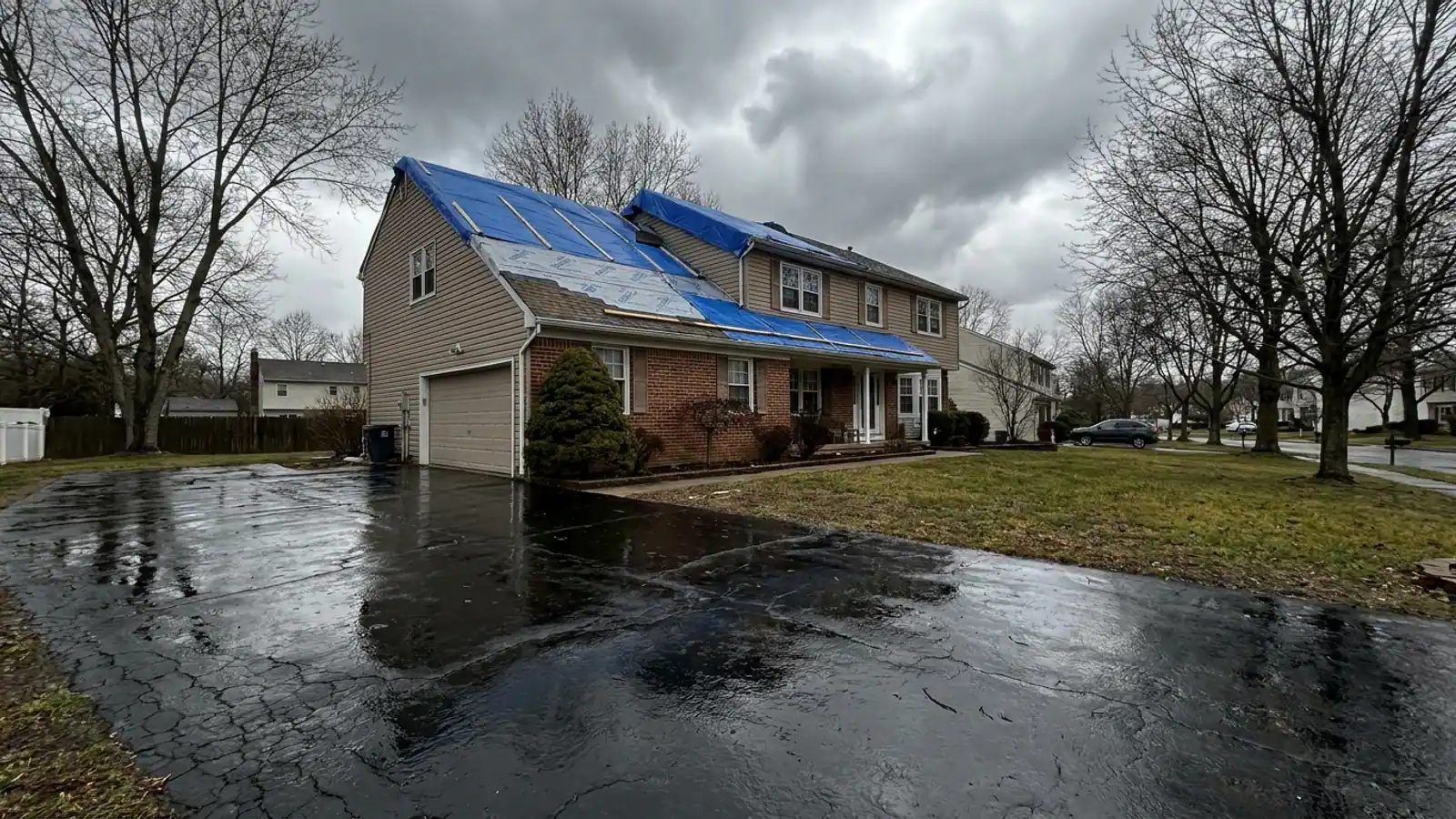
- Any section that cannot be dried in fast enough gets tarped, with the tarp run over the ridge and fastened so wind does not lift it.
- Open flashing points — chimney, sidewalls, skylight curbs — get temporary sealing, because those are the places water finds first.
- Loose debris, nails and shingle bundles get secured or moved off the roof, since wet shingles and wet plywood are slick and everything on the slope wants to slide.
- The crew waits it out or leaves, and the foreman tells you which one and when they are coming back.
If it clears within an hour or two, work often resumes the same day. The deck has to dry first. Nailing shingles over a wet surface traps moisture between the underlayment and the new roof, and nobody who plans to warranty their work does that.
Why shingles cannot go down on a wet roof
Asphalt shingles rely on a sealant strip that bonds each course to the one below it once the sun warms the roof. Water on the shingle face or the underlayment interferes with that bond. A shingle that never seals is a shingle that lifts in the next windstorm. On top of that, wet decking swells slightly and holds moisture that has nowhere to go once the roof is closed up.
Cold and wet together are worse than either alone. Late-season jobs in New Jersey sometimes need hand-sealing at rakes and eaves because the sealant will not activate on its own. That is a normal practice, not a shortcut, and it should be discussed rather than discovered later. The best time of year to replace a roof in New Jersey guide covers how the seasons affect scheduling in more depth.
Rain scenarios and what should happen in each
| What the weather does | What a good crew does | What you should see |
|---|---|---|
| What the weather doesLight drizzle, deck still dry | What a good crew doesKeeps working, watching radar | What you should seeNormal pace, underlayment kept tight to the tear-off |
| What the weather doesSudden downpour mid tear-off | What a good crew doesStops stripping, dries in and tarps | What you should seeNo bare decking left uncovered anywhere |
| What the weather doesRain for the rest of the day | What a good crew doesJob pauses, roof left dried in | What you should seeTarps fastened, site cleaned, a return date given |
| What the weather doesRain overnight before the job | What a good crew doesStart pushed to later in the day or reschedule | What you should seeA phone call before the truck arrives |
| What the weather doesStorm during the return-visit gap | What a good crew doesDried-in roof sheds it | What you should seeNo interior leaks, no water in the attic |
What rain during the job actually risks
The honest list is short. Interior water damage is the one people fear, and it is the one that dried-in work prevents. The realistic risks are these: a longer schedule, a second dumpster day, muddy ground where the tarps and debris were staged, and shingles that need to wait for a dry surface.
The risk that matters is a contractor who tears off more than the crew can cover, usually because they are trying to beat a storm rather than plan around one. That is when water reaches decking, seams and finally drywall. If you already have active leaks from a storm before the replacement starts, what to do after storm damage walks through documenting the damage before anyone begins work.
What to settle in writing before the crew shows up
Ask three things and get the answers on paper.
Who pays if the schedule slips
Weather delays should cost you nothing. Lightning Construction writes no change orders, so the written estimate is the final price whether the roof goes on in one day or the crew comes back to finish a slope. There is also no deposit, so a rain delay does not leave your money sitting with a contractor while the job is half done.
How the roof will be left overnight
The answer should be specific: which sections are dried in, where the tarps are, and what time the crew returns. A vague answer here is the warning sign.
Who handles the inspection
Weather sometimes shifts the municipal inspection date. Lightning pulls the permit from your municipality's construction office and attends the inspection under the New Jersey Uniform Construction Code, so a moved date is not something you have to chase.
What to do next
If rain is why you have been putting off a replacement, that is not a good reason to wait — New Jersey crews work through this weather all year, and the dry-in step is what makes it possible. What matters more is having the roof looked at before anything is scheduled, so extra shingle layers, soft decking and worn flashing get priced into the quote instead of turning into surprises on a wet afternoon.
See what a full roof replacement in New Jersey includes, or book a free inspection and written estimate. It is genuinely no-obligation, and a salesperson comes to the house.