Short answer
Repair when the missing shingles are confined to one area, the rest of the roof is still sealed and sound, and a close color match is available. Replace when tabs are lifted across several slopes, the shingles have gone brittle with age, or the deck under them got wet. File a claim only when the storm damage clearly exceeds your deductible and the roof was in good shape before the wind.
On this page
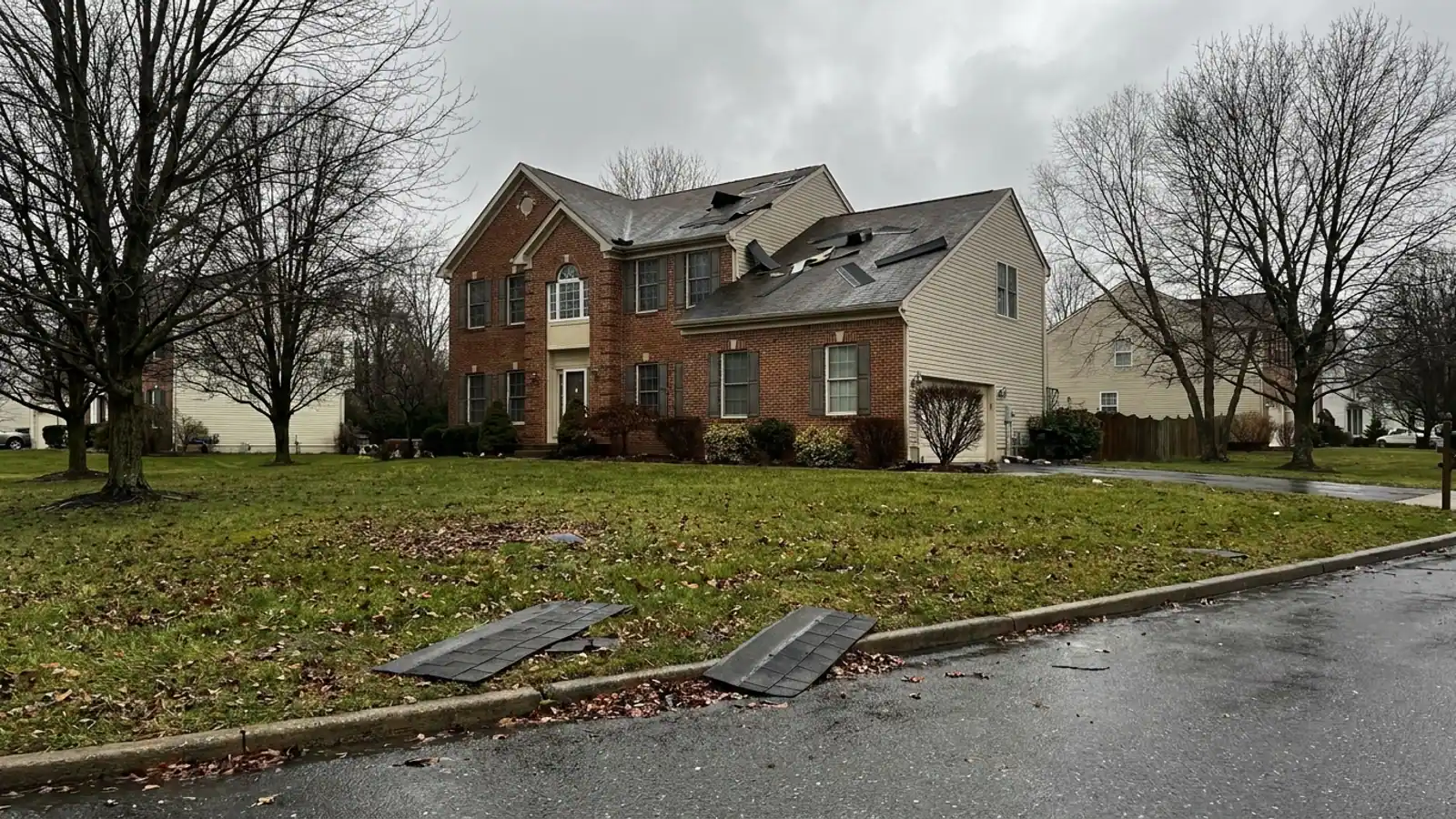
Wind pulled shingles off your roof last night. Before you call anyone, walk the yard and pick up what landed there, then decide which of three things you are dealing with: a localized repair, a roof at the end of its life, or an insurance claim. The three are not the same conversation, and contractors who lead with the claim before they have been on the roof are selling, not diagnosing.
Here is how the decision actually gets made in New Jersey, and what to do in the meantime.
What to do in the first 48 hours after shingles blow off
- Photograph everything from the ground. Shoot each elevation of the house, the bare spots on the slope, and the shingles lying in the yard or the neighbor's driveway. Date-stamped phone photos are fine.
- Go into the attic with a flashlight. Look at the underside of the deck for wet plywood, dark stains, or daylight. Wet insulation directly under a bare spot tells you water got in.
- Check the ceilings below. A stain that was not there yesterday changes the urgency.
- Note the date of the storm. An insurer will ask for it, and so will any contractor writing a scope.
- Do not throw the loose shingles away. They tell a roofer whether the tabs tore through the nail line, released at the sealant strip, or snapped clean because the asphalt has gone brittle. That distinction drives the whole decision.
- Call for an inspection. If water is actively coming in, that call is the same day.
Lightning Construction runs 24/7 emergency response, and the inspection and written estimate are free with no obligation. A salesperson comes to the house; that is a straightforward appointment, not a secret.
What wind actually did to the shingles that stayed on
The bare spots are the obvious damage. The bigger issue is usually the shingles still up there.
Asphalt shingles hold down with a factory sealant strip that softens in sun and bonds each course to the one below. When wind gets under a course hard enough to break that bond, the shingle can flop back into place and look untouched from the driveway while no longer being sealed at all. The next storm takes it.
A roofer checks this by hand, lifting tabs across several slopes. Two findings matter:
- Tabs that lift with no resistance across a wide area. The sealant has released far beyond the visible damage. Patching the bare spots leaves the rest of the roof loose.
- Tabs that crack or crumble when lifted. The asphalt has dried out. That roof is at the end of its service life and no repair will change that.
Also look at the fasteners in the bare area. Nails still standing in the deck with shingle fragments torn around them mean the shingle failed. Nails pulled out with the shingle, or nail heads set above the deck, point at an installation problem instead.
Repair or replace: how the call gets made
| Finding on the roof | Usual answer |
|---|---|
| Finding on the roofDamage confined to one slope or one corner, rest of the roof sealed tight | Usual answerRepair |
| Finding on the roofShingles pliable, close color match available, roof under about half its expected life | Usual answerRepair |
| Finding on the roofLifted or unsealed tabs found on multiple slopes | Usual answerReplace |
| Finding on the roofShingles cracking when lifted, granules heavily worn, exposed asphalt | Usual answerReplace |
| Finding on the roofDecking soft or delaminated where water got in | Usual answerReplace, with deck repair |
| Finding on the roofSecond layer of shingles found underneath | Usual answerReplace with a full tear-off |
| Finding on the roofDamage across the front elevation where a patch will show | Usual answerUsually replace |
The honest version of the repair answer sounds like this: your roof has years left, the damage is on the back slope, we will match it as closely as the batch allows and you will know it is a patch but nobody at the curb will. The honest version of the replacement answer names the specific evidence, and any roofer telling you to replace should be able to hand you the photos that prove it. The 10 signs you need a new roof guide covers what those signs look like in more detail.
Why matching is the quiet problem with repairs
Granule color is blended in production batches, and every roof lightens with UV exposure. Even a shingle in the exact same product line and color name will read brighter than a ten-year-old field around it. If your roof is a discontinued line, matching gets harder still.
That is workable on a rear slope, a garage, or an area screened by trees. It is a lasting annoyance on the plane you see when you pull into the driveway. Where the match matters, some homeowners pull replacement shingles from a less visible slope to patch the visible one and let the mismatch land where nobody looks.
Should you file an insurance claim for wind damage?
File when the cost to put the roof back clearly exceeds your deductible and the roof was in sound condition before the storm. Do not file when a handful of tabs came off a roof you already knew was aging, because wear and age are excluded on every homeowners policy and a denied claim still sits in your history.
What helps a wind claim:
- A specific storm date, with the damage reported promptly.
- Photos of the damage and of the shingles that landed in the yard.
- A contractor's written scope listing what is damaged, slope by slope.
- A roof that is documented as maintained.
What hurts one: waiting weeks, cleaning up all the evidence, or letting anyone start work before the adjuster has been out unless there is an active leak that has to be stopped. Our New Jersey roof insurance claim guide walks through the sequence, and the storm damage guide covers documentation in depth.
One warning specific to storm weeks. After a wind event, out-of-state crews work New Jersey neighborhoods door to door. Ask anyone who knocks for their New Jersey Home Improvement Contractor registration number before they get on your roof, and verify it. Lightning's is 13VH12437000.
What the written estimate should say
Whether the answer is repair or replacement, get it in writing with specifics.
- The exact shingle line and color, not just "architectural shingle."
- The number of squares in the scope, and which slopes.
- What happens to the flashing at chimneys, sidewalls and valleys. Reused step flashing is one of the most common reasons a storm repair leaks the following spring.
- What happens if the deck under the bare area is soft. On a Lightning estimate, decking, extra layers and flashing are found at the free inspection and priced into the quote, so there is no change order on the day.
- Permit responsibility. Lightning pulls it and attends the municipal inspection in every municipality.
- When money is due. Lightning takes no deposit; nothing is owed until the work is finished and you have inspected it.
Most New Jersey asphalt roof replacements run $9,000 to $22,000 in standard-value towns, $14,000 to $35,000 in higher-value towns, and $25,000 to $60,000 for large or luxury homes, with the band set by the municipality's median home value from ACS 2024 five-year estimates. A wind repair is a much smaller job and should be priced as one.
What to do next
Get eyes on the roof while the evidence is still there. If the answer is a repair, take the repair and keep the photos in a file for the next storm. If the answer is replacement, most asphalt roofs are torn off and finished in a single day, so the disruption is shorter than the decision usually is.
See what roofing work covers, or book a free inspection and written estimate with no obligation. Lightning Construction is veteran-owned, GAF Certified, licensed and insured, and works in all 21 New Jersey counties.