Short answer
Use a high-temperature synthetic underlayment under a metal roof. The deck under metal panels runs hotter than it does under asphalt shingles, and ordinary felt can dry out, soften or bleed at those temperatures. The cost shows up inside the metal roofing price rather than as a separate bill, and on a Lightning Construction estimate it is written in before the job starts.
On this page
- What underlayment actually does under metal panels
- Felt, standard synthetic and high-temp compared
- Why heat is the deciding factor
- Ice and water shield still goes down separately
- How the layers go down on install day
- What metal roof underlayment costs in New Jersey
- What to get in writing before you sign
- Next step
Use a high-temperature synthetic underlayment under a metal roof. That is the short answer, and it holds for standing seam, metal shingles and panel systems alike. The deck under a metal roof gets hotter than the deck under asphalt shingles, and the two cheaper options — 15-pound felt and standard synthetic — are not built for that heat.
Underlayment is the layer almost nobody asks about and almost every quote treats differently. It is also the layer that has to outlive the panels above it, because a metal roof system has a 50-plus year material life and nobody is pulling the panels off in year twenty to swap the felt.
What underlayment actually does under metal panels
It is the secondary water barrier. The panels shed almost everything, but wind-driven rain gets past seams and trim details, meltwater backs up at the eave in February, and condensation forms on the underside of cold metal. Whatever gets through lands on the underlayment, and the underlayment is what keeps it off the decking.
It does three other jobs during the install. It keeps the deck dry between tear-off and panel installation, which on a two to four day metal job matters more than it does on a single-day asphalt roof. It gives the crew a surface with grip. And on concealed-fastener systems it separates the panel clips and the back of the metal from the wood.
Felt, standard synthetic and high-temp compared
| 15/30-pound felt | Standard synthetic | High-temp synthetic | |
|---|---|---|---|
| Base material | 15/30-pound feltAsphalt-saturated paper or fiberglass mat | Standard syntheticWoven polypropylene or polyethylene | High-temp syntheticWoven polymer with a high-temperature coating or SBS-modified self-adhered |
| Heat tolerance | 15/30-pound feltLowest; softens and can bleed | Standard syntheticModerate; rated for asphalt shingle use | High-temp syntheticHighest; made for metal and tile |
| Tear strength | 15/30-pound feltLow, especially when wet | Standard syntheticHigh | High-temp syntheticHigh |
| Behavior when wet | 15/30-pound feltAbsorbs, wrinkles, can telegraph through panels | Standard syntheticSheds water, stays flat | High-temp syntheticSheds water, stays flat |
| Exposure window before covering | 15/30-pound feltShort | Standard syntheticLonger | High-temp syntheticLonger |
| Right answer under metal | 15/30-pound feltNo | Standard syntheticOnly on low-heat, light-color assemblies, and still not ideal | High-temp syntheticYes |
The column that decides it is heat tolerance. Everything else is secondary.
Why heat is the deciding factor
Metal panels conduct. On a sunny August afternoon the underside of a dark standing-seam panel is hot, and with a concealed-fastener system there is often very little air gap between the panel and the underlayment. Felt in that position dries out and loses its oils. It gets brittle, it wrinkles, and the asphalt saturant can soften enough to stick to the back of the panels. Ten years in you have a roof with a crumbling secondary barrier that cannot be replaced without removing the entire metal system.
High-temp underlayments are formulated for exactly this. Some are mechanically fastened sheets with a heat-stable coating. Some are self-adhered SBS-modified membranes rated for high-temperature service. Both exist because metal and tile roofs cook their underlayment in a way asphalt roofs do not.
Color matters here too, and the two decisions are linked. If you are weighing a dark panel, read how finish and attic ventilation interact in the standing-seam metal roofing guide before you lock the color.
Ice and water shield still goes down separately
High-temp underlayment across the field does not replace self-adhered ice and water membrane at the vulnerable spots. On a New Jersey metal roof the membrane belongs at the eaves, in every valley, and around chimneys, skylights and sidewalls.
Freeze-thaw is not a northern-counties-only problem here. Sussex County carries a 50 psf ground snow load and Passaic 40 psf under New Jersey DCA Bulletin 19-1, with Warren, Hunterdon and Morris at 35 psf, but a Monmouth or Ocean County roof with a cold edge and a warm attic will still back water up under the panels. The ice dams guide covers why the edge freezes in the first place, and the fix is usually ventilation and insulation rather than a thicker membrane.
One detail to ask about: where the self-adhered membrane meets the metal, the membrane needs to be a high-temperature product too. A standard ice and water shield directly under hot panels has the same bleeding problem felt does.
How the layers go down on install day
- Tear off the old roof to the bare deck.
- Inspect and replace any decking that is soft, delaminated or will not hold a fastener.
- Install drip edge at the eaves.
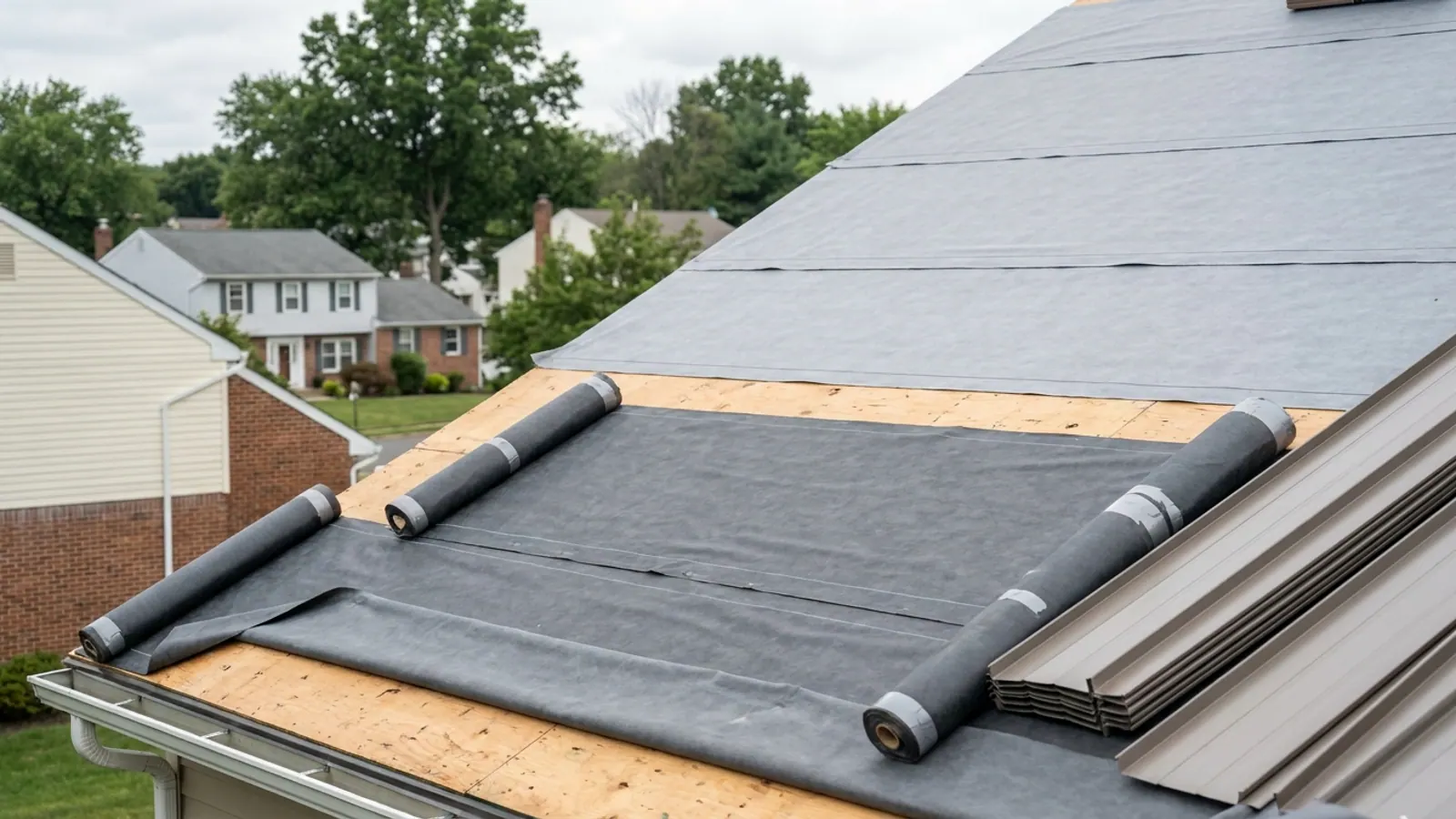
- Roll self-adhered high-temp ice and water membrane at the eaves, valleys and penetrations.
- Run high-temp synthetic underlayment across the remaining field, lapped and fastened per the manufacturer's instructions, then cap it off at the end of each day.
- Set panel clips or starter trim, then install the panels and the flashing and trim details.
On a standing-seam job that sequence spreads across two to four days, which is why step five matters. A deck left open overnight in a New Jersey October is a deck that gets rained on.
What metal roof underlayment costs in New Jersey
It is not a separate purchase. Underlayment is part of the installed price of the roof system, bundled with the panels, clips, trim, flashing, tear-off, disposal, labor and the permit.
Metal roofing in New Jersey runs $18,000 to $35,000 in standard-value towns, $28,000 to $55,000 in higher-value towns, and $45,000 to $120,000 for large or luxury homes. The band is set by the municipality's median home value from ACS 2024 five-year estimates, not by your underlayment choice. Roof size, pitch, the number of valleys and penetrations, and panel profile move the number far more than the upgrade from standard to high-temp synthetic does.
That upgrade is one of the cheapest decisions on the whole estimate relative to what it protects. If a quote is noticeably low and the underlayment line says felt, that is part of the reason.
What to get in writing before you sign
Ask for the underlayment by product name and temperature rating, not by category. "Synthetic underlayment" on a line item tells you nothing about whether it is rated for the heat under metal.
Also confirm in writing where the self-adhered membrane goes — eaves, valleys, penetrations — and how far up the slope at the eave. And confirm who handles the permit. Lightning Construction pulls it from your municipality's own construction office under the New Jersey Uniform Construction Code and attends the inspection, in every municipality, so you file nothing.
If you are still deciding between metal and asphalt in the first place, the asphalt vs. metal comparison lays out the trade-offs on service life, weight and cost.
Next step
Get the roof looked at before you price anything. The inspection and the written estimate are free and carry no obligation, and a salesperson does come to the house. Decking condition, existing layers and flashing are identified then and priced into the quote, which is why there are no change orders later and no deposit before the work is finished and you have inspected it.
See what a full system includes on the metal roofing page, or request a free estimate and have the underlayment spelled out on paper.